
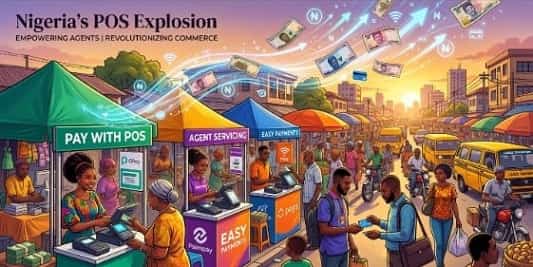
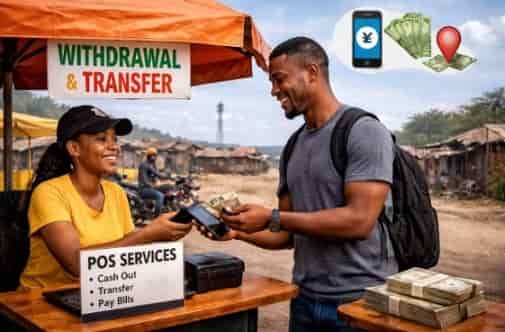
Walk down any street in Nigeria, and you’ll spot them every few steps: a small kiosk or canopy, a plastic table, a POS machine, sometimes a lone chair, and a bold sign that reads “Withdrawal & Transfer.”
These agents are now as essential to Nigerian street life as food stalls and transport hubs. But this isn’t just another hustle story; it’s a structural shift in how Nigerians access money.
What used to be a simple payment tool has become something much bigger.
POS in Numbers: Nigeria's Financial Revolution on the Streets
In 2024, Nigeria's Point-of-Sale (POS) transactions reached an unprecedented ₦18 trillion, a 69% increase from the ₦10.7 trillion recorded in 2023, according to the Nigeria Inter-Bank Settlement System (NIBSS).
The growth extended beyond just the monetary value; the volume of POS transactions also climbed, reaching approximately 1.5 billion, an 8% year-on-year rise.
As of early 2025, POS terminals were handling roughly ₦4.87 billion every hour, a clear sign of continued expansion. The total number of registered POS terminals in Nigeria reached over 8 million by early 2025.
At this point, POS agents have quietly become the most accessible bankers in the country.
How Did We Get Here? A Quick History
POS machines didn’t suddenly appear on street corners.
- In the early 2000s, they were introduced as retail payment tools in supermarkets and formal businesses.
- Early 2010s financial reforms under Governor Sanusi Lamido Sanusi introduced agent banking frameworks and a cashless agenda.
- By the mid‑2010s, fintechs such as OPay, PalmPay, Moniepoint, and Paga entered the market with cheaper, more reliable terminals, increased transaction volumes, and improved infrastructure for agent banking.
Over the 2020s, these devices evolved into a nationwide decentralized banking network. What banks couldn’t scale physically, agents solved on the streets.
Why POS Took Root So Fast
1. The cash struggle: Nigeria runs on cash, but accessing it at ATMs is often a pain due to ATM failures, long queues, withdrawal limits, and the long distance to ATM machines, which have turned basic banking into a daily struggle.
The 2023 Naira Redesign Policy made things worse, triggering a nationwide cash shortage that forced millions to seek alternatives.
POS agents solved a distribution problem traditional banks never fully fixed.
2. The 2023 cash crunch had a profound impact on various aspects of life: The Naira Redesign Policy was borderline catastrophic for ordinary Nigerians. Banks couldn't meet demand. ATMs ran dry for days, forcing millions to turn to POS agents.
That crisis forced millions of Nigerians who had never interacted with a POS agent to start.
3. Fintech companies moved quickly: Traditional banks were slower; they took a gradual approach to POS infrastructure. In contrast, fintechs saw a big market opportunity and acted quickly.
Moniepoint now has over one million active terminals and claims to process over ₦10 trillion monthly, with more than 33 million people using its terminals monthly. PalmPay reports over 1.1 million onboarded businesses, while OPay claims over one million businesses depend on it.
These companies didn't just sell machines; they recruited agents, trained them, offered float support, and created reward systems that made the business genuinely attractive.
4. It's a real business with real income: People aren't doing this for fun. Depending on location and traffic, a POS operator handling 20 to 50 transactions a day can earn a minimum of ₦2,000 daily.
Busy spots near motor parks, markets, hospitals, and bus stops push those numbers even higher.
For a young Nigerian with limited startup capital, a POS terminal is one of the most accessible businesses to enter. It requires no degree, no large office, no inventory. Just a machine, some float, and a good location.
5. Nigeria’s informal economy needed this: Nigeria's informal sector is the backbone of the economy, and most of it runs on cash. POS bridges a crucial gap: converting digital money to physical cash, enabling transfers in areas where banking apps fail, and creating a financial touchpoint in communities that formal banks never reached.
POS has brought banking services closer to rural areas that don't have accessible bank branches.
POS and Street-Level Commerce
POS machines have become deeply embedded in everyday trade. From small kiosks to neighborhood supermarkets:
Payments are faster. Cash flow is smoother. Transactions are more predictable.
For small businesses, POS isn’t optional anymore; it’s infrastructure.
The Challenges Nobody Likes to Talk About
The boom is loud, but so are the cracks forming underneath it.
1. Over-Saturation: The low barrier to entry that made the POS business appealing is now a problem. As more agents open up in the same places, competition gets tougher and profits go down. In a lot of places, several kiosks now serve the same customers, which means that agents have to either lower their fees or rely on doing more transactions to stay in business. What was once a high-margin opportunity is gradually becoming a volume-driven business.
2. Problems with Getting Cash: One of the operational problems for POS agents is getting cash. Many agents have to get cash from informal sources because banks have strict limits on withdrawals and don't always have enough cash on hand. This can be expensive. That cuts into profits and often makes customers pay more.
3. Risks of Fraud: Fraud is becoming more common in the POS system. According to a report from Agusto & Co. in 2025, Nigerian banks lost more than ₦52.3 billion to fraud in 2024. Agents and customers on the ground are always worried about security because of fake alerts, card skimming, and suspicious reversals.
4. Rising Regulation: Regulation is tightening across the POS space. The Central Bank of Nigeria has introduced stricter measures, including daily withdrawal limits, mandatory registration, and geotagging requirements tying terminals to fixed locations.
Non‑compliance can lead to disabled terminals or penalties.
Geotagging means that each POS machine is now linked to a certain business location and is only supposed to work from there. If a terminal is moved or used somewhere else, it can be marked or even turned off.
What This Really Tells Us
The POS boom isn't just a story about fintech; it's also a story about adaptation, resilience, and entrepreneurship. When formal banking infrastructure fell short, Nigerians built an alternative that is
- Decentralized – operating on the streets, in neighborhoods, and in rural towns.
- Accessible - cash and banking services are available where traditional banks can’t reach.
- Scalable – growing one kiosk, one agent, one transaction at a time
POS agents didn’t just enter the financial system; they reshaped it, brought banking to communities ignored by formal institutions, and turned ordinary Nigerians into the backbone of financial infrastructure.
Fintech companies didn’t just supply machines; they built entire ecosystems, making starting a POS business one of the lowest-barrier entry points into entrepreneurship in Nigeria.
The market also created opportunities where jobs were scarce. For many young Nigerians, POS became a primary source of income and a side hustle.
And it works. Busy agents can earn between ₦3,000 and ₦12,000 daily, depending on location and transaction volume.
Beyond income, there’s convenience. Nigerians will pay to avoid long ATM queues and failed transactions. POS agents now act as the last-mile solution:
- Delivering banking services to underserved areas.
- Allowing transactions with just a phone number.
- Eliminating the need for physical bank visits
In short, POS isn't just a quick fix; it's a long-term solution for financial inclusion, powered by people, not apps, bridging gaps that banks and ATMs can’t.
The system is evolving with deeper fintech integration, smarter & multifunctional devices, stronger regulation, and continued dominance in informal markets.
Nigeria won't be completely cashless for a while. Instead, it's making a hybrid financial system where digital and in-person access meet, and POS agents are still at the center of everyday transactions.
Keep reading
Related Topics



Conversation
Comments (0)
Sign in to join the conversation or like this post.