

Ask a working-class Nigerian whether they have savings and watch their reaction. Most will laugh, not because it’s funny, but because it hits a little too close to reality. Saving money used to be basic financial discipline. It was simply what responsible people did. But somewhere along the line, that logic started to weaken for many working-class Nigerians. This isn’t about discipline. It’s what happens when the economics of saving stop working the way people expect.
Saving in Nigeria has started to feel less like security and more like a slow erosion of value. You earn, you set money aside, you do everything "right," and over time, inflation quietly reduces what that money can actually buy. What looks like progress in numbers slowly loses meaning in real life.
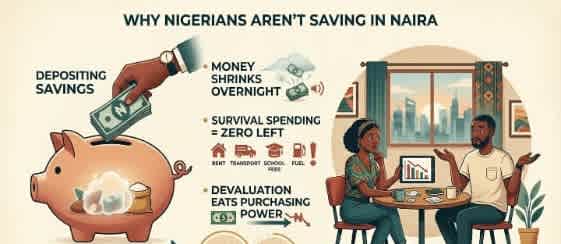
The Money Loses Value Before You Even Save It
Inflation in Nigeria has been high enough for most people to feel it in their everyday lives, while savings accounts still offer returns that barely move the needle. Do the simple math, and the issue becomes obvious: you are not really growing your money by saving it in cash; you are watching its value quietly slip away over time.
When basic things like food, transport, or rent jump in price within a short period, the question starts to answer itself. What exactly is the point of leaving money in a savings account that cannot keep up with rising costs?
In that kind of environment, behavior changes. People don’t necessarily stop saving; they just stop trusting cash savings as a reliable way to hold value and start looking for anything that feels more stable over time.
Survival Spending Has Replaced Saving
The cost of basic living in Nigeria has surged to the point where saving is no longer the default; survival is. The removal of fuel subsidies in 2023 triggered sharp increases across transport, food, and utilities almost overnight. Electricity tariffs followed. School fees climbed. Rent in cities like Lagos, Abuja, and Port Harcourt has become increasingly out of reach for the average salary earner.
For many households, income is no longer something that stretches, it is something that gets allocated the moment it arrives. Rent, transport, school fees, food, fuel for generators, and data costs consume it in layers. By the end of the month, there is often nothing left to set aside.
This is not a failure of personal discipline. It is the outcome of a long-running gap between wages and the cost of living. When expenses rise faster than income for years, saving stops being a routine and becomes a luxury.
The Naira Problem
Currency devaluation has quietly destroyed the savings of many Nigerians who were doing everything right. Someone who had ₦5 million saved in 2020 and felt financially secure is now sitting on the equivalent of a fraction of what that money used to mean in real terms. The naira has lost significant value against the dollar and against the prices of nearly everything people actually buy.
People have noticed. The lesson many Nigerians have drawn from watching savings evaporate through devaluation is that naira-denominated savings are not a safe store of value. Some have moved to dollar accounts, others to real estate, others to crypto. Plenty have simply stopped saving in any formal sense.
Banks Are Not Helping
Nigerian banks have not exactly made themselves attractive places to keep money. Charges appear everywhere: SMS alerts, card maintenance, account maintenance, and transfer fees. It often feels like you are being charged for keeping your money in the bank and charged again for trying to use it. The joke writes itself, but the frustration behind it is very real.
On the other side, savings interest rates have historically been too low to matter in real terms, often failing to keep up with rising prices. So while money sits in the account, its purchasing power quietly erodes.
The message the system sends, whether intentional or not, is simple: traditional saving is not designed to benefit the saver.
The Informal Safety Net Has Also Weakened
Traditionally, Nigerians did not rely solely on banks or formal savings systems. Extended family networks often acted as a form of informal insurance. You supported a cousin through a difficult period knowing the support would return when you needed it. Rotational savings groups like Ajo or Esusu provided structure, discipline, and trust-based saving outside the formal banking system.
Those systems still exist, but they are under increasing pressure. Urbanization has stretched the extended family unit, making it harder for people to consistently rely on one another. Inflation has also made regular contributions to cooperative groups more difficult to maintain. At the same time, trust has been damaged in some cases by organizers disappearing with pooled funds or groups collapsing under financial strain.
What remains is a weakened version of a system that once quietly supported financial stability for millions of households.
The Mental Shift: From Saving to Surviving
There has been a psychological shift that is worth naming. A generation of Nigerians has grown up watching careful saving fail to deliver the expected security. Parents saved diligently, only to see value eroded by devaluation. Hospital bills wiped out years of discipline. Businesses collapsed due to policy changes that came without warning. Over time, the lesson absorbed is simple: the future is too uncertain to confidently defer consumption today.
This is often misread as financial irresponsibility or short-term thinking. In reality, it is a rational response to repeated experience. When saving has consistently failed to protect value, trust in the system weakens.
What Would Actually Change This
The answer is not more financial literacy campaigns telling Nigerians to budget better. People who cannot cover basic expenses do not have a literacy problem. What would actually move the needle is structural: bringing inflation under control so that saved money holds its value, raising real wages, and making savings products that offer returns that make the trade-off worthwhile.
Some fintech platforms have tried to bridge the gap with higher-yield products, dollar savings options, and investment-linked savings. These have attracted users, but reach is still limited, and trust remains fragile after a few high-profile collapses in the space.
Until the macroeconomic environment makes saving a rational choice again, telling Nigerians to save more is asking people to work against their own financial interest. The problem is not the behavior. The problem is the conditions that make the behavior make sense.
So the next time someone tells you that Nigerians just do not know how to save, ask them this: save in what? Save for what? And save how, exactly, when everything costs twice as much as it did two years ago and your salary has not moved? The conversation tends to get quieter very quickly.
Keep reading
Related Topics





Conversation
Comments (0)
Sign in to join the conversation or like this post.

Elizabeth Ayoola
Elizabeth is a finance analyst and writer passionate about making financial markets accessible to everyday readers.
She has a deep interest in global markets, crypto, and everything shaping the financial world. She writes to simplify complex financial topics, turning them into practical, accessible insights for everyday readers.
108
Stories
36153
Reads
1
Likes
0
Comments