
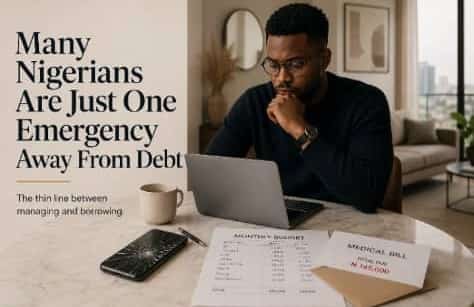
Your rent is due next month. Your data subscription expired two days ago, and you haven’t topped up. You’re managing tightly, then your phone screen cracks. Or your mother calls from the village. Or the generator spoils. And just like that, the careful balance you have been maintaining collapses.
That is the reality for a large and growing number of Nigerians. Not people in poverty, necessarily. Workers. Graduates. Civil servants. People with jobs and responsibilities and a general sense that they are moving forward. Yet one unexpected expense is all it takes to tip them into debt, into borrowing from family, and into “pay me when you can” arrangements that quietly strain relationships. The margin between okay and not okay is razor-thin.
And the worst part? It has nothing to do with laziness or bad choices; the system is just not built for people to catch a break.
The Financial Buffer Most Nigerians Don’t Have
There is a basic personal finance concept called the emergency fund: three to six months of living expenses kept in liquid savings, untouched unless something goes wrong. It’s a straightforward idea. It is also, for most Nigerians, something close to fantasy.
EFInA's 2023 survey found that only 16% of Nigerian adults were financially healthy, down from 28% in 2020, meaning most households cannot reliably meet basic needs, recover from shocks, or plan for the future. More people have bank accounts than ever. They have nothing in them. Of those who do save, many are saving for a specific goal: school fees, a business, or rent.
Very few are saving for nothing in particular, which is exactly what an emergency fund requires. You cannot plan for a broken arm or a flooded house. You can only have money set aside and hope you never need it.
The question is not whether Nigerians want to save. Most people do. The question is whether the income structure of the Nigerian economy allows for it. And increasingly, the answer is no.
Inflation has been running in the double digits for years, peaking above 30% in 2024. Wages and salaries, particularly in the public sector, have not kept pace. What N50,000 covered in 2020 barely covers half as much today. When every naira of income is already spoken for: rent, transport, food, airtime, and utilities, there is no surplus left to set aside. The emergency fund slot is simply empty.
What “One Emergency” Actually Looks Like
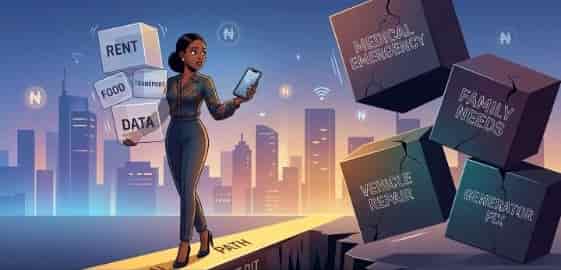
It helps to be specific about what we mean. In middle-income households, the most common financial shocks are:
- Medical expenses: a hospital admission, a surgery, and medication for a chronic condition. Nigeria’s health insurance coverage remains extremely low, and out-of-pocket health spending can run into hundreds of thousands of naira overnight.
- Vehicle or transport disruption: for anyone who drives for work or depends on a car to reach clients, a breakdown is not just an inconvenience. It is a direct income threat.
- Home and appliance repairs: a burst pipe, a fried inverter, a spoilt freezer for a food business. These are not luxuries. They are the infrastructure of daily life.
- Family obligations: a funeral, school fees for a sibling, a parent’s medical bill. In a country with weak social safety nets, the extended family is the safety net. Which means you are also someone else’s emergency fund.
Any one of these, hitting at the wrong time, is enough. And the cruel thing is that they do not hit at convenient times. Emergencies do not wait for salary week.
The Borrowing Economy
When Nigerians have no savings buffer to draw from, they borrow. And Nigeria has built a whole ecosystem around this reality.
At the informal end, you have the “I will pay you back” economy, borrowing from friends, family, or colleagues with the implicit understanding that repayment will come eventually. This works until it doesn’t. Relationships fracture over unpaid debts all the time, and the person who borrowed is often not irresponsible; they just had no other option.
At the formal-ish end, digital lending apps have exploded in the last five years. Names like FairMoney, Carbon, PalmCredit, and Branch are now familiar brands in urban Nigeria. They offer quick credit, minimal paperwork, and disbursement within minutes. Depending on the borrower and loan terms, interest rates can be very high, with some short-term loans translating to annualized rates well above 100%. People use them because the alternative is worse, not because the terms are good.
The BNPL (buy now, pay later) model is growing too, particularly for devices and electronics. You can walk out of a phone shop with a new handset today and pay over six months. For someone who needs a working phone for their business, this can be rational. But it means taking on an obligation that compounds if your income dips at any point during those six months.
None of this is fundamentally wrong. Credit exists because it is useful. The problem is when the only reason people access credit is that they have no other way to absorb a shock that a functional savings culture or a stronger social safety net would have covered.
It’s Not Just About Personal Discipline
There is a version of this conversation that goes, "Nigerians need to learn to save, to spend less on celebrations, and to stop buying things they cannot afford." There is some truth in that. Financial habits matter. But it is an incomplete and somewhat dishonest framing when applied at a systemic level.
With a large share of Nigerians earning income through informal or self-employed work, where earnings can be irregular and unpredictable, the standard advice to set aside a fixed amount every month does not always apply cleanly. You cannot save 20% of what you did not receive this month.
When fuel costs, which affect everything from transport to generator use, spiked by double digits in a single year after the 2023 subsidy removal, it wasn’t a budgeting failure that caused households to fall behind. It was a policy shock arriving faster than incomes could adjust.
When the naira lost more than 40% of its value against the dollar in 2024, imported goods became significantly more expensive within a short period. Households that were saving diligently in naira saw the real value of those savings erode. That is not indiscipline. That is the consequence of macroeconomic instability.
Personal finance education is valuable. But it operates within constraints set by the broader economy. You can give someone every personal finance tip in the world, and if their income is structurally insufficient and their economic environment is volatile, they will still be vulnerable.
What Would Actually Help
A few things worth saying clearly:
- Health insurance coverage needs to expand. The National Health Insurance Authority (NHIA) exists, but its reach is still limited. Medical emergencies are one of the most common triggers of household debt in Nigeria. Expanding meaningful health coverage would remove one of the biggest risks people currently absorb entirely on their own.
- Wage growth has to outpace inflation. Minimum wage conversations in Nigeria are often treated as political performance rather than economic policy. The 2024 increase to N70,000 was an improvement, but in an environment where inflation had already significantly eroded purchasing power, the real gain is modest. Salaries that keep pace with the cost of living create the conditions for saving. Stagnant wages do not.
- Deposit rates on savings accounts in Nigeria remain largely below inflation, meaning savers often earn negative real returns as inflation erodes purchasing power over time. This weakens the incentive to save formally, even though banks remain important for safety and access to financial services. A monetary environment that improves real returns for savers, without choking credit to the economy, would strengthen household saving behavior.
Financial literacy has a role, but it must be honest about what it can and cannot do. Teaching people about budgeting and emergency funds is useful. Framing financial vulnerability as primarily a personal failing, in a country where the macro environment creates structural barriers to saving, is not.
The Takeaway
The image of someone “living on the edge” financially usually brings to mind extreme poverty. But in Nigeria today, many people with steady salaries, side hustles, and otherwise stable lives are just one car breakdown or medical bill away from debt. This is not a niche problem. It is a widespread condition shaped by insufficient incomes, volatile prices, weak safety nets, and limited access to affordable credit.
Financial resilience (the ability to absorb a shock without everything unravelling) should not be a privilege. Yet for too many Nigerians, it still is.
Keep reading
Related Topics

Conversation
Comments (0)
Sign in to join the conversation or like this post.