
The Nigerian Middle Class Is Shrinking Fast—And It’s Taking the Economy With It

Picture this: a bank worker, a secondary school teacher, and a small business owner sitting in the same traffic on the Third Mainland Bridge. Different jobs, different salaries, but the same WhatsApp group where every conversation eventually returns to the same topic: the rising cost of living. That’s Nigeria’s middle class in 2026. And that group chat? It’s getting smaller.
So Who Even Counts as Middle Class in Nigeria?
Before we dive in, let’s quickly define who we’re talking about. In Nigeria, there is no single agreed definition of the middle class, but it is often described as households that can afford private healthcare, private schooling, decent housing, and some discretionary spending without being constantly financially stretched. Income estimates vary widely across sources, typically ranging from about ₦300,000 to ₦900,000 monthly. However, in high-cost cities like Lagos, even the upper end of this range is increasingly under pressure from rising living costs.
They are not surviving on tight weekly hand-to-mouth spending, but they are also not in the financial space where business-class travel is routine.
The African Development Bank has previously estimated that Nigeria’s middle class makes up roughly a quarter of the population. However, this classification is based on broader consumption measures rather than current income realities, and many households within this group remain financially vulnerable. In practice, Nigeria’s middle class is widely viewed as both small and increasingly under pressure.
How Did We Get Here?
The short answer: a series of economic shocks that hit the middle class squarely in the chest.
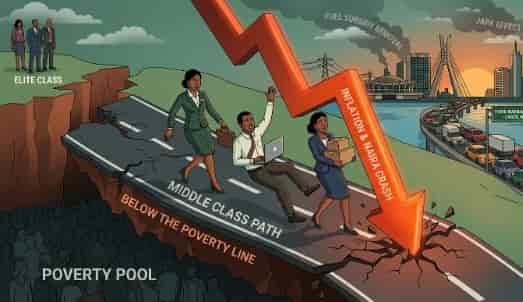
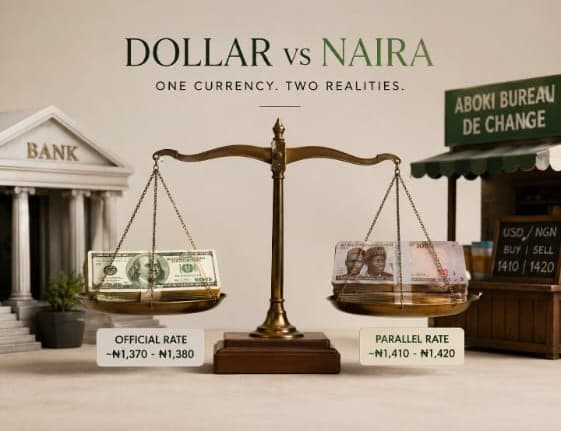
When President Tinubu announced the removal of the fuel subsidy in May 2023, petrol prices rose sharply, triggering a broader increase in transport costs, which quickly fed into food inflation and the rising cost of doing business. Shortly after, the naira was allowed to float more freely under a unified exchange rate policy. Since then, the currency has experienced significant volatility and sharp depreciation, moving from roughly the mid-₦400s per dollar to peaks above ₦1,500–₦1,600 at different points.
For the middle class, this wasn’t an abstract economic policy. It was suddenly paying ₦1,500 for the same tomatoes that used to cost ₦500. It was your rent doubling. It was watching your monthly salary stay the same while everything around you got more expensive.
Nigeria's headline inflation peaked at nearly 35% in 2024, the highest in almost three decades, driven by naira depreciation, fuel subsidy removal, and rising food and energy costs. While inflation has since declined significantly, dropping to around 15% by the end of 2025, the damage to household purchasing power has already been done. Prices that doubled and tripled during the crisis don't reverse just because the inflation rate falls. Your salary didn't get a 35% raise in 2024. And it certainly didn't get one in 2023 either.
What Does “Shrinking” Actually Look Like?
It does not look like a dramatic economic collapse. It looks like slow, quiet downward pressure, salaries that stopped stretching, savings habits that became harder to maintain, and lifestyles that gradually shrank.
The broader picture reflects this strain. Nigeria’s poverty numbers have risen significantly over the past decade, with recent estimates placing tens of millions more people below the poverty line compared to the late 2010s. While exact figures vary across sources and methodologies, the direction is consistent: more households are becoming financially vulnerable, and the gap between income and living costs continues to widen.
This pressure is visible in everyday behavior: families pulling children from private schools, households reducing non-essential spending, and small business owners seeing fewer customers. When incomes remain largely unchanged while rent, food, transport, and education costs rise sharply, purchasing power erodes even if pay slips do not immediately reflect it.
And Then There’s Japa
The shrinking isn’t only about people falling into poverty. Some of the middle class are leaving the country. The Japa wave resonates most with Nigeria’s middle class, particularly educated youth who see emigration not as ambition but as survival.
The departure of relatively high-income earners is constraining demand growth, particularly for premium consumer goods and services. Every doctor, engineer, or finance professional that boards that flight is not just a personal story; it’s a loss of a taxpayer, a consumer, a business owner, and a contributor to the local economy.
Why This Matters Beyond Individual Households
Here’s the thing about the middle class that people don’t talk about enough: it’s not just about the people in it. It’s about what they do for the broader economy.
The middle class drives consumption. They’re the ones buying furniture, paying for private schools, eating at restaurants, subscribing to services, and keeping small businesses alive. They were once the backbone of consumption, investment, and job creation. When they stop spending or stop existing as a class, the ripple effects are significant.
Businesses lose their primary customer base. Tax revenue shrinks. Innovation slows down. And the economy gradually shifts toward a two-class system: a small, wealthy elite at the top and a very large, very poor majority at the bottom. That’s not a good place to build a modern economy from.
Is There a Way Out?
Honestly? There’s no quick fix here. The structural problems: weak currency, high inflation, energy costs, and underfunded public services didn’t appear overnight, and they won’t disappear overnight either.
What experts are calling for includes energy cost reduction, special intervention funds for SMEs, and productivity-enhancing policies at the state level, because waiting on the federal government alone isn’t a realistic strategy.
For the middle class, the math is unforgiving: incomes are in naira, but living costs keep rising faster than pay can keep up. The only real hedges are income diversification, dollar-denominated earnings where possible, and deliberate financial planning.
Keep reading
Related Topics


Conversation
Comments (0)
Sign in to join the conversation or like this post.