
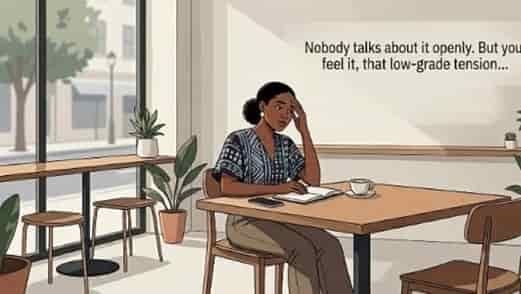
Nobody talks about it openly. But you feel it, that low-grade tension that settles in your chest at the end of the month, or when your phone buzzes with a debit alert. It is not dramatic. It is not a crisis you can point to. It is just...... there. Quietly draining you.
This is what financial pressure looks like for a lot of Nigerians. Not one big disaster, but a thousand small cuts, every single day.
The Cost of Just Getting By
Waking up in Lagos, or Abuja, or Port Harcourt, anywhere, really means immediately calculating. Transport money. Data. Lunch. What happens if light does not come and the fuel for the generator runs out? Before you do a single thing, your mind is already doing the math.
Basic expenses have become complicated. Rent that once felt manageable has quietly doubled in most cities. A bag of rice that cost ₦15,000 a couple of years ago now goes for over ₦70,000 in many markets. Transport fares move with fuel prices, up fast, down never. Data bundles finish faster than they should because everything now requires the internet, from POS transactions to work messages to school assignments.
And still, many Nigerians are expected to manage quietly, without complaint, and somehow still show up looking put together.
The Pressure Nobody Budgets For
There is a particular kind of financial stress that does not show up in any budget spreadsheet: social obligation.
In Nigerian culture, showing up matters. If a colleague's mother dies, you are expected to contribute to the burial. A relative is getting married, your aso-ebi is non-negotiable. A friend has a baby, you cannot come empty-handed. These are not bad things in themselves. Community is one of our greatest strengths. But when your salary barely covers essentials, every social event quietly becomes another line item you did not plan for.
Then there is the family support system. Many working Nigerians are not just paying their own bills; they are paying school fees for a younger sibling, sending money home to parents, and covering a cousin's hospital bill. The expectation is unofficial but iron-solid. And the guilt of not being able to help, when you yourself are barely afloat, hits differently.
What This Does to Your Head
Financial stress is not just a money problem. It is also closely linked to mental health in ways that are often overlooked in everyday conversation.
Chronic financial pressure reduces what researchers describe as cognitive bandwidth, the mental capacity available for focus, memory, and decision-making. When someone is constantly worried about survival, that mental space becomes heavily constrained.
Studies in behavioural economics suggest that scarcity can shift how people think and behave. It can make individuals more prone to anxiety, more reactive, and less able to plan long-term. Sleep can be affected, emotions become harder to regulate, and decision-making often shifts toward short-term survival rather than long-term stability, including taking loans or making financial decisions that would normally be avoided.
And then there is the shame of it. Nigerian society can be quietly brutal about financial struggle. There is an unspoken pressure to appear okay, to keep posting on social media, to dress well at events, to never let anyone see the cracks. So people suffer in silence, pretending they are fine when they are anything but.
This silence is dangerous. Because when you cannot name what is happening to you, you cannot begin to address it.
The Naira in Your Head Rent-Free
Something that does not get enough discussion is the mental energy spent just tracking money in a country where everything is unpredictable.
You check your account balance multiple times a day, not because you are organised, but because you are anxious. You convert prices in your head automatically. You do rapid calculations every time you enter a shop. You start avoiding calls from certain numbers because you already know what they want. You feel vaguely guilty during moments of rest because your brain keeps reminding you of what is unpaid, unsorted, or unresolved.
Over time, this becomes more than a habit. It becomes background noise in your mind, a constant low-level monitoring of survival.
None of this is laziness or poor discipline. It is what happens when you live inside a system that is genuinely hard to navigate.
You Are Not Failing. The System Is Difficult.
Before anything else, let that land. Inflation has stayed in double digits for years. Petrol prices have tripled within a year. Exchange rates have wiped out savings built over time.
These are not personal failures. They are structural realities. You can be disciplined, hardworking, and financially smart and still feel the squeeze.
That said, there are small, practical things that can take some of the edge off, not fixes, but footholds.
Small Things That Actually Help
1. Name your numbers, even when they scare you.
Avoidance makes financial anxiety worse, not better. Writing down exactly what comes in and what goes out, even just on paper or a free notes app, takes some power away from the fear. What you can see, you can begin to work with.
2. Separate needs from obligations.
Not every social expectation has to be met at full price. Contributing less is better than not contributing at all. Most people understand more than we think, and the ones who do not are rarely the ones who would bail you out if you needed help. Protect your survival first.
3. Find one thing to automate or regularise.
Even ₦5,000 moved to a separate savings account on payday, before anything else, adds up and, more importantly, gives you a small sense of control in a situation that often feels uncontrollable. Apps like PiggyVest or Cowrywise make this easy and low-friction.
4. Talk about it.
Not necessarily on social media, but with someone you trust. Financial stress thrives in isolation. Realising someone else is navigating the same reality doesn’t fix the problem, but it does ease the shame around it. And sometimes, you even pick up useful strategies.
5. Permit yourself not to be okay with it.
There is a kind of toxic resilience Nigerians are praised for, the ability to endure everything without complaint. But endurance is not the same as healing, and pretending things are fine does not make them fine. It is okay to acknowledge that this is hard. That acknowledgement is not a weakness. It is honesty.
The Conversation We Need to Have
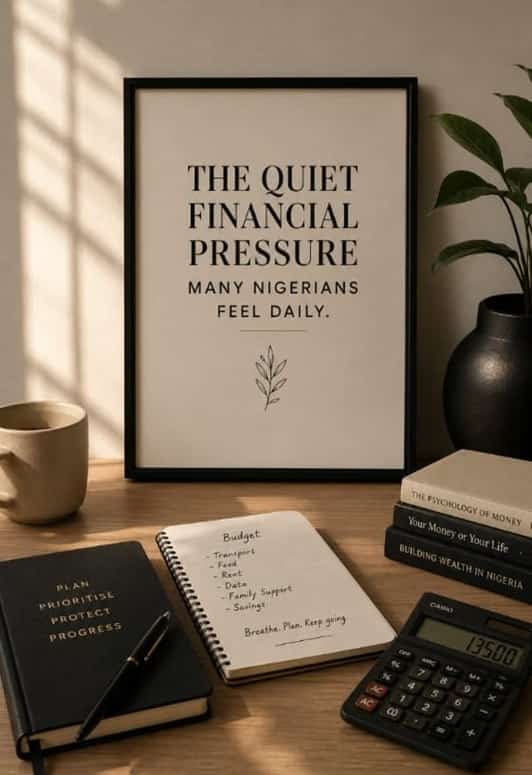
The quiet financial pressure many Nigerians feel daily is real, it is widespread, and it deserves to be spoken about plainly, without judgment, without performative optimism, and without reducing everything to personal discipline.
You are not alone in feeling like you are paddling hard just to stay in place. Millions of people across this country are doing the same thing.
That does not make the situation acceptable. But it does mean you are not broken, you are just a person trying to live inside a genuinely difficult economy.
And that is worth talking about.
Keep reading
Related Topics






Conversation
Comments (0)
Sign in to join the conversation or like this post.