
Remember when you first sent money on your phone without going near a bank? That moment was actually the result of years of chaos, billion-dollar bets, and more than a few companies that did not survive to see it happen.
A few years ago, fintech in Nigeria felt unstoppable. Everywhere you turned, there was another payment app, another startup promising to "revolutionize finance." Investors were pouring millions into startups. Traditional banks suddenly looked old and out of touch. For many Nigerians, fintech was not just convenient; it solved real problems the formal banking system had ignored for decades.
For a while, it seemed like fintech had finally cracked the code.
But then funding slowed, regulations tightened, and competition turned brutal. Some startups struggled. Others disappeared quietly. The same industry once celebrated as the future of African finance suddenly faced serious questions about survival.
So, what exactly happened?
How It All Started: The Promise of a New Financial System
Nigeria was almost the perfect environment for fintech growth.
Traditional banking had frustrated people for years. Anyone who has spent hours inside a crowded banking hall or dealt with a transfer hanging for an entire day understands why Nigerians were so eager for alternatives. You needed ID documents, a permanent address, a minimum balance, and the patience to stand in a queue for hours, sometimes just to deposit ₦10,000. Long waits, poor customer service, frequent network failures, hidden charges, and branches that barely reached rural communities meant tens of millions of Nigerians simply could not participate. The system was not built for them.
Then came fintech.
Interswitch arrived in 2002 and quietly laid the infrastructure that would make digital payments possible. Paga launched in 2009 and began putting mobile wallets in the hands of everyday people. But the real explosion came in the 2010s, when a new generation of founders looked at the broken financial system and saw not a problem, but an opportunity.
Paystack was founded in 2015, making it easier for businesses to collect payments online. Flutterwave followed in 2016, connecting Nigerian merchants to global payment networks. OPay, PalmPay, Moniepoint, Kuda, Cowrywise, and Carbon: company after company entered the space, each solving a different piece of the puzzle: payments, savings, lending, insurance, and investments.
Instead of physical branches, these companies focused on mobile apps, digital wallets, and agency banking. Services became faster, simpler, and more accessible, often overnight.
Investors noticed. Between 2019 and 2021, hundreds of millions of dollars poured into Nigerian fintech from venture capital firms around the world. The hype was deafening. Nigeria was being called Africa's Silicon Valley. Flutterwave became a unicorn, a startup worth over $1 billion, and then, shortly after, "a billion" was not enough to describe it. By 2022, it was valued at over $3 billion.
What the Numbers Actually Looked Like
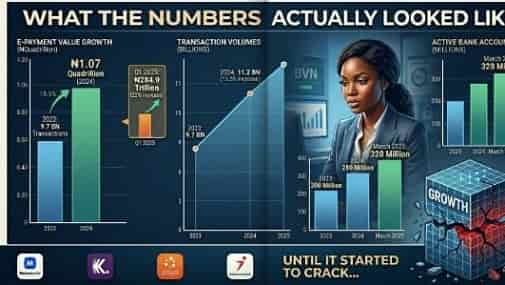
The growth was real. Genuinely, impressively real. In 2024, electronic payment transactions in Nigeria hit an all-time high of ₦1.07 quadrillion, a record never seen before in the country's financial history. Transaction volumes jumped from 9.7 billion in 2023 to 11.2 billion, a 15.5% increase year on year. And the momentum did not stop there. In Q1 2025 alone, e-payment transactions reached ₦284.9 trillion, a 22% increase over the same period in 2024.
Nigeria processed nearly 11 billion transactions in 2024, making it Africa’s largest real-time payments market and one of the most active globally by transaction volume. It sits within the group of leading real-time payments economies alongside systems such as India’s UPI, Brazil’s PIX, and Thailand’s PromptPay, although at a smaller scale compared to the largest global players.
Nigeria’s instant payment infrastructure, the Nigeria Instant Payment (NIP) system, was launched in 2011, about 12 years before the United States introduced FedNow in 2023, its first central bank–operated real-time payment rail.
Financial inclusion improved. People who had never had a bank account could now save money, send it to family in another state, or get a small loan to stock their shop, all from their phone. By March 2025, the number of active bank accounts in Nigeria had reached 320 million.
Nigeria further cemented its position as the dominant force in African fintech, accounting for approximately 44% of total fintech funding and 47% of fintech deals across the continent in early 2024.
In the same year, Moniepoint achieved unicorn status, joining Flutterwave as one of Nigeria’s homegrown billion-dollar fintech companies and reinforcing the country’s leadership in Africa’s digital finance landscape.
It seemed like things were going well for the country until cracks appeared in the narrative.
Where Things Went Wrong
The Fraud Problem
In 2023, Nigerian financial institutions lost ₦17.67 billion to fraud. By 2024, that figure had climbed to ₦52.26 billion, nearly triple in a single year.
Fintechs were supposed to be the safe, tech-forward alternative to traditional banks. Systems scaled faster than the safeguards that were meant to protect them. And fraudsters, who were organized, coordinated, and operating across multiple platforms simultaneously, quickly found the gaps.
The Regulatory Hammer
For a long time, Nigerian fintech operated in a relatively open environment. The CBN was supportive of innovation, financial inclusion was a government priority, and startups had room to experiment.
That changed.
As the naira weakened in 2023 and 2024, regulators began scrutinizing the role of fintech platforms in currency movements. Crypto came under particular pressure. Nigeria's National Security Adviser classified cryptocurrency trading as a national security issue. Binance, the world's largest crypto exchange, found itself at the center of a diplomatic incident that shocked the global tech industry; two of its employees were detained, and peer-to-peer trading was shut down. Other platforms like Moniepoint and OPay were warned to steer customers away from crypto entirely.
The CBN also began fining banks for compliance failures, and those fines trickled down to the fintechs that depended on them. Licenses were revoked. Pressure mounted.
The regulatory environment was not anti-fintech by design; the CBN's stated goal was always stability and consumer protection. But the speed and unpredictability of these interventions rattled founders and investors who had built their businesses on the assumption of a more permissive environment.
The Funding Drought
Most of the money that built Nigerian fintech did not come from Nigeria. It came from venture capital firms in the United States and Europe, and that dependence became a serious vulnerability.
When interest rates rose in America in 2022 and 2023, global investors pulled back from high-risk emerging market bets. The tap turned off. Companies that had planned to expand had to cut staff instead. Products that were almost ready went back on the shelf. The number of fintech shutdowns in 2023 alone told the story; it was the single worst year for Nigerian fintech closures on record.
The Trust Deficit
There is a painful irony at the heart of Nigeria’s fintech story.
The country built one of the most sophisticated digital payment systems in the world yet remains associated globally with financial fraud, not as a victim but as a perpetrator. That reputation, however unfair it is to the legitimate players in the ecosystem, has real consequences. It makes cross-border expansion harder. It makes partnerships with international companies more complicated. It becomes a ceiling that the entire sector bumps its head against.
What Is Still Standing and Why It Matters
Nigerian fintech did not collapse. It corrected.
The companies that survived, Moniepoint, OPay, PalmPay, Kuda, and Paystack, are leaner, more profitable, and more compliant than they were at peak hype.
Digital payment fraud losses have dropped by 51%, proof that systemic interventions, when well-designed, work.
The CBN, after years of erratic messaging on cryptocurrency, launched a formal compliance pilot program in March 2026, bringing Flutterwave, Paystack, and other major platforms into a structured oversight framework for virtual assets. It is a signal of maturation: regulators are no longer trying to pretend crypto does not exist, and the industry is no longer pretending it can operate without regulatory legitimacy.
What Comes Next
The era of “grow at any cost” is over.
Compliance is now a competitive advantage, not a burden. The fintechs that invested early in strong KYC processes, fraud detection, and regulatory relationships are the ones still standing.
The next wave of growth will likely come from two directions. First, deeper penetration into the underserved, the 26% of Nigerian adults who still have no access to formal financial services, and the rural communities where agency banking networks are only beginning to reach. Second, expansion across Africa, though this remains slow and expensive because every country requires its own license from scratch. If regional regulatory passporting ever becomes a reality, Nigerian fintechs, with their hard-won experience in one of the world’s most demanding markets, would be extremely well-positioned.
Artificial intelligence is already reshaping how fintechs operate internally. Nearly 9 in 10 companies use AI primarily for fraud detection. That will expand into customer service, credit scoring, and personalized financial advice.
And the funding dependence on foreign venture capital, one of the sector’s most dangerous structural weaknesses, needs to change. A dedicated fintech growth fund or credit guarantee scheme backed by local capital would reduce the volatility that comes from being at the mercy of American interest rate decisions.
Keep reading
Related Topics




Conversation
Comments (0)
Sign in to join the conversation or like this post.