

The short answer? Not you.
May 2023 changed Nigeria forever. Three years on, we're asking the uncomfortable question no one in Aso Rock wants to answer.
On May 29, 2023, President Bola Tinubu stood at Eagle Square and said three words that changed everyday life in Nigeria: "Subsidy is gone."
By that evening, petrol had jumped from around ₦185 per litre to ₦500 in some areas. Within months, it crossed ₦1,000. Transport fares doubled. Food prices climbed. And millions of Nigerians quietly started doing the maths on whether they could survive the month.
We were told this was good for us. That the subsidy was a drain on the nation: lining the pockets of fraudsters, starving roads and schools of funding. Over two years later, the question we need to ask loudly, without apology, is: who actually benefited?
First, What Was the Subsidy Really?
The fuel subsidy started in the 1970s as a response to the 1973 global oil crisis. The logic was simple: Nigeria produces oil, so Nigerians should be able to afford petrol. The government would cover the difference between the international landing cost of fuel and the price you paid at the pump.
Sounds fair. But here's where it gets complicated.
66 million litres per day. That's what NNPC claimed Nigerians were consuming, nearly double the 40 million litres recorded in 2019, with zero explanation for the jump.
Former CBN Governor Sanusi Lamido Sanusi publicly questioned that figure. But if the consumption numbers were inflated, and many believe they were, then subsidy payments were inflated too. Someone was getting paid for fuel that was never imported.
In February 2022, while the official pump price was around ₦185/litre, the actual landing cost was ₦315/litre, yet NNPC sold to distributors at ₦113/litre. A ₦202 gap, multiplied across tens of millions of litres, every single day.
This is what the subsidy actually was by the end: not a welfare policy, but a feeding trough. A small network of importers and middlemen had turned a programme meant to help everyone into a system that reliably enriched them, at the expense of government revenue that should have gone into roads, hospitals, and schools.
The Corruption Nobody Wants to Fully Investigate
Here's what gets buried over in the 'subsidy is evil' narrative: the problem was never the idea of a subsidy. It was the implementation.
In 2012, a 200-page parliamentary inquiry uncovered a $6 billion fraud involving subsidy payments to oil marketers. In 2015, Muhammadu Buhari called the subsidy "fraud" and "non-existent." Then his administration spent ₦11.7 trillion on it between 2016 and 2023, more than any administration before it.
₦6.72 trillion. That's what the subsidy was projected to cost in 2023 alone. In that same period, the federal government retained just ₦586.7 billion in oil revenue. A country that produces oil, spending twelve times its oil earnings to subsidise fuel.
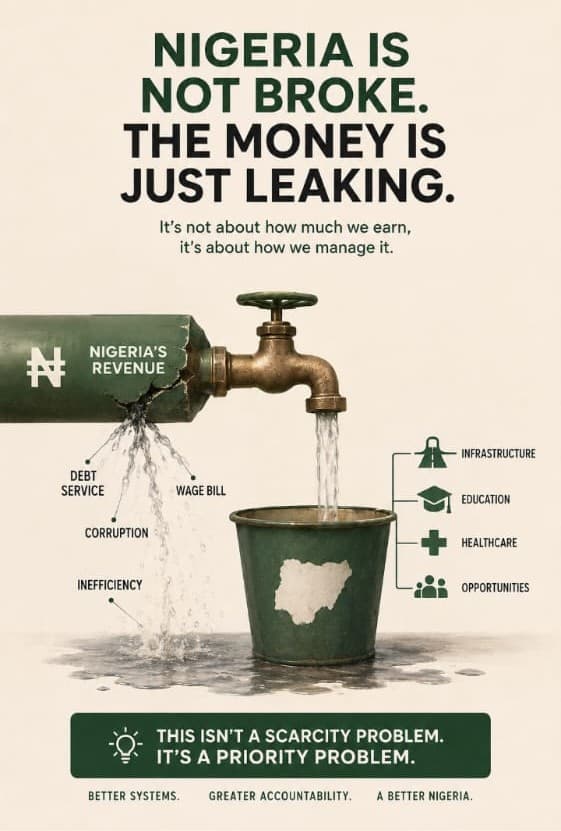
The money wasn't disappearing because Nigerians were gaming the system at the pump. It was disappearing through inflated consumption figures, ghost imports, and a procurement process designed to reward the people closest to power.
The removal didn't fix any of that. The importers are still there. The opacity is still there. All that changed is who absorbed the cost and in 2023, that became you.
Who Actually Won When Subsidy Was Removed?
The Federal Government, on paper, at least.
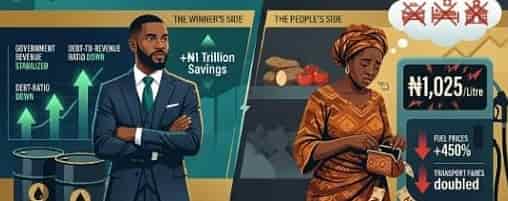
The government saved over ₦1 trillion in just two months post-removal, with the World Bank, projecting potential savings of ₦3.9 trillion for 2023. Credit rating agencies Fitch and Moody's upgraded their outlook on Nigeria. The debt-to-revenue ratio fell from 97% in 2023 to around 64% by mid-2025. The 2025 budget, for the first time in decades, had capital expenditure (₦23.96 trillion) exceed recurrent spending.
Foreign Investors.
Foreign investment inflows hit $6 billion in the first half of 2024, a 54% jump from $3.9 billion for all of 2023. The subsidy removal, paired with exchange rate unification, was a green flag for international capital. Nigeria cleared a $7 billion FX backlog owed to airlines and multinationals. External reserves rose from $35 billion in May 2023 to $38.9 billion by March 2025.
NNPC Limited.
The corporation publicly welcomed the removal, unsurprising, given that the government owed it ₦2.8 trillion ($6 billion) in subsidy arrears. Removal cleaned up the company's balance sheet, as Nigerians cleaned out their savings.
Dangote Refinery.
The $20 billion Lekki refinery began operations in 2023 and rolled out its first petrol by September 2024. A deregulated fuel market is far more hospitable to a private refining behemoth than one where the government controls pump prices. The conditions for local private refining, long overdue, finally exist.
State Governments.
With more revenue flowing into the Federation Account, states received higher allocations. Several that had struggled to pay salaries reportedly stabilised, though 'more money' and 'better governance' are rarely the same thing.
Who Lost?
You. And About 63% of Nigeria.
63% of Nigerians were living in poverty shortly after the removal, up from 49.8% before. The poverty gap, which measures how far below the poverty line people are falling, widened from 31.6% to over 45%. Meaning the poor didn't just get poorer, they got significantly poorer.
Fuel prices surged from ₦185/litre in May 2023 to ₦1,025/litre in 2024. The naira collapsed from ₦460 to ₦1,700 per dollar. These aren't abstract statistics, this is the food seller who raised prices twice in one month. The bus conductor who raised fares because diesel doubled. The small business that shut down because generator costs became unsustainable.
Low-income households were hit hardest. Wealthier households largely absorbed the shock. This is the nature of inflation as a regressive force. It takes more from those who have less.
What About the Promises?
The government pledged that subsidy savings would flow into roads, schools, hospitals, and direct support for the poor. The National Orientation Agency touts 40 road projects financed from savings. The Nigerian Education Loan Fund launched with ₦203 billion for tertiary students. CNG buses were announced as transport alternatives.
But the palliatives; cash transfers, transport grants, wage increases, arrived late, reached a fraction of who needed them, and for many Nigerians, never received at all.
Only 3% of Nigerians feel the government has done anything meaningful to keep prices stable.
Was Removal the Wrong Call? It's Complicated.
Economically, most analysts, including those who are deeply critical of how it was done, agree: the subsidy had to go eventually.
The subsidy regime was genuinely bad for Nigeria. It worsened budget deficits, bred corruption, diverted resources from productive investment, and was deeply inequitable. Nigeria has among the fewest vehicles per capita in the world.
The people who benefited most from cheap pump prices weren't the keke rider or the woman frying akara. They were car owners, fleet operators, and politically-connected fuel importers with access to subsidised products at scale.
Neighbouring countries operating at market prices created a profitable smuggling corridor. Fuel that should have powered Nigerian generators was being smuggled out across borders. So yes, there were real distortions worth addressing.
But the how matters as much as the what.
"Tinubu didn't just remove the subsidy. He did it on Day 1, without a safety net, while simultaneously floating the naira. Two shocks at once, on a population already struggling.”
A gradual removal over several months, backed by real social protection measures like food subsidies, wage increases, subsidised public transport, would have softened the blow considerably.
Instead, Nigerians absorbed shock therapy. The inflationary effect of an abrupt removal is not just economic theory: research shows it could take up to 20 months for inflation to stabilize after a fuel price shock of this magnitude.
The Bottom Line
The fuel subsidy system was broken. But the people who broke it paid nothing for the damage. They're doing just fine.
Ordinary Nigerians did.
By 2025, 140 million people were living below the poverty line, up from 56% in 2023. Inflation has eased on paper, but household incomes haven't kept pace. The gap between what things cost and what people earn keeps widening.
The economy looks better on a chart. Life feels worse at the market.
Keep reading
Related Topics


Conversation
Comments (0)
Sign in to join the conversation or like this post.

Elizabeth Ayoola
Elizabeth is a finance analyst and writer passionate about making financial markets accessible to everyday readers.
She has a deep interest in global markets, crypto, and everything shaping the financial world. She writes to simplify complex financial topics, turning them into practical, accessible insights for everyday readers.
102
Stories
31719
Reads
1
Likes
0
Comments