
Hidden Charges in Nigerian Banks. What They’re Deducting From Your Account (And Why)
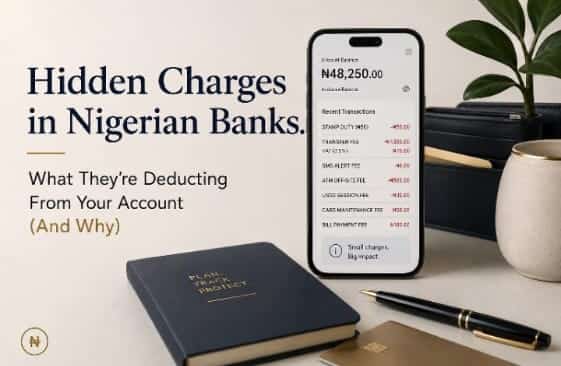
You check your account balance, and everything is in order. You haven’t made any major transactions. But somehow, the number is lower than it should be. No SMS explanation. No warning. Just a debit alert that arrives faster than your money ever did.
If you’ve ever lived this experience, you’re not alone. Hidden and poorly communicated bank charges are one of the most common financial frustrations for Nigerians, whether you’re a salaried worker, a student, or a business owner. The problem isn’t just that the charges exist; it's that most people don’t know what they’re being charged for, when it applies, or whether it’s even legal.
First, Let’s Be Clear: Some Charges Are Legitimate
Not every deduction from your account is theft. The Central Bank of Nigeria periodically issues and updates its Guide to Charges by Banks and Other Financial Institutions, which spells out what banks are permitted to charge. The most widely referenced framework was issued in 2020, with subsequent adjustments introduced over time to reflect changes in the financial system.
So yes, your bank has legal grounds to charge you for certain things. The issue is when charges go beyond what’s approved, are applied without disclosure, or are structured in ways that penalize low-income customers disproportionately.
The Charges You’re Probably Already Paying
1. Electronic Transfer Levy (Stamp Duty)
Any time you send a transfer of ₦10,000 or more, a ₦50 levy applies.
This charge was originally known as the Electronic Money Transfer Levy (EMTL). It is a government-imposed charge, not a bank fee, and the bank does not retain the money. It used to be deducted from the receiver's end. That changed with the Nigeria Tax Act 2025: effective January 1, 2026, it was renamed Stamp Duty, and the ₦50 charge now falls on the sender instead.
It applies to eligible electronic inflows, while certain internal transfers (such as transfers between accounts within the same bank and the same customer identity, depending on BVN/NIN linkage) are typically exempt.
2. Transfer Charges
Every interbank transfer comes with a fee, and it doesn't stop there. A 7.5% Value Added Tax (VAT) is charged on top of the transfer fee itself, not the amount you're sending. So that "₦1,000 transfer" is never really ₦1,000 out of your pocket. This isn't new; VAT has always applied to bank service charges.
So while it may look like a small deduction per transaction, it accumulates quickly over time, especially for users who make frequent transfers. This is made even worse considering that such a failed transfer will still result in a deduction being held until reversed, thus reducing your balance even when no transaction actually took place.
3. Current Account Maintenance Fee (CAMF)
The Current Account Maintenance Fee (CAMF) is applied mainly to current accounts and is levied on qualifying debit transactions made to third parties by the customers. The fee is normally charged on a basis not exceeding ₦1 per ₦1,000 (per mille) depending on the frequency of the transaction.
Highly active current accounts can incur significant charges on a monthly basis in relation to the volume of transactions taking place.
Under recent revisions to banking charge guidelines issued by the Central Bank of Nigeria, the CAMF rate has been placed on a downward adjustment path, with reductions already introduced and further easing expected in subsequent phases.
4. ATM Withdrawal Fees
Withdrawals are not always “free access to your own money.”
- Using your bank’s ATM: usually free within allowed limits.
- Using another bank’s ATM: charged per withdrawal.
- Off-site ATMs (malls, markets): often attract additional surcharges of up to ₦500 per ₦20,000 transaction.
For people in areas with limited banking infrastructure, these charges become a recurring cost rather than an occasional inconvenience.
5. Card Issuance and Maintenance Fees
From May 1, 2026, the CBN increased the one-time card issuance fee from ₦1,000 to ₦1,500. The good news: the ₦50 monthly maintenance charge on naira debit and credit cards has been scrapped.
Virtual cards are generally offered at low or no issuance cost, depending on the provider. However, foreign currency (dollar) cards may still attract annual maintenance fees (commonly around $10, depending on the bank).
6. SMS Alert Charges
One of the most consistent deductions feels harmless until you calculate it yearly. SMS alert charges are applied per transaction notification and vary across banks, typically ranging from about ₦4 to ₦6 per message in recent years, following gradual adjustments linked to rising telecom costs.
Because every inflow or outflow triggers an alert, the cost quietly accumulates over time. However, most banks also provide free email notifications as an alternative, making it one of the simplest ways to reduce or eliminate SMS-related charges entirely.
7. USSD Banking Charges
USSD is often the most accessible banking option in Nigeria; no internet access is needed, and it works on any phone. But accessible doesn't mean free.
USSD transactions typically attract a bank charge, and on top of that, your network provider (MTN, Airtel, Glo, or 9mobile) may also charge for the session. That's two separate parties billing you for one action. Even more frustrating, failed USSD sessions, where the transaction didn't go through, have been known to trigger charges anyway, leaving customers paying for something that never happened.
8. Hardware Token Fee
If your bank issues a physical hardware token for two-factor authentication, customers are typically charged a one-time issuance or replacement fee depending on the bank’s pricing structure, often within the ₦2,000–₦3,000 range.
Many banks now encourage software or app-based tokens, which are generally free and more convenient. Replacement fees may apply for physical tokens that are lost or damaged, depending on the bank’s policy.
9. Bill Payment Charges
Payments for utilities and subscriptions (such as electricity, TV subscriptions, and similar services) made through bank channels may attract service fees.
These charges are usually capped, but the exact amount can vary depending on the bank and payment channel used.
The Charges That Cross the Line
a) Phantom Deductions
Some of the most frustrating bank charges are the ones customers don’t immediately understand. You see deductions labeled as “VAT,” “service charge,” or “maintenance fee,” but the description doesn’t always make it clear what exactly you’re being charged for or why.
In many cases, these are legitimate fees. In others, the issue is simply poor labeling and lack of clarity in transaction descriptions, which makes it difficult for customers to track what is happening in their accounts.
Clearer transaction breakdowns are increasingly being encouraged within the banking system to improve transparency and customer trust. Still, for the average user, the experience often feels confusing.
b) Overcharging on Negotiable Fees
Some banking fees in Nigeria are not fixed; they are set as maximum limits, meaning banks can technically charge less depending on the relationship with the customer.
A good example is the Commission on Turnover (COT) applied to current accounts, which is capped by regulatory guidelines from the Central Bank of Nigeria.
In theory, these charges are negotiable. In practice, however, most customers are not informed that negotiation is possible, and many end up paying the standard rate by default.
The result is that a “flexible” fee often behaves like a fixed one for the average customer.
c) Double Charges and Overlapping Deductions
Another common complaint among bank users is the appearance of multiple deductions on a single transaction.
For example, a transfer may attract a transfer fee, VAT, and, in some cases, stamp duty depending on the transaction type. While these charges are meant to serve different purposes within the financial system, they can feel repetitive or overlapping to the customer.
This becomes more frustrating when the breakdown is not clearly explained in real time, leaving users to piece together what was actually deducted after the fact
d) Charges on Low or Zero-Balance Accounts
Bank accounts with low balances are often the most sensitive to deductions.
In general, banking rules require that charges apply only where there are sufficient funds available. However, when multiple small fees accumulate over time, accounts can still end up with negative balances depending on how the deductions are processed.
This is why many customers suddenly notice their accounts “going into debt” from charges they did not actively trigger.
The key issue here is not necessarily wrongdoing, but the lack of visibility. Most customers only see the end result, not how the charges built up over time.
What the House of Representatives Said
In October 2024, the Nigerian House of Representatives moved to investigate what lawmakers described as arbitrary and excessive deductions from customers’ bank accounts. During deliberations, legislators argued that repeated and unclear charges were eroding public trust in the banking system and undermining Nigeria’s financial inclusion and cashless policy objectives.
The debate came at a time when many Nigerian banks were reporting record profits, while customers continued to complain about rising transfer fees, maintenance charges, SMS alert deductions, and other banking costs. For many Nigerians, the contrast between growing bank earnings and increasing customer charges has become difficult to ignore.
How to Reduce Unnecessary Bank Charges
You can't avoid every charge, but you can be smarter about how many you absorb.
- Start with the easy wins. Switch from SMS alerts to email or in-app notifications; email alerts are now free by CBN mandate, and the savings add up faster than you'd think. When you need cash, use your own bank's ATM; that ₦500 off-site surcharge is entirely avoidable.
And if you're sending money across multiple transactions, consolidate where you can. Every transfer attracts a fee plus VAT; fewer transfers mean fewer deductions.
- Know your account. Current account holders especially need to understand how current account maintenance fees work. In many cases, the charge is calculated based on the volume or value of debit transactions on the account. This means frequent withdrawals and transfers can quietly increase banking costs over time. If your account type does not match how you actually use your account, you could end up paying more in maintenance charges than necessary.
- Use virtual cards for online payments when possible. Many banks and fintech platforms issue virtual cards at low or no cost, making them useful for subscriptions, e-commerce, and app payments. They can also reduce exposure to unauthorized transactions since they are easier to manage or disable than physical cards. However, users should still check for foreign exchange and transaction fees, as these vary by provider.
- Read your statements, every line. Make statement-checking a habit, not a crisis response; most people only look at their account when something feels wrong. By then, months of quiet deductions had already gone unquestioned. A quick monthly review tells you exactly what's leaving and why and gives you grounds to dispute anything that shouldn't be there. If a charge is unclear or doesn't match any known fee, report it to your bank immediately. Unresolved? Escalate to the CBN's Consumer Protection Department at cpd@cbn.gov.ng.
Final Word
Hidden bank charges in Nigeria aren’t always hidden by design; sometimes it’s poor disclosure, confusing terminology, or customers who never knew what to look for.
The good news is that the CBN framework actually gives customers meaningful protections if you know them. The revised 2025 guide tightened disclosure obligations, capped several fees, and moved some recurring charges toward elimination entirely. That’s progress, even if it doesn’t feel like it when you’re staring at an unexplained debit.
Stay informed, read your statements, and don’t be afraid to ask questions.
Keep reading
Related Topics





Conversation
Comments (0)
Sign in to join the conversation or like this post.