
Village Prices Fell in September, But Not Where It Counts: Transport and School Fees Shot Up
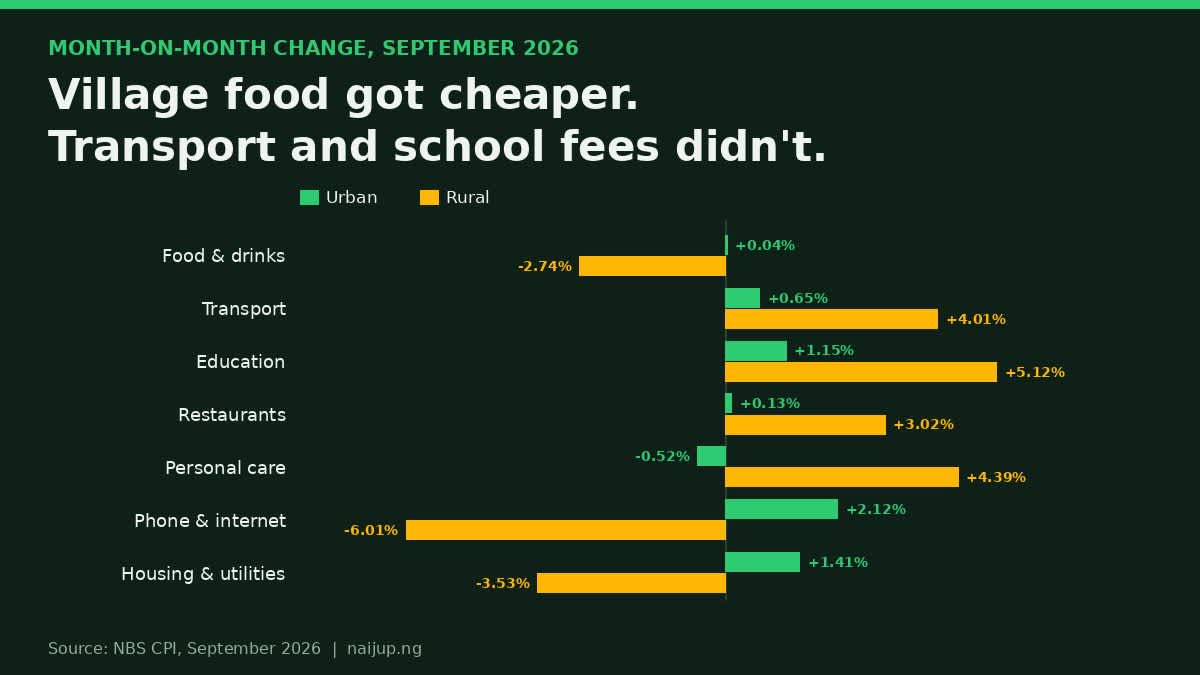
On paper, September 2026 was a good month for rural Nigeria. The NBS says average prices in rural areas actually fell 0.89% from August. In towns and cities they rose 0.53%.
But averages hide a lot. When we broke the rural numbers down by spending group, we found two very different stories in the same village.
Story one: the harvest effect
Most of the rural drop came from food.
• Rural food index: down 4.90% in one month
• Rural farm produce: down 5.11%
• Rural food and non-alcoholic beverages: down 2.74%
This is what harvest season looks like in the data. The new crop comes in, supply in village markets goes up, and prices drop. Food also carries a big weight in rural spending, so a fall like this drags the whole rural average down.
In the cities, food and drinks prices were basically flat (+0.04%). New harvest takes time to travel. It also has to pay its way through transport, middlemen and market levies before it reaches urban buyers.
Story two: services got pricier in the village
Here's the part the headline misses. While food got cheaper, several other costs in rural areas jumped:
| Rural spending group | Aug to Sept 2026 |
|---|---|
| Education services | +5.12% |
| Personal care and miscellaneous | +4.39% |
| Transport | +4.01% |
| Restaurants | +3.02% |
| Energy | +4.25% |
Compare those with the cities. Urban transport rose 0.65%, urban education 1.15%, and urban restaurants just 0.13%.
So the rural family saved on garri, beans and yam, then spent some of it on okada fare, school bills and the barber. That's the real picture of September in many villages.
Rural core inflation is now running hotter than urban
Core inflation strips out farm produce and energy. It's the best guide to the "underlying" cost of living. In September:
• Rural core inflation (month on month): +1.84%
• Urban core inflation (month on month): +0.84%
Rural underlying prices rose more than twice as fast as urban ones in September. Over the full year rural core is still lower (10.62% vs 13.86% urban), so the village isn't worse off overall. But the monthly direction is worth watching. If it continues, the gap could close quickly.
Where the village actually caught a break
To be fair, rural households got relief beyond food too:
• Phone and internet: down 6.01% in rural areas (but up 2.12% in cities)
• Housing, water, electricity and fuels: down 3.53% (up 1.41% in cities)
• Furniture and household items: down 4.00%
• Health: down 2.85% (up 2.41% in cities)
The health one stands out. City dwellers saw medical costs rise 2.41% in a single month, while village health costs fell.
The yearly picture
On a year-on-year basis, rural Nigeria is still doing better than urban Nigeria:
| Urban | Rural | |
|---|---|---|
| Headline inflation | 15.64% | 12.46% |
| Food inflation | 21.28% | 16.43% |
| Core inflation | 13.86% | 10.62% |
| Housing & utilities | 18.23% | 5.05% |
The housing gap is the widest. City rent and utility costs are rising more than three times as fast as in villages.
What this tells us
1. The harvest is doing real work. Rural food prices falling almost 5% in a month is significant. If supply chains move that produce into cities efficiently, urban food prices should follow in October and November.
2. Services are the new pressure point in rural areas. Transport, schooling and personal services are where village costs are climbing now. These are harder to escape than food, because you can't grow your own bus fare.
3. The rural "relief" may not last past harvest. Once the season's crop is sold or stored, food prices usually start climbing again. Meanwhile, services have already reset higher.
The bottom line
September's rural price drop is real, and it's mostly about the harvest. Under it, rural transport, school fees and personal care costs rose much faster than in the cities. And rural core inflation outpaced urban for the month. The village is cheaper for food right now, but not for much else.
Are you in a rural area? Did transport or school costs jump where you are? Let us know in the comments.
Quick FAQ
What is the rural inflation rate in Nigeria?
The NBS reports rural inflation at 12.46% year on year in September 2026. Month on month, rural prices fell 0.89%.
Why did rural prices fall in September 2026?
Mainly because of food. The rural food index fell 4.90% in one month, consistent with the harvest season increasing supply.
Which costs rose most in rural Nigeria in September 2026?
Education services (+5.12%), personal care (+4.39%), energy (+4.25%) and transport (+4.01%) rose the most month on month.
Data source: National Bureau of Statistics, Consumer Price Index, September 2026 (Base 2024 = 100). Calculations by Naijup.
Keep reading
Related Topics



Conversation
Comments (0)
Sign in to join the conversation or like this post.

Mujeeb Olagunju
I am a finance professional with a strong background in economics and financial technology.,My work centers on building systems that support payments, digital banking, and investment solutions in emerging markets.,I have experience with risk management, transaction monitoring, fraud prevention, and the design of scalable financial products tailored to both retail and institutional clients.,With over 8 years of industry experience, I combine financial insight with technical expertise to deliver solutions that balance compliance, security, and business growth.,My goal is to bridge the gap between finance and technology, creating platforms that expand access to modern financial services and strengthen trust in digital finance.
75
Stories
22695
Reads
0
Likes
0
Comments
Latest by Mujeeb Olagunju
Village Prices Fell in September, But Not Where It Counts: Transport and School Fees Shot Up
general
Imported Food Is Now Rising Half as Fast as Food Grown in Nigeria. Here's What the NBS Numbers Show
general
Clothing Prices Rose Just 1.08% in a Year: The Six Things Inflation Almost Forgot in Nigeria
general