
Market Prices Dropped in September. So Why Is Your Plate of Rice at the Buka Still Going Up?
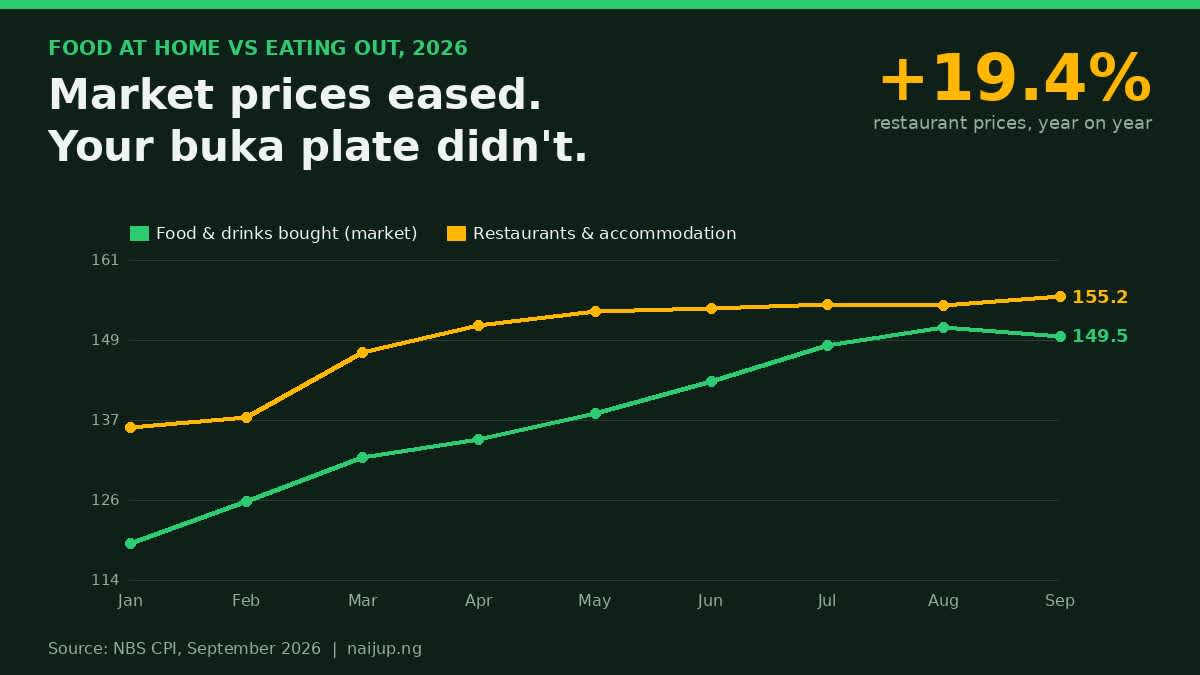
Here's something that has probably happened to you. You hear on the radio that food prices are coming down. You go to your usual mama put, order the same rice, beans and two pieces of meat, and the price is either the same or ₦200 higher.
You're not crazy. The NBS September 2026 numbers back you up.
Food at home went one way, eating out went the other
Between August and September 2026:
• Food and non-alcoholic beverages (what you buy in the market) fell 0.92%
• Restaurants and accommodation services rose 0.78%
On a yearly basis, eating out has now pulled ahead:
| Category | Sept 2026 vs Sept 2025 |
|---|---|
| Restaurants & accommodation | 19.38% |
| Food & non-alcoholic beverages | 18.39% |
| Headline inflation | 14.63% |
So eating out is now rising faster than the raw food that goes into it.
Restaurant prices go up easily but almost never come down
The clearest example is January 2026. That month, food and drink prices in the market fell 7.10%, a huge drop. Restaurant prices? Down just 0.08%. That's basically flat.
Then in March, restaurants jumped 6.92% in a single month. No other major spending group in the CPI has risen that much in a single month this year.
Economists call this "sticky prices". Your buka woman calls it common sense. Once she has painted ₦1,500 on the board, she isn't repainting it to ₦1,400 because tomatoes got cheaper this week. Too much wahala, and she's not sure the drop will last.
Why your plate isn't getting cheaper
Food is only part of what you pay for at a restaurant. The rest includes:
• Cooking gas and diesel. The NBS energy index jumped sharply in September. For a canteen running a generator and two gas burners all day, that's a direct hit.
• Rent for the shop. House rent is up more than 22% in a year, and shop owners face similar pressure when their leases come up.
• Staff wages. Workers are asking for more because their costs went up.
• Packaging. Takeaway packs, nylon and the rest are mostly made from petroleum products.
• Water. Restaurants buy a lot of it.
When food prices fall, only one part of the restaurant's cost drops. Everything else keeps rising. So the plate price stays where it is or keeps creeping up.
This matters more than you think
Restaurants and accommodation services carry a weight of 12.92 in the national CPI basket. That's the second largest of all the spending groups, behind food and non-alcoholic beverages. In September, this group alone contributed 1.89 percentage points to the 14.63% headline inflation rate.
That makes sense when you think about how Nigerians eat. Workers in Lagos, Abuja, Kano or Onitsha often buy at least one meal a day outside. Some buy two.
The village canteen saw it too
You might assume this is a city problem. It isn't. In rural areas:
• Food and drink prices fell 2.74% in September
• Restaurant prices rose 3.02%
That gap is even wider than in the cities. In urban areas restaurant prices rose just 0.13% in the same month. Over the year, both are high: 20.08% urban and 18.74% rural.
What you can do
Nobody is asking you to stop buying lunch. But a few small habits help:
1. Cook in bulk on weekends. Soups and stews freeze well. If market prices are genuinely easing, this is the time when cooking at home gives you the most savings compared with buying.
2. Know your regular spot's prices. If the price went up and the portion went down, that's a double increase. It happens a lot. Notice it.
3. Group buy. Office colleagues ordering together from one canteen can often negotiate a better rate or extra portions.
4. Don't wait for buka prices to fall. Based on how this index has behaved all year, it probably won't happen soon, even if market prices keep easing.
The bottom line
Falling market prices are good news for people who cook. For those who buy food outside, the September data shows that relief isn't reaching the plate yet. Restaurant prices are now rising faster than food prices on a yearly basis. And in January the restaurant index barely reacted even when market food fell sharply.
Has your favourite spot reduced prices at all this year? We'd honestly love to hear about one that did.
Quick FAQ
How much have restaurant prices risen in Nigeria?
NBS data shows restaurant and accommodation service prices were 19.38% higher in September 2026 than a year earlier.
Why didn't restaurant prices fall when food prices fell?
Restaurant prices include energy, rent, wages and packaging, not just raw food. These costs kept rising, and restaurants rarely cut menu prices.
How important is eating out in Nigeria's inflation?
Restaurants and accommodation services have the second-largest weight (12.92) in the CPI basket and contributed 1.89 points to September 2026 headline inflation.
Data source: National Bureau of Statistics, Consumer Price Index, September 2026 (Base 2024 = 100). Calculations by Naijup.
Keep reading
Related Topics



Conversation
Comments (0)
Sign in to join the conversation or like this post.

Mujeeb Olagunju
I am a finance professional with a strong background in economics and financial technology.,My work centers on building systems that support payments, digital banking, and investment solutions in emerging markets.,I have experience with risk management, transaction monitoring, fraud prevention, and the design of scalable financial products tailored to both retail and institutional clients.,With over 8 years of industry experience, I combine financial insight with technical expertise to deliver solutions that balance compliance, security, and business growth.,My goal is to bridge the gap between finance and technology, creating platforms that expand access to modern financial services and strengthen trust in digital finance.
75
Stories
22695
Reads
0
Likes
0
Comments
Latest by Mujeeb Olagunju
Village Prices Fell in September, But Not Where It Counts: Transport and School Fees Shot Up
general
Imported Food Is Now Rising Half as Fast as Food Grown in Nigeria. Here's What the NBS Numbers Show
general
Clothing Prices Rose Just 1.08% in a Year: The Six Things Inflation Almost Forgot in Nigeria
general