

Growing up, many Nigerians were sold a familiar dream: go to school, get good grades, graduate, find a decent job, and everything else will fall into place. Financial success appeared straightforward: work hard, earn money, and gradually build a comfortable life. Yet adulthood has a way of exposing realities nobody prepared us for.
Many young Nigerians are discovering that earning money and building wealth are two completely different things. The financial advice that worked for previous generations frequently feels outdated in today's economy, where rising costs, inflation, infrastructure inefficiency, and economic uncertainty have changed the rules of the game.
That's not because those lessons were wrong, but because the economic realities have changed.
Here are five financial realities nobody warned Nigerians about.
1. A higher salary doesn't automatically solve money problems.
Most people spend years pursuing bigger paychecks, believing that earning more money will eliminate their financial struggles. The surprise comes when the salary increase finally arrives. Instead of feeling more secure financially, many people simply upgrade their lifestyle. They move into a more expensive apartment, buy a better phone, start eating out more frequently, and take on new financial responsibilities.
This phenomenon, often called lifestyle inflation, explains why some high-income earners still live paycheck to paycheck. The hard truth is that wealth is not determined by how much you earn. It's determined by how much you keep, save, and invest after earning it. A person earning ₦300,000 and managing money wisely may be financially healthier than someone earning ₦1 million and spending recklessly.
2. The cost of living rises faster than you expect.
Nobody really warns you how expensive adulthood can be.
As children, many of us assumed that once we started earning a salary, life would become easier. What we didn't realize was that adulthood comes with an endless stream of expenses. Rent. Electricity. Internet. Transportation. Groceries. Medical bills. Family responsibilities. Adulthood has an impressive capacity to keep adding items to the invoice.
The most shocking part is how quickly these costs increase over time. What seemed affordable a few years ago may now cost twice as much. This is why many Nigerians feel like they're running a race they can never quite win. Even when income increases, the cost of living often seems determined to keep up. The lesson is simple: don't plan your finances based on today's expenses alone. Future costs will likely be higher than you think.
3. One source of income is more risky than it looks
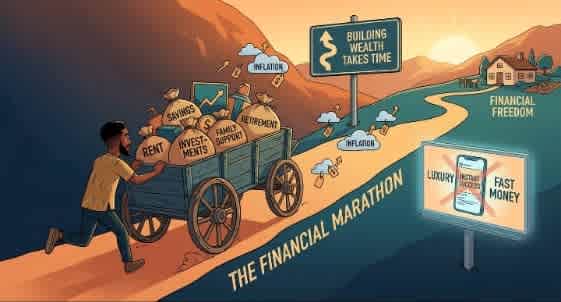
For decades, people believed getting a stable job was the ultimate financial security. Today, that assumption is becoming increasingly dangerous. Companies restructure, businesses struggle, industries change, and economic conditions change, usually without sending anyone a courtesy notice beforehand. Relying entirely on one income source can leave you vulnerable when unexpected changes happen.
This doesn't mean everyone must become an entrepreneur overnight. It simply means creating additional streams of income where possible. Whether it's freelancing, consulting, investing, content creation, remote work, or a side business, having multiple income sources provides a financial cushion during difficult times. The goal is to avoid a situation where one unexpected event completely disrupts your finances.
4. Saving money alone is not enough.
Many Nigerians were taught that saving is the key to financial security. While saving is important, it is only part of the equation. The reality you need to know is that money sitting idle gradually loses value, especially during periods of high inflation. While your account balance may remain the same, the purchasing power of that money keeps shrinking.
In other words, your money may still be sitting quietly in the account, but it's buying less each year.
Financial development requires learning how to make money work for you through investments, businesses, assets, and other wealth-building opportunities. Saving protects money. Investing helps it grow. Understanding the difference can completely change your financial future.
5. Building wealth takes longer than social media makes it look.
Social media has convinced many people that everyone is getting rich except them. A few minutes online can make you feel like you missed a secret meeting where everyone else learned how to become successful overnight.
Every day, timelines are filled with luxury vacations, new cars, business wins, expensive gadgets, and declarations of financial success. What social media rarely shows is the years of effort, setbacks, and sacrifices behind those achievements.
As a result, many Nigerians feel pressured to achieve in five years what often takes people ten, fifteen, or even twenty years to accomplish. Real wealth creation is usually built through consistent saving, disciplined investing, continuous learning, calculated risks, and patience.
Conclusion
Perhaps the biggest financial reality nobody warned Nigerians about is this: making money is only the beginning. The real challenge is learning how to keep it, grow it, and make it work for you. Financial success is rarely about luck or dramatic breakthroughs. More often, it's the result of boring decisions made consistently, which is far less exciting but usually far more effective.
The sooner you accept that building wealth is a marathon rather than a sprint, the better equipped you'll be to navigate the realities of modern Nigeria. In today's economy, earning money is only part of the challenge. The real task is learning how to manage it, grow it, and make it work for you over the long term.
Keep reading
Related Topics





Conversation
Comments (0)
Sign in to join the conversation or like this post.

Hep
Hep contributes reporting and analysis for NaijUp, covering the stories, markets, and business trends shaping Nigeria.
4
Stories
186
Reads
0
Likes
0
Comments