

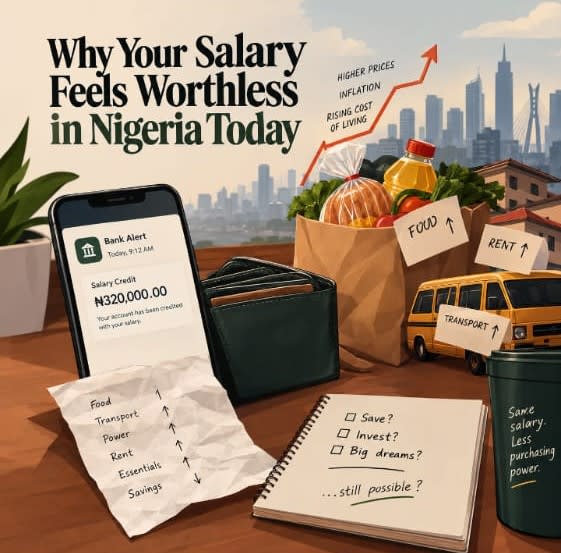
Living in Nigeria comes with an uncomfortable reality: your money doesn't go as far as it used to. Now it seems like your salary is chasing your expenses. The ₦100,000 that comfortably covered monthly expenses a few years ago now struggles to handle the basics. From groceries and transportation to rent and electricity, prices continue to climb while incomes often remain stagnant.
Inflation is more than an economic buzzword. It's the silent force reducing purchasing power and making it harder for individuals and families to achieve their financial goals. While you may not have control over the economy, you can control how you manage your money during uncertain times.
The good news is that surviving inflation is not necessarily about earning a massive income. Here are five practical ways Nigerians can protect themselves from inflation in 2026.
1. Focus on increasing your income, not just cutting expenses
When inflation rises, many people's first reaction is to reduce spending. While cutting unnecessary expenses is important, there is a limit to how much you can save. There is, however, often no limit to how much you can earn.
This is why one of the smartest responses to inflation is finding ways to increase your income. Don't put your eggs in one basket, be a gbogboniche. Relying solely on a salary can be risky, especially when annual pay raises fail to match rising prices.
Consider acquiring skills that can generate additional income, such as digital marketing, graphic design, copywriting, virtual assistance, software development, or social media management. You could also explore small businesses, freelancing, consulting, or remote work opportunities.
The goal is simple: if prices are rising, your earning capacity should also be rising. The more valuable your skills become, the easier it is to protect yourself against inflation.
2. Stop leaving large amounts of money idle
Many Nigerians feel financially secure when they have money sitting in their bank account. It’s giving high available cash and better financial security, but unfortunately, inflation steadily reduces the value of idle cash.
Imagine saving ₦500,000 and leaving it untouched for several years while the prices of goods and services continue to increase. Even though the amount remains the same, what that money can buy gradually decreases.
This doesn't mean you shouldn't save. You just have to give your money a purpose. Keep emergency funds accessible, but explore opportunities that can help preserve or grow your wealth over time.
3. Become intentional about every naira you spend
Inflation punishes careless spending. Many people underestimate how quickly small unnecessary expenses can drain your finances. Frequent food deliveries, impulse online purchases, multiple subscriptions, and daily convenience spending may seem harmless individually, but together they can consume a significant portion of monthly income. Refrain from doing “If I perish, I perish” for unnecessary expenses.
This is why budgeting becomes even more important during inflationary periods. Review your spending habits regularly and ask yourself an important question before making purchases: "Do I need this, or do I simply want it?"
Being intentional doesn't mean living a miserable life, you just have to make sure your spending aligns with your priorities and financial goals. In difficult economic times, financial discipline can often make the difference between stability and constant struggle.
4. Invest in skills that remain valuable

One of the best inflation-resistant assets is knowledge. Economic conditions may change, industries may evolve, and job markets may become more competitive, but valuable skills remain in demand.
Many professionals focus entirely on earning money today while neglecting the skills that could multiply their income tomorrow. The reality is that employers and clients are willing to pay more for expertise that solves problems.
Instead of spending all your money on consumption, allocate some of it to courses, certifications, training programs, books, and professional development. Whether you're an employee, entrepreneur, freelancer, or student, investing in yourself often produces returns far greater than traditional purchases. Your skills are one asset inflation cannot take away from you.
5. Build financial resilience through saving and emergency planning
Inflation creates uncertainty. Unexpected events such as job losses, medical emergencies, business challenges, or urgent family responsibilities can become even more stressful when living costs are rising.
This is why every Nigerian should prioritize building an emergency fund. One unexpected expense can humble your finances overnight. You don't have to save huge amounts immediately, you just have to build the habit of setting money aside consistently, regardless of your income.
Having savings provides breathing room during difficult periods and helps you avoid high-interest borrowing when emergencies occur. It also gives you the flexibility to make better financial decisions without acting out of desperation.
Conclusion
Inflation has become one of the biggest financial challenges facing Nigerians today, but it doesn't have to completely derail your finances. While you can't control rising prices, you can control how you earn, spend, save, and invest your money.
Adapting to rising costs means finding ways to increase your income, developing valuable skills, spending intentionally, and preparing for unexpected expenses.
In a high-inflation environment, financial survival is about becoming smarter with every naira that passes through your hands. The sooner you embrace that mindset, the better equipped you'll be to navigate whatever the economy throws your way.
Keep reading
Related Topics




Conversation
Comments (0)
Sign in to join the conversation or like this post.

Hep
Hep contributes reporting and analysis for NaijUp, covering the stories, markets, and business trends shaping Nigeria.
2
Stories
8
Reads
0
Likes
0
Comments