

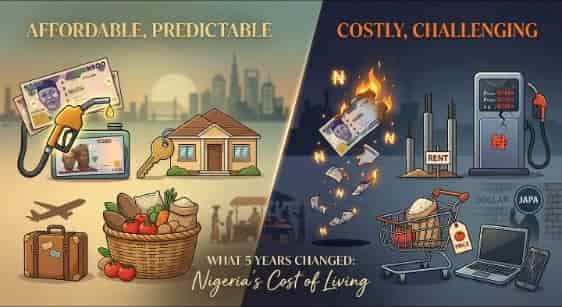
Five years doesn't sound like a long time. But ask anyone who's been managing a household budget in Nigeria since 2021, and they'll tell you it feels like a different economic era entirely. The naira you earned then and the naira you earn now don't buy the same life, not even close.
This isn't nostalgia for its own sake. It's a real look at how far things have shifted and why so many people feel like they're working harder for less. Here's what used to be within easy reach and what changed underneath it.
1. Filling Up a Tank of Petrol Without Flinching
Back in 2021, fueling a car was a routine errand, not a financial event. You'd pull into the station, fill up, and barely think about it afterward. Fast forward to today, and petrol prices have moved in ways that turned "let me just drive there" into a real calculation of "Is this trip worth the fuel it'll cost?’
The removal of the fuel subsidy in 2023 is the single biggest reason for this shift. For decades, the government absorbed a chunk of the real cost of petrol, so pump prices stayed artificially low. When that support was withdrawn, prices adjusted toward their true cost almost overnight, and they've kept climbing since, compounded by naira depreciation and the exchange-rate exposure of imported fuel and other petroleum supply-chain costs.
This one change rippled into everything else. Transport fares went up because drivers pass on fuel costs directly. Food prices rose because transporting goods from farm to market got more expensive, and that cost gets added at every stage between farm gate and market stall.
Small businesses that depend on generators for power, given how unreliable the national grid still is, saw their overhead quietly balloon. A single line item on the household budget ended up touching almost every other line item too, which is why this one shift is often cited as the starting point for the broader affordability crisis
2. Renting a Decent Apartment on a Single Salary
Five years ago, a graduate with a stable entry-level job could at least imagine moving into their own one-bedroom apartment within a year or two of working. It required saving, sure, but for many people, it felt achievable. Today, in most major cities, that same salary trajectory doesn't stretch nearly as far, and the gap has widened for a stack of overlapping reasons. Rents have climbed in raw naira terms as landlords adjust to inflation, and rising costs of building maintenance, agency, and agreement fees remain punishing.
The result is a generation of young professionals staying in shared apartments or with family far longer than they planned to, not from lack of ambition, but because the math genuinely doesn't work the way it used to.
3. Feeding a Family Without Constant Menu Adjustments
Staples like rice, beans, garri, and tomatoes used to be predictable expenses; you knew roughly what your weekly food budget looked like, and it didn't change dramatically month to month. That predictability is largely gone, driven by a combination of transport cost increases, insecurity disrupting farming in parts of the country, and currency depreciation raising the cost of imported agricultural inputs.
Now, grocery runs come with quiet negotiations at home: maybe we skip beef this week, maybe the portion sizes shrink a little, or maybe a meal that used to include meat twice a week now includes it once. These adjustments rarely get talked about outside the home, but they're happening in kitchens across the country, and they compound in ways that are easy to underestimate. A family that quietly reduces protein intake or meal variety over months isn't just spending less; they're often eating measurably less nutritiously, even if nobody's technically going hungry.
4. Traveling Abroad for School or Vacation on Modest Savings
Five years ago, with disciplined saving, a solid-but-not-extravagant income could get someone reasonably close to funding a study-abroad program or an international vacation within a few years. The naira, while never especially strong, still converted into something workable, a target that felt distant but achievable.
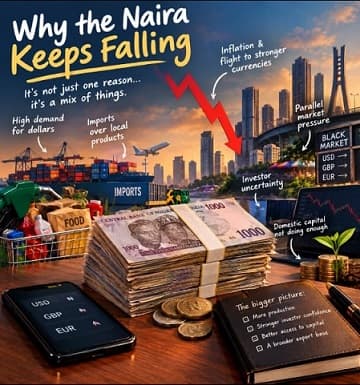
The currency's movement since then has changed that calculation dramatically. The naira has lost a significant share of its value against major currencies since 2021, particularly after the unification of exchange rates in 2023 removed the multiple-rate system that used to let some people access dollars more cheaply through official channels. Tuition quoted in dollars or pounds now costs significantly more in naira terms than it did before.
This is a major reason "japa" conversations often circle back to visa costs and proof-of-funds requirements as the real bottleneck, not the desire to travel, but the sheer naira cost of qualifying. A proof-of-funds requirement that meant saving a manageable sum in 2021 can now require substantially more naira for the same dollar figure, which is why so many study-abroad plans that started years ago have had to be paused, scaled down to cheaper destinations, or abandoned entirely, not for lack of admission, but for lack of naira keeping pace with a dollar-denominated goal.
5. Building or Renovating a House on a Modest Budget
Cement, roofing sheets, tiles, iron rods, and construction materials have all climbed sharply in price, partly due to currency depreciation (many materials or their raw inputs are imported) and partly due to rising fuel and transport costs baked into every stage of production and delivery, from the factory to the depot to the actual building site.
A building project that was fully costed out five years ago, if revisited today without adjustment, would come in dramatically over budget, sometimes by a margin large enough to require an entirely new plan rather than a small top-up. This has quietly stalled personal building projects across the country in a very visible way; drive through many developing neighborhoods and you'll see foundations and half-finished structures exposed to the elements, waiting for the owner to save enough to match new material prices, sometimes for years at a stretch. Now phased building plans are designed around this reality: build the foundation and structure this year, roof next year, and finish interiors the year after, rather than completing the entire project at once.
6. Owning a Reasonably Current Phone or Laptop
Smartphones and laptops are heavily exposed to dollar-denominated import costs, because Nigeria still relies heavily on imported devices. As the naira has weakened, that dollar-denominated cost has translated into steadily climbing naira price tags, even for mid-range devices that used to be considered comfortably affordable for a working professional.
What used to be a comfortable upgrade every couple of years has, for a lot of people, become a much longer stretch, nursing an aging phone or laptop well past its ideal lifespan, replacing cracked screens instead of the whole device, or turning to the used and refurbished market simply because replacing it new now competes with rent, food, and transport for the same limited naira. This has had a knock-on effect on anyone whose work depends on having decent, current tech, freelancers, content creators, and remote workers, who now face a real tradeoff between professional tool quality and basic living costs in a way they didn't five years ago.
7. Saving Meaningfully Without Elaborate Strategy
Five years ago, simply putting money aside in a regular savings account felt more sufficient; it held its purchasing power better than it does today, even if the interest earned wasn't spectacular. Today, inflation has run high enough for long enough that money sitting idle in a standard savings account loses real value noticeably fast, sometimes within a matter of months. because typical savings account interest rates have stayed well below the inflation rate for extended stretches.
This has quietly pushed more people toward learning about inflation-beating options, treasury bills, mutual funds, dollar-denominated savings, and even basic dividend-paying stocks, out of necessity to simply not lose ground against rising prices.
The rise of financial platforms and apps that make these options accessible to ordinary savers, not just wealthy investors, is itself a sign of how the conversation around saving has changed, which is itself a sign of how widespread this shift in thinking has become. Saving used to be a largely passive act: put money away, let time do the rest. Now it requires active thought, some basic research, and often a willingness to move money between platforms just to keep pace with where prices are heading.
Why This Matters
None of this is about romanticizing the past; 2021 had its own struggles, and nostalgia rarely tells the full story. But naming these shifts clearly and understanding the mechanisms behind them: subsidy removal, currency depreciation, exchange-rate unification, and import dependence, matters., because it reframes a lot of what looks like individual financial failure as something bigger: a genuinely harder economic environment that requires different strategies than the ones that worked before. Understanding what changed, and why, is the first step toward adapting. The old playbook, built for a different naira, isn't wrong exactly. It's just outdated. And recognizing that is where any real adjustment has to start.
Keep reading
Related Topics


Conversation
Comments (0)
Sign in to join the conversation or like this post.

Elizabeth Ayoola
Elizabeth is a finance analyst and writer passionate about making financial markets accessible to everyday readers.
She has a deep interest in global markets, crypto, and everything shaping the financial world. She writes to simplify complex financial topics, turning them into practical, accessible insights for everyday readers.
102
Stories
31703
Reads
1
Likes
0
Comments