
You don't have to look far to find someone convinced Nigeria is already in a recession. Someone's shop sales dip, fuel prices tick up, and suddenly a WhatsApp forward is flying around your family group chat: "Nigeria don enter recession again." Everybody starts nodding along, because honestly? Life is hard right now. Food is expensive. Rent keeps climbing like it's training for the Olympics. Salaries haven't caught up. That feeling is real, and it's not wrong to trust your own pocket.
But here's the thing nobody wants to hear: feeling broke and being in a recession are not the same thing. They're not even cousins. And right now, the actual numbers, not vibes, not group chat wisdom, are saying Nigeria is not heading into one. If anything, the data is telling a completely different story.
Let me walk you through why.
First, What a Recession Actually Means
A recession has a technical definition: two consecutive quarters of negative GDP growth. That's it. Not "things are expensive." Not "business is slow." Not "I can't afford what I used to afford." It specifically means the total value of goods and services the economy produces is shrinking, quarter after quarter.
Nigeria was last in a recession in 2020, when COVID-19 shut the world down, and before that in 2016, when oil prices crashed and the naira was in freefall. Those were real, textbook recessions; GDP contracted, businesses closed en masse, and the numbers backed up what people were feeling.
That is not what's happening today.
What the Data Is Actually Showing
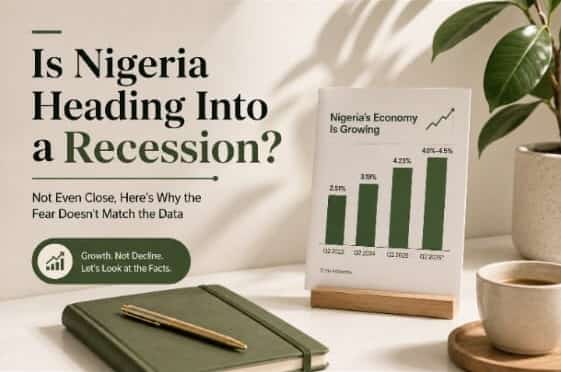
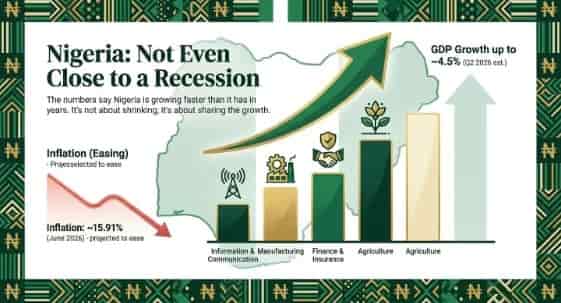
Nigeria's economy grew 3.89% year-on-year in Q1 2026, and early estimates put Q2 2026 growth at somewhere between 4% and 4.5%, which, if confirmed, would be the fastest second-quarter expansion in five years. This isn't a one-off. It's part of a three-year run of steadily improving growth: from 2.51% in Q2 2023 to 3.19% in Q2 2024 to 4.23% in Q2 2025 and now this.
That growth isn't just an oil story either, which matters because Nigeria's old boom-and-bust cycles were almost always tied to crude prices. This time, the non-oil sector: services, agriculture, and industry are doing the heavy lifting. Information and communication is growing at nearly 11%. Financial and insurance services are up over 8%. Even manufacturing is contributing, with oil refining output up more than 37% year-on-year, largely thanks to the Dangote refinery finally hitting its stride.
So when people say "recession," what the data actually shows is an economy that is growing and growing faster than it has in years.
But What About Inflation? Doesn't That Mean We're in Trouble?
This is where the confusion usually comes from, and it's a fair point to raise. Inflation is still high; headline inflation sat at 15.91% in June 2026. That is not a small number, and food inflation specifically is even worse, north of 17%. For the ordinary person budgeting for garri, tomatoes, and transport, that pain is real, and I'm not going to pretend otherwise.
But high inflation and recession are not the same thing, and mixing them up is where a lot of the panic comes from. In fact, what we're seeing is the opposite of a typical pre-recession pattern: inflation has been easing, not spiking. It dropped from a multi-high above 30% in 2024 to the mid-to-high teens now, and June's reading was actually the first month-on-month deceleration in three months. Analysts are projecting it could ease further, toward 15.5%, in July.
An economy sliding into recession usually shows slowing growth and often stagflation-like symptoms, prices rising while output collapses. What Nigeria has instead is a classic post-shock recovery pattern: inflation cooling from painfully high levels while output accelerates. That's not comfortable, but it's not a recession. It's the tail end of adjustment.
The Naira Story Nobody's Talking About
Here's something that would have seemed unthinkable two years ago: the naira has been stable, and Nigeria's external reserves just hit a 17-year high above $52.5 billion, according to the CBN. The gap between the official and parallel market exchange rates, the black market premium that used to be a national embarrassment and a reliable predictor of doom, has narrowed to below 2%.
That matters more than people give it credit for. A shrinking parallel market gap tells you the market actually trusts the official rate. It tells you dollar liquidity has genuinely improved, not just on paper. It's one of the clearest technical signs that the FX unification reforms of 2023, painful as they were in the short term, are doing what they were designed to do.
So Why Does It Feel Like a Recession?
This is the part I think matters most, and it's the part most "recession" takes conveniently to skip.
Nigeria's economy is growing at roughly 4%. Nigeria's population is growing at roughly 2.4% a year. When you're adding tens of millions of new mouths, new job seekers, and new households every few years, a 4% GDP growth rate doesn't translate into 4% more prosperity per person; it barely outpaces population growth once you adjust for it. That's the disconnect. The aggregate economy can expand while the average Nigerian's real, felt experience of income and affordability barely moves or even declines.
Add to that the scars of the 2023–2024 reforms, fuel subsidy removal, naira devaluation, and the inflation spike that followed, and you get a population that is still digesting years of real income loss even as the rate of new pain slows down.
That gap, between macro recovery and micro pain, is real, and it's worth taking seriously. But it is a different problem from a recession, and it needs different language and different solutions. Calling it a recession when it isn't one actually does us a disservice, because it points policymakers and public conversation at the wrong diagnosis.
My Take
Nigeria is not heading into a recession. If anything, the data says we're in one of the more genuine growth phases the economy has had in years, broad-based, non-oil-led, backed by a stabilizing currency and cooling inflation. What we are in the middle of is something harder to name and harder to fix with a single policy lever: a growing economy that hasn't yet translated into a country where growth is felt.
That's not a recession story. That's a distribution story, an inequality story, a "who actually benefits from GDP growth" story. And honestly, it deserves more attention than the recession headlines that keep recycling every few months, because it's the actual problem sitting underneath the fear.
The economy is not shrinking. But for too many Nigerians, their share of it still is. Those are two different crises, and we should stop confusing them.
Keep reading
Related Topics



Conversation
Comments (0)
Sign in to join the conversation or like this post.

Elizabeth Ayoola
Elizabeth is a finance analyst and writer passionate about making financial markets accessible to everyday readers.
She has a deep interest in global markets, crypto, and everything shaping the financial world. She writes to simplify complex financial topics, turning them into practical, accessible insights for everyday readers.
102
Stories
31703
Reads
1
Likes
0
Comments