
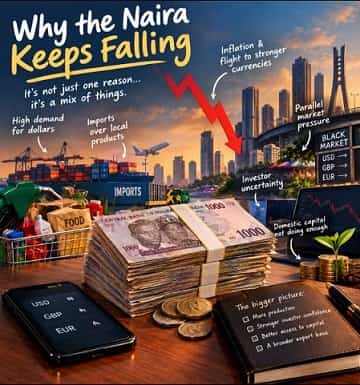
The naira falling again is hardly news in Nigeria anymore. What once triggered alarm now feels almost routine: another drop, another round of headlines, another reminder of how difficult it has become to keep the currency stable. But the more important question is not why the naira fell this time. It is why the currency keeps coming under pressure in the first place.
There is no single culprit. The naira’s weakness reflects a mix of structural problems, financial habits, limited dollar supply, and investor sentiment that continue to put pressure on the currency.
Here are some of the forces behind it.
When Dollar Demand Outruns Supply
At the root of the problem is a simpler imbalance: Nigeria's demand for foreign exchange can outpace the supply available to the economy. Fuel, machinery, food, and many everyday consumer goods depend on imports that must be settled in foreign exchange, while the country's ability to earn dollars remains relatively narrow and heavily dependent on oil. When oil prices fall or production falters, dollar inflows can shrink just as demand for foreign exchange remains strong. The result is pressure on the naira, particularly when available dollar supply cannot keep up with demand.
Nigeria has normalized importing from other countries to such an extent that many consumers have come to prefer imported goods over locally made products. A culture of concern and distrust has developed toward some Nigerian-made products, driven by fears that locally made goods may be substandard or unreliable. In many respects, Nigeria has become heavily reliant on imported goods, with imports playing a significant role in meeting the country's demand for products that could otherwise be produced locally.
Inflation and the Flight to Stronger Currencies
Persistent inflation compounds the problem. As the naira loses purchasing power at home, both individuals and businesses look for ways to protect their wealth, and increasingly, that could mean holding dollars instead of naira, among other strategies. This isn't just a psychological reaction; it can be rational self-preservation in an environment where prices rise faster than incomes. But when more people buy dollars to protect themselves from inflation, it can add further pressure to the very currency people are trying to escape from.
Individuals and businesses recognize that Nigeria's economic stability and its inflation rate are closely linked. When inflation remains high and the naira continues to weaken, many naturally look for alternative stores of value to protect themselves financially. This reflects a broader pattern of self-preservation, where individuals and businesses do what they can to protect their purchasing power and financial interests.

The Parallel Market Problem
Another piece of the puzzle is the parallel foreign exchange market. When access to dollars through official channels becomes difficult or expensive, individuals and businesses often turn to alternative markets to meet their foreign exchange needs. The more demand that shifts into these markets, the more pressure is placed on the naira, particularly when the supply of dollars remains limited.
The problem goes beyond the exchange rate itself. A wide gap between the official and parallel market rates can influence how people value the naira, encouraging businesses and individuals to use the parallel rate as a reference when pricing goods, services, and transactions. This can create a cycle where expectations of further depreciation increase demand for dollars, which in turn puts additional pressure on the naira.
When the parallel market becomes a significant reference point for economic activity, it also becomes harder for the formal foreign exchange market to accurately reflect underlying demand and supply. The result is another layer of complexity for a currency already facing pressure from limited foreign exchange supply, high inflation, and strong demand for dollars.
When Risk Changes the Equation
Currencies don't just reflect trade balances; exchange-rate movements can also shape investor sentiment. When investors are uncertain about Nigeria's economic direction, security situation, or policy consistency, they may hesitate to bring capital in, while existing investors may look for the exit. That hesitation slows the inflow of foreign currency, leaving less foreign exchange available in the market and making it harder for the central bank to intervene and support the naira.
Investors are also known to be highly sensitive to risk. At the slightest hint of instability or uncertainty, often before any real crisis has fully materialized, some investors may withdraw or reposition their capital to protect their own interests.
When Domestic Capital Isn’t Doing Enough
A quieter but equally important piece of the puzzle is what Nigerians do with the money they already have. A significant amount of household and business savings does not make its way into long-term productive investment. Some are held as cash, kept within the informal economy, or placed in relatively short-term instruments. That means a pool of domestic capital that could help finance businesses, infrastructure, and expansion does not always translate into the kind of investment that grows productive capacity.
High interest rates add another twist to the story. They can help cool inflation by making borrowing more expensive, but they also raise the cost of financing for businesses looking to expand production, build factories, or increase export capacity. So even when money is available within the financial system, it does not automatically translate into the investment needed to expand the economy's productive base.
The issue, then, is not simply that money is sitting idle. It is that too little domestic capital is being channeled into activities that can expand production and strengthen Nigeria's ability to earn foreign exchange. Channelling more savings into productive businesses, infrastructure, and capital markets would put that money to work while supporting the kind of economic activity that can strengthen the naira over time.
The Bigger Picture
None of these forces work in isolation. Strong demand for dollars puts pressure on the naira. Inflation and weak confidence can push people toward foreign currency, while uncertainty can make investors more cautious about bringing capital into the country. And when domestic savings are not flowing into productive investment at the scale needed, Nigeria's ability to expand production and strengthen its foreign-exchange earnings remains limited.
That is why the naira's weakness cannot be fixed by exchange-rate intervention alone. The longer-term answer lies in expanding productive capacity, strengthening investor confidence, improving access to capital, and building an economy that earns more foreign exchange from a broader base of exports and investment. Until those underlying pressures are addressed, the naira is likely to remain vulnerable to another round of pressure.
Keep reading
Related Topics



Conversation
Comments (0)
Sign in to join the conversation or like this post.

Elizabeth Ayoola
Elizabeth is a finance analyst and writer passionate about making financial markets accessible to everyday readers.
She has a deep interest in global markets, crypto, and everything shaping the financial world. She writes to simplify complex financial topics, turning them into practical, accessible insights for everyday readers.
102
Stories
31702
Reads
1
Likes
0
Comments