

Mainland or island, everybody go collect. That's just how Lagos works. No matter which side of the bridge you sleep on, the city finds a way to bill you. And lately, a lot of people are doing the math and asking the same question: how am I earning this much and still feeling broke every single month?
Here's the truth nobody tells you before you move to Lagos, or before Lagos happens to you if you were born into it: the cost of living here isn't just rent. Rent is just the headline. The real damage happens in the fine print, food, transport, light, and a dozen small bills that quietly stack up until you're staring at your account balance wondering where all that money went. And if you're lucky enough to be earning what people would call an “armed robber salary", you might be wondering the same thing. Let's break it down.
Rent: The Bill That Sets the Tone for Everything Else
Rent takes the biggest bite, and everyone knows it. But what's less talked about is how differently that bite lands depending on where you are. Island rent, Lekki, Victoria Island, Ikoyi, operates in a different universe entirely, often quoted in figures that make mainland rent look almost reasonable by comparison. Mainland areas like Yaba, Surulere, or Ikeja aren't cheap either, but they at least stay within shouting distance of what an average salary can stretch to cover.
The real sting is the structure of paying the rent. Most landlords still want one to two years upfront, plus agency fees, plus agreement fees, plus caution fees, all due at once. So even someone earning a genuinely good salary can find themselves broke for months after "successfully" securing an apartment, because the moving-in cost alone wiped out savings that took a year to build. Renting in Lagos is expensive in a way that demands you have a lump sum sitting idle, which is its own kind of privilege most people don't have.
Food: The Daily Bill You Don't Notice Until You Total It
Rent is annual. Food is daily, and that's exactly why it sneaks up on people. Nobody sits down and budgets "how much will I spend feeding myself this month" the way they budget rent; food happens meal by meal, market run by market, and it's easy to lose track until the money's simply gone.
Lagos food prices carry their own premium on top of already-rising national food inflation, partly because so much of what the city eats travels in from somewhere else: tomatoes from the north, garri from the southwest, fish from the coast, and every leg of that journey adds cost by the time it reaches a Lagos market stall. Add the Lagos habit of eating out or ordering in because the hustle leaves no time to cook, and food quietly becomes one of the largest line items in anyone's month, even for people who'd swear they're "not really spenders".
Transportation: The Tax on Simply Getting to Work
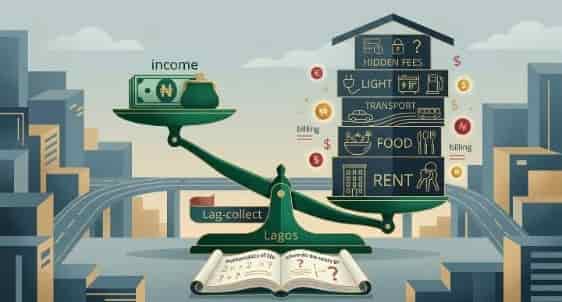
Lagos is not a small city, and it's definitely not a walkable one for most people's daily commute. Whether it's danfo, BRT, keke, or ride-hailing apps, getting from where you sleep to where you earn money costs money, and that cost has climbed sharply as fuel prices rose, since every driver, no matter the vehicle, is pricing their fare around what it costs to fill their tank.
For a lot of people, transport now eats a chunk of the monthly budget that would've seemed unreasonable a few years ago, sometimes rivalling food as a top expense. And it's not optional. You can cut back on eating out; you generally can't cut back on getting to your job. This is part of why Lagosians increasingly factor commute distance into every housing decision, it's not just "Can I afford this rent?" It's "Can I afford this rent plus what it'll cost me to get to work from here every single day."
Light: The Bill for a Service That Doesn't Fully Show Up
"Up NEPA" used to be a joke about celebrating when the power came back. These days, the joke has a sharper edge, because Lagosians are paying more for electricity through tariff increases and estimated billing that often has little relationship to actual usage, while still not being able to rely on it fully enough to skip the generator.
That's the real cost hiding in plain sight: many households and businesses are effectively paying twice for power. Once to the electricity company for a supply that isn't fully dependable, and again for fuel to run a generator to cover the gap. Add the cost of maintaining that generator, and "light" becomes one of those bills that looks small on paper but adds up to something significant once you total the official bill plus everything spent working around its unreliability.
The Bills Nobody Budgets For
Beyond the big four: rent, food, transport, and light, Lagos has a way of adding smaller charges that rarely make it into anyone's official budget. Data and airtime to stay connected for work. Security levies that many streets and estates now collect from residents and other informal community contributions. Even things like generator fuel storage, water (since municipal water isn't reliable everywhere either), and waste collection fees that vary wildly by area.
None of these individually feels like a big deal. But this is exactly the trap: Lagos rarely breaks you with one huge, obvious expense. It breaks you with a dozen smaller ones that all show up in the same month, quietly, until the salary that looked generous on offer-letter day starts feeling painfully small by the third week.
The Takeaway
If you're in Lagos and feeling like your money disappears faster than it should, you're probably not imagining it, and you're definitely not alone. The math genuinely doesn't work the way it used to; rent takes more, food costs more, transport costs more, and light costs you twice over.
The honest first step is clarity: know exactly where your money goes, factor in the full picture, not just rent, but the transport and light and food that ride along with it, and plan around the city Lagos actually is today, not the one it used to be five years ago. Everybody go collect. The best you can do is plan for it before it happens.
Keep reading
Related Topics



Conversation
Comments (0)
Sign in to join the conversation or like this post.

Elizabeth Ayoola
Elizabeth is a finance analyst and writer passionate about making financial markets accessible to everyday readers.
She has a deep interest in global markets, crypto, and everything shaping the financial world. She writes to simplify complex financial topics, turning them into practical, accessible insights for everyday readers.
102
Stories
31703
Reads
1
Likes
0
Comments