
Food Got Cheaper in October. Your Fuel, Transport and Light Bills Didn't

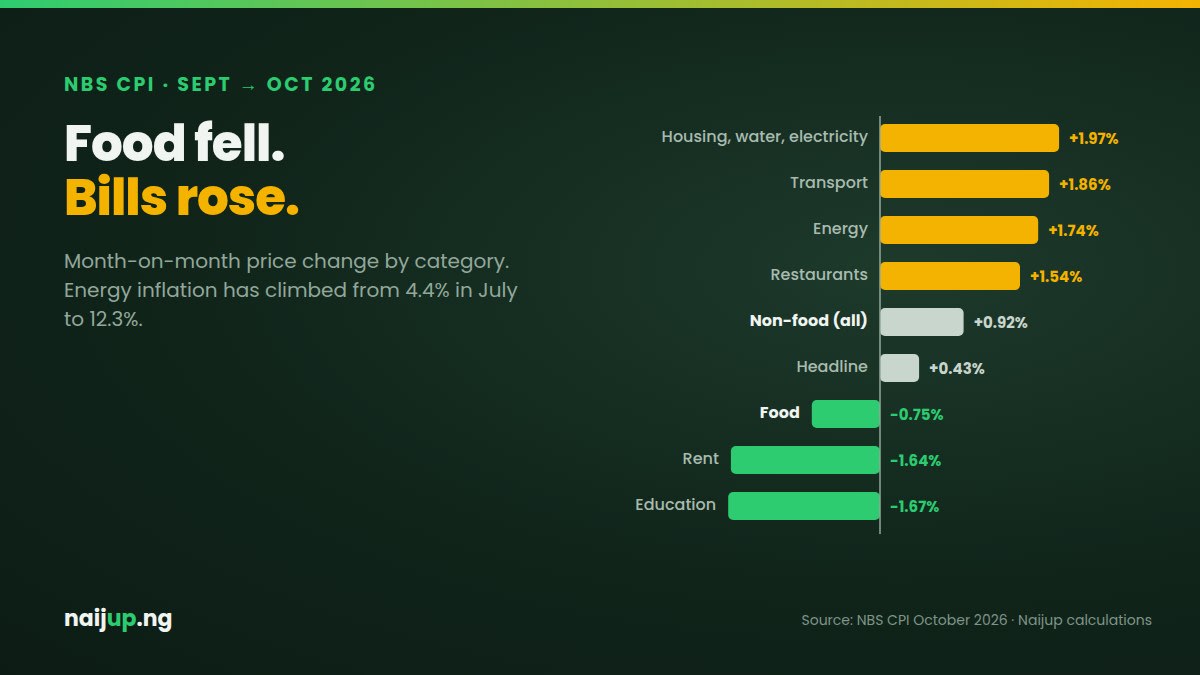
If you only read the headline, October 2026 looks like a quiet month. Overall prices rose just 0.43% from September.
But split the basket in two and you get two very different months:
• Food: down 0.75%
• Everything except food: up 0.92%
Harvest pulled food down. Almost everything you pay for that isn't food went up.
What went up in October
| Category | Change from September | Year on year |
|---|---|---|
| Housing, water, electricity, gas, other fuels | +1.97% | 14.97% |
| Transport | +1.86% | 11.48% |
| Energy (special index) | +1.74% | 12.30% |
| Restaurants and accommodation | +1.54% | 18.73% |
| Recreation, sport and culture | +1.28% | 4.46% |
| Information and communication | +1.18% | 5.27% |
| Personal care and miscellaneous | +0.53% | 12.26% |
And the ones that went down:
| Category | Change from September |
|---|---|
| Education services | −1.67% |
| Housing (rent) index | −1.64% |
| Insurance and financial services | −1.64% |
| Food | −0.75% |
| Health | −0.65% |
Energy is creeping back up
The energy index covers things like petrol, diesel, kerosene, cooking gas and electricity. Its yearly rate has been climbing for three months straight:
| Month | Energy inflation (YoY) |
|---|---|
| Jul 2026 | 4.40% |
| Aug 2026 | 4.69% |
| Sep 2026 | 10.85% |
| Oct 2026 | 12.30% |
From 4.4% to 12.3% in three months. Energy is only 6.42% of the CPI basket, so it doesn't move the headline much on its own. But energy costs leak into everything else: transport fares, the price of food that has to be moved, what restaurants charge, what your barber charges to run his generator.
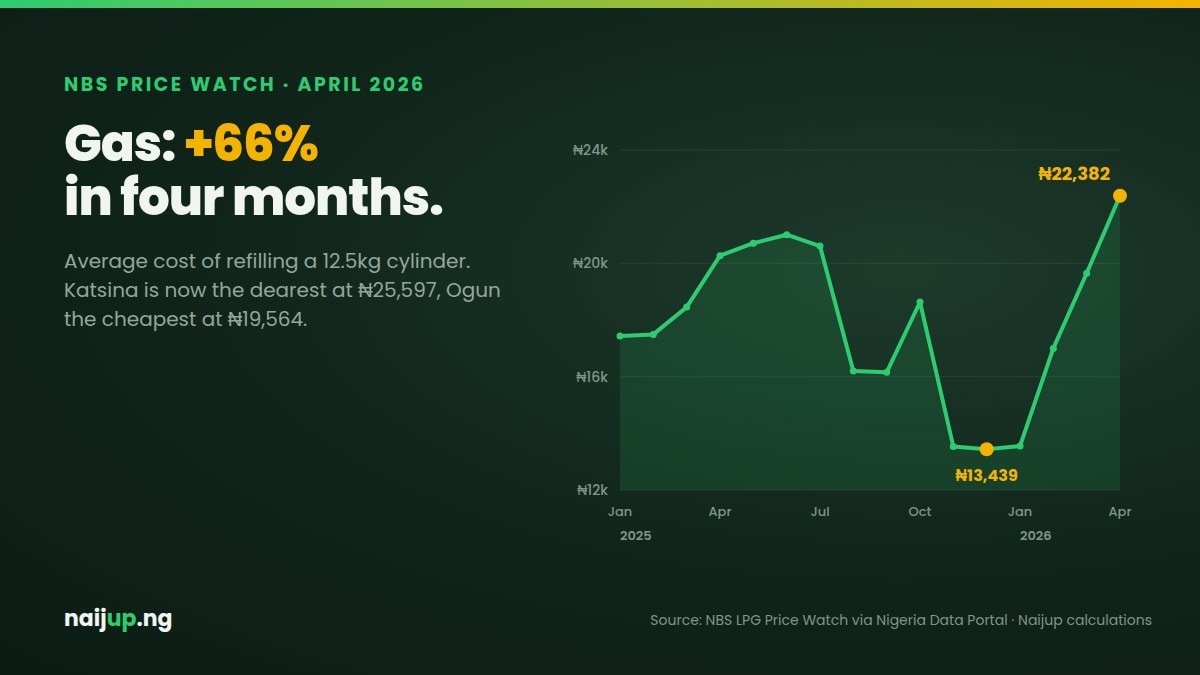
(We saw a version of this in the NBS cooking gas data too. The average 12.5kg refill went from ₦13,439 in December 2025 to ₦22,382 in April 2026.)
Transport: cities got hit, villages didn't
Transport rose 1.86% nationally in October. But the urban and rural numbers are almost opposites:
• Urban transport: +3.76% in one month
• Rural transport: −3.34%
Urban energy rose 2.81% while rural energy fell 1.99%. City dwellers paid more to move around in October. In rural areas it was the reverse, which partly makes up for September, when rural transport jumped.
Urban housing, water, electricity and gas also went up 1.75%.
Eating out keeps climbing
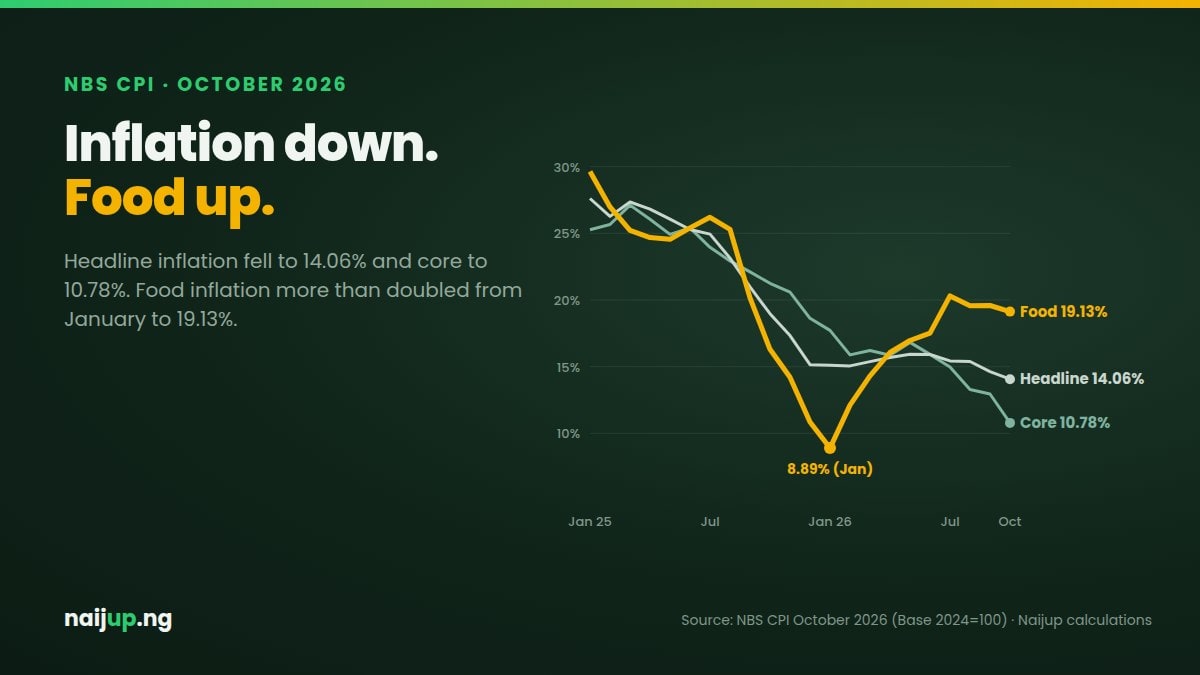
Restaurant and accommodation prices rose another 1.54% in October and are 18.73% higher than a year ago. That's close to the food inflation rate (19.13%), and it's the second biggest contributor to headline inflation after food itself.
What's interesting: food at the market fell 0.75% in October, but food at the restaurant rose 1.54%. Restaurants don't pass on falling ingredient costs quickly, but they do pass on higher gas, diesel and rent.
The quiet good news
A few things are actually getting more affordable, relatively speaking:
• Clothing and footwear: just 0.40% inflation year on year. In cities, clothing prices are actually lower than a year ago (−0.92%).
• Insurance and financial services (which in the NBS basket includes things like POS service charges and ATM charges): 1.35% a year.
• Furnishings and household equipment: 2.27%.
• Education: dropped 1.67% in the month, and yearly inflation is down to 7.11% from 9.77% in September.
What this means for you
• Watch your transport budget, especially in cities. A 3.76% jump in one month is big. If it repeats in November and December (fuel demand usually rises around festive season), city commuting costs could keep rising into early 2027.
• Food relief is seasonal. Use the cheaper harvest prices now to stock up, because energy-driven costs tend to show up in food prices a few months later.
• If you run a small business: your energy and transport costs are rising faster than your customers' food costs are falling. That makes price increases harder to justify to customers. Look at where you can cut energy use (solar for small loads, fewer generator hours).
Have you noticed your transport or fuel costs going up in the last month? Share what you're paying now.
Quick FAQ
Did food prices fall in Nigeria in October 2026?
Yes. The NBS food index fell 0.75% from September to October 2026. Year on year, food inflation is still 19.13%.
What is energy inflation in Nigeria in October 2026?
12.30% year on year, up from 10.85% in September and 4.40% in July 2026. The energy index rose 1.74% month on month.
How much did transport prices rise in October 2026?
Transport prices rose 1.86% month on month nationally and 11.48% year on year. In urban areas, transport rose 3.76% in one month.
Which prices are rising slowest in Nigeria?
Clothing and footwear (0.40% year on year), insurance and financial services (1.35%) and furnishings (2.27%) in October 2026.
Data source: National Bureau of Statistics, Consumer Price Index October 2026 (Base 2024 = 100), Tables 2, 3 and 4. Month-on-month and year-on-year rates by division are Naijup calculations from NBS index values.
Found this useful? Share it
Help friends, family and colleagues stay informed on Nigerian finance.
Keep reading
Related Topics
Conversation
Comments (0)
Sign in to join the conversation or like this post.

Mujeeb Olagunju
I am a finance professional with a strong background in economics and financial technology.,My work centers on building systems that support payments, digital banking, and investment solutions in emerging markets.,I have experience with risk management, transaction monitoring, fraud prevention, and the design of scalable financial products tailored to both retail and institutional clients.,With over 8 years of industry experience, I combine financial insight with technical expertise to deliver solutions that balance compliance, security, and business growth.,My goal is to bridge the gap between finance and technology, creating platforms that expand access to modern financial services and strengthen trust in digital finance.
94
Stories
30466
Reads
0
Likes
0
Comments