
$10.4 Billion Came Into Nigeria in Q1 2026. Only $135 Million of It Was FDI

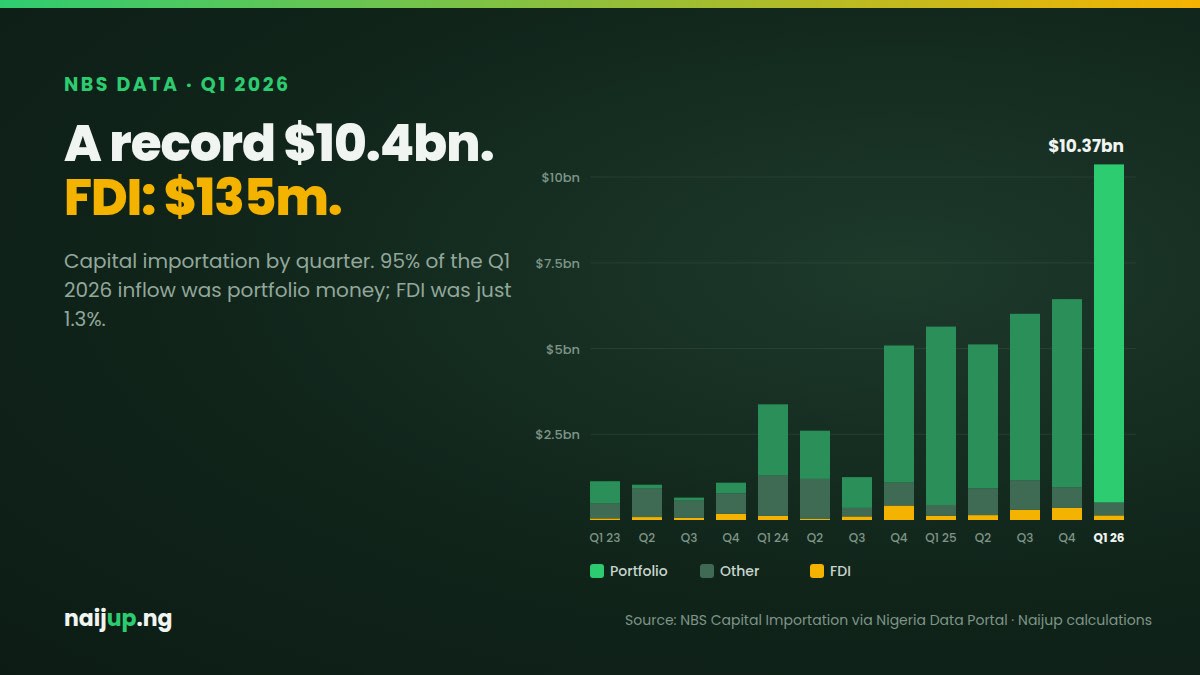
The headline from the NBS capital importation report for January to March 2026 looks fantastic. Foreign investors brought $10.37 billion into Nigeria in one quarter.
That's up 83.8% from $5.64 billion in Q1 2025, and up 61% from the $6.44 billion in Q4 2025. We went back through every quarter on the NBS data portal (it starts in mid-2013) and this is the biggest single quarter in the whole series. The previous high was $8.51 billion in Q1 2019.
So, good news? Partly. Look at what kind of money it was.
95 cents of every dollar was portfolio money
| Type of investment | Q1 2025 | Q4 2025 | Q1 2026 | Share of Q1 2026 |
|---|---|---|---|---|
| Portfolio investment | $5,204.61m | $5,486.03m | $9,862.34m | 95.1% |
| Other investment (loans etc.) | $311.17m | $599.65m | $374.48m | 3.6% |
| Foreign direct investment (FDI) | $126.29m | $357.80m | $135.08m | 1.3% |
| Total | $5,642.07m | $6,443.48m | $10,371.90m | 100% |
Portfolio investment is money that buys Nigerian financial assets: treasury bills, bonds, shares. It can come in fast, and it can leave just as fast. FDI is the slower kind of money, the factory, the farm, the company someone builds or buys a big stake in.
95.1% portfolio is the highest share in the NBS series. The last time it came close was Q1 2025 at 92.2%.
FDI at 1.3% is the second lowest share on record. Only Q2 2024 (1.1%) was worse. And in dollar terms FDI actually fell 62% from the previous quarter, from $357.8 million to $135.1 million.
Where the portfolio money went
Breaking down the $9.86 billion in portfolio flows:
| Portfolio instrument | Q1 2025 | Q1 2026 | Change |
|---|---|---|---|
| Money market instruments (mostly T-bills, OMO) | $4,209.86m | $6,504.52m | +54.5% |
| Bonds | $877.41m | $3,226.01m | +267.7% |
| Equity (shares) | $117.33m | $131.81m | +12.3% |
Money market instruments alone were $6.5 billion, which is about 63% of everything that came in. Bonds nearly quadrupled.
Equity, meaning foreigners buying Nigerian stocks, stayed small at $131.8 million. That's interesting because the NGX had a strong run. The rally was mostly a local affair, pension funds and Nigerian investors, not foreign money. (We wrote about how pension funds drove a big part of it.)
Why are foreigners buying T-bills and bonds?
Simple: the returns are still high in dollar terms and the naira has been more stable than in 2023–2024. A foreign fund can buy a Nigerian T-bill, earn a double digit yield, and if the exchange rate holds, convert back to dollars with a nice profit. People call it the "carry trade".
Nothing wrong with that, it brings dollars into the FX market and helps the naira. But it's not the kind of money that builds a factory in Aba or hires 500 people in Kano. And when yields drop or the naira wobbles, it can leave in a hurry. We saw this play out in 2015–2016 and again in 2020 when portfolio inflows fell from $4.3 billion in Q1 2020 to just $35 million in Q4 2020.
Four banks handled 86% of it
The NBS also reports which bank the money came through. This is where it gets concentrated:
| Bank | Q1 2026 inflow | Share |
|---|---|---|
| Standard Chartered | $4,414.37m | 42.6% |
| Stanbic IBTC | $2,778.92m | 26.8% |
| Rand Merchant Bank | $930.82m | 9.0% |
| Citibank Nigeria | $782.84m | 7.5% |
| Access Bank | $710.03m | 6.8% |
| First Bank | $274.74m | 2.6% |
Standard Chartered, Stanbic, RMB and Citi together handled $8.91 billion, about 86% of the total. All four have foreign parent banks with big custody and FX businesses, which is exactly where you'd expect portfolio money to land.
By sector, "Banking" took $7.55 billion (72.8%) and the financing sector another $2.43 billion. Real-economy sectors were tiny: agriculture $37.3 million, transport $65.8 million, IT services $11.3 million.
Where did the money come from?
On the portal, the UK is listed as the source of about $5.08 billion (49%) and the United States $3.18 billion (31%). The US figure is up from $369 million in Q1 2025, so American funds were clearly much more interested this year.
One honest note: the country table on the open data portal has some labelling problems (some rows are duplicated under wrong country names), so treat the country split as a rough guide. The totals by type and by bank add up properly.
What this means for you
• The naira's stability has a weak point. A lot of the dollar supply right now is hot money. If you're planning a big dollar payment (school fees abroad, imports), don't assume today's rate will hold forever.
• High T-bill rates are why foreigners are here. They're also available to you. If you have savings sitting in a current account, a T-bill or money market fund earns you the same yield foreigners are chasing, without the FX risk.
• Watch the next reports. If FDI stays around 1–3% of inflows, that's a sign that long-term investors still aren't convinced, whatever the headline says.
Does a $10 billion quarter feel real to you, or is it just numbers on paper? Let us know what you think.
Quick FAQ
How much capital came into Nigeria in Q1 2026?
$10.37 billion, according to the NBS. That's up 83.83% from $5.64 billion in Q1 2025 and 60.97% from $6.44 billion in Q4 2025.
How much FDI did Nigeria get in Q1 2026?
$135.08 million, or 1.3% of total capital importation. It was $357.80 million in Q4 2025.
Which bank received the most capital importation in Q1 2026?
Standard Chartered Bank Nigeria, with $4.41 billion (42.6%), followed by Stanbic IBTC with $2.78 billion.
What is portfolio investment?
Foreign money used to buy financial assets like treasury bills, bonds and shares. It made up 95.1% of Nigeria's capital inflow in Q1 2026.
Data source: National Bureau of Statistics, Nigerian Capital Importation Q1 2026 and earlier quarters, via the Nigeria Data Portal (nigeria.opendataforafrica.org). Shares, rankings and "highest since 2013" comparisons are Naijup calculations from the quarterly series, which begins in Q3 2013.
Found this useful? Share it
Help friends, family and colleagues stay informed on Nigerian finance.
Keep reading
Related Topics
Conversation
Comments (0)
Sign in to join the conversation or like this post.

Mujeeb Olagunju
I am a finance professional with a strong background in economics and financial technology.,My work centers on building systems that support payments, digital banking, and investment solutions in emerging markets.,I have experience with risk management, transaction monitoring, fraud prevention, and the design of scalable financial products tailored to both retail and institutional clients.,With over 8 years of industry experience, I combine financial insight with technical expertise to deliver solutions that balance compliance, security, and business growth.,My goal is to bridge the gap between finance and technology, creating platforms that expand access to modern financial services and strengthen trust in digital finance.
94
Stories
30466
Reads
0
Likes
0
Comments