

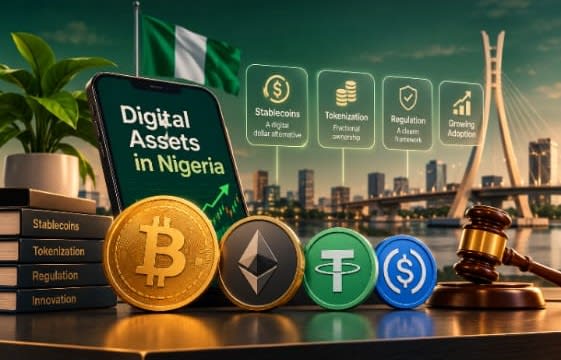
For years, Bitcoin has been the poster child of digital assets in Nigeria. If you mention crypto to anyone in Nigeria, they'll immediately think of price charts, bullish predictions, and the stories of people who got in early and just can't stop talking about it.
But Bitcoin is no longer the whole story. Growing interest in stablecoins, tokenized assets, and new regulations is expanding the conversation beyond trading and speculation. Questions about price remain, but they are increasingly being joined by another one: how useful are these assets in everyday life?
Stablecoins: Nigeria's Digital Dollar Alternative
If any digital asset is winning over Nigerians for practical reasons rather than hype, it's probably the stablecoin. With the naira under pressure in recent years, many Nigerians are looking for ways to preserve value outside the local currency. As a result, dollar-pegged stablecoins such as USDT and USDC have become increasingly popular, giving users a way to hold and transfer value linked to the US dollar.
Their appeal extends far beyond savings. Freelancers working with overseas clients can receive payments faster, small businesses can settle international transactions more easily, and individuals can transfer funds across borders without the delays often associated with traditional banking systems. Through peer-to-peer (P2P) trading platforms, users can also move between naira and stablecoins with relative ease.
The appeal of stablecoins is easy to understand. They solve real problems for some users, whether that's receiving international payments, sending money abroad, or reducing exposure to the naira's ups and downs. Still, stablecoins should not be mistaken for risk-free digital assets. Like any other asset, it comes with its own share of scams, security issues, and unexpected regulations.
Bitcoin and Ether Still Command Attention
Despite the popularity of new digital assets, Bitcoin and Ether still attract most attention when people are discussing crypto investments. Many investors expect the asset to increase in price and to bring higher returns on investment. Young people in Nigeria, who feel comfortable with digital finance, are increasingly including cryptocurrency as part of their investment strategies.
Unlike stablecoins, Bitcoin and Ether are not tied to any traditional currency. Their prices can move dramatically in either direction, often in response to shifts in investor sentiment, economic conditions, or broader market events. Bitcoin's history alone offers plenty of examples of rapid rallies followed by equally painful declines.
For some investors, those swings create opportunities. For others, they highlight just how unpredictable the asset class can be.
Tokenization: Opening New Doors to Investment
Apart from the already mentioned digital assets, tokenization is gaining popularity in recent years as well. It involves converting ownership rights in real-world assets, such as real estate, commodities, or financial instruments, into digital tokens recorded on a blockchain.
It seems evident why people find it interesting. By purchasing tokens instead of real property or other assets, investors might avoid the necessity of owning huge amounts of money needed for purchasing those assets. As a result, young Nigerians, entrepreneurs, and small businesses will have an opportunity to enter the market and start building their wealth.
However, technology is not everything here. Whether it is successful or not will largely depend on the legal scope, which must provide investors with information about what rights are implied by the ownership of a particular token, whether those rights will be protected, and if they could be enforced in case of any conflicts.
A Regulatory Framework Taking Shape
As adoption grows, regulators are paying closer attention to how these assets are bought, sold, and used. The Investments and Securities Act 2025 formally recognizes digital assets within Nigeria's securities framework, bringing relevant activities under the supervision of the Securities and Exchange Commission (SEC).
At the same time, ongoing tax reforms introduce obligations relating to gains from digital asset transactions, while companies operating within the sector may also be subject to applicable corporate tax requirements.
Authorities are also trying to create clearer rules for a sector that has often developed faster than regulation. A presidential executive order has signaled a broader push towards harmonized oversight of crypto-assets, stablecoins, and tokenized assets.
Even so, important questions remain. Businesses, investors, and everyday users are still waiting to see how some of these rules will work in practice, how responsibilities will be shared among regulators, and what the evolving rules will mean for businesses and everyday users.
Some observers also worry that heavy-handed regulation could push activity further underground rather than bring it under proper oversight. If access to legitimate cryptocurrency trading channels becomes unnecessarily difficult, users may migrate to less transparent alternatives, creating fresh challenges for regulators and potentially increasing risks within the wider financial system.
Key Trends to Watch
While the focus on digital assets has broadened beyond cryptocurrency trading, people are increasingly paying attention to the aspects that could affect the future.
- Investor protection: Can regulators safeguard consumers while still encouraging innovation and legitimate market participation?
- Tokenization: Will the concept move beyond industry conversations into practical investment products backed by enforceable legal rights?
- Stablecoin adoption: Will more Nigerians embrace dollar-pegged digital assets for payments, savings, and international transactions?
- Tax clarity: Will individuals and businesses receive clearer guidance on their obligations when buying, selling, or transferring digital assets?
Conclusion
No matter your opinion on the matter, whether you think that digital assets will define the future of finance or simply represent yet another step in its evolution, the fact that it can no longer be overlooked is clear.
From stablecoins offering a digital route to dollar-linked value to Bitcoin and Ether attracting long-term investors, the market has expanded well beyond its early reputation for speculation. Meanwhile, tokenization could unlock entirely new investment opportunities, provided the legal and regulatory foundations are strong enough to support them.
For anyone looking to get involved, curiosity alone isn't enough. Understanding how these assets work, where the risks lie and what the rules require is just as important as picking the right investment.
Found this useful? Share it
Help friends, family and colleagues stay informed on Nigerian finance.
Keep reading
Related Topics






Conversation
Comments (0)
Sign in to join the conversation or like this post.

Elizabeth Ayoola
Elizabeth is a finance analyst and writer passionate about making financial markets accessible to everyday readers.
She has a deep interest in global markets, crypto, and everything shaping the financial world. She writes to simplify complex financial topics, turning them into practical, accessible insights for everyday readers.
116
Stories
42333
Reads
1
Likes
0
Comments