
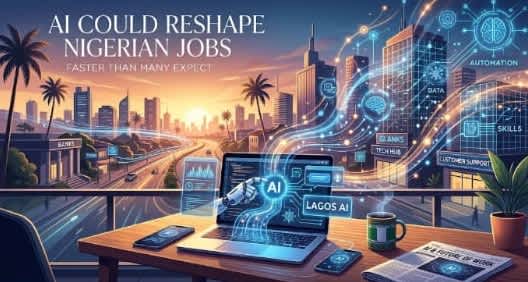
For many Nigerians, artificial intelligence still feels like a distant conversation happening in Silicon Valley boardrooms and global tech hubs. Inflation, unemployment, and the rising cost of living remain far more immediate concerns. Yet AI has moved from being a distant prospect to an active force shaping today's workplace. Businesses are increasingly automating routine work and reassessing the talent required to stay competitive.
The focus now shifts to readiness: whether Nigerian workers, businesses, and policymakers can keep pace with the speed of this change.
Why the “It Won’t Affect Us” Argument Is Losing Ground
Nigeria’s infrastructure challenges are often cited as a buffer against automation. Unstable electricity, uneven internet access, and limited technological adoption have long slowed digital transformation. AI, however, is different. Many of today’s most powerful tools require little more than a smartphone, a laptop, and an internet connection.
Businesses can now access applications that write reports, summarize documents, respond to customer inquiries, generate marketing copy, and assist with software development. Unlike traditional automation, these tools do not require expensive factories or specialized machinery, making adoption far easier and more affordable.
The Roles Facing the Greatest Disruption
Customer service is among the sectors already feeling the impact. Banks, telecommunications companies, and fintech firms increasingly rely on chatbots and AI-powered assistants to handle routine inquiries, reducing the need for large support teams.
Content creation is also evolving rapidly. AI tools can produce product descriptions, social media captions, marketing emails, and basic articles within minutes. Administrative and data-entry roles are being streamlined as software takes over repetitive tasks such as form processing, record organization, and scheduling.
Transcription, translation, routine bookkeeping, entry-level coding, and basic graphic design are undergoing similar changes, with AI reducing the time and manpower required to complete assignments.
For many young Nigerians, that presents a significant concern. These jobs often serve as entry points into the formal economy, providing graduates with critical experience before advancing into higher-level roles.
Why Nigeria May Feel the Pressure Deeply
Each year, thousands of graduates enter an already competitive labour market. If businesses increasingly automate entry-level responsibilities, the pathway into formal employment could become even narrower.
The pressure extends beyond traditional office jobs. Many Nigerians earning foreign currency through freelance platforms now compete not only with other professionals but also with AI systems capable of delivering routine work at a fraction of the cost. Writers, virtual assistants, designers, and transcriptionists are among those witnessing this shift firsthand.
Businesses, meanwhile, have strong incentives to embrace automation. Rising operating costs and persistent economic pressures make productivity-enhancing technologies increasingly attractive, especially when they promise to reduce expenses.
Not Every Profession Is Under Threat
The rise of AI does not mean the end of work. Occupations that require hands-on expertise, physical presence, and human judgment remain far more difficult to automate. Electricians, mechanics, farmers, builders, nurses, and skilled artisans continue to perform work that software cannot easily replicate.
History also suggests that technological disruption often creates new opportunities even as it renders some roles less relevant. The challenge lies in helping workers adapt quickly enough to take advantage of those opportunities.
What Needs to Happen Next
Businesses must view AI as a tool for augmentation rather than simply a means of reducing headcount. Investing in employee training and helping workers collaborate with emerging technologies will be essential for long-term competitiveness.
The government also has a critical role to play. Expanding digital education, improving access to technology training, and strengthening internet and power infrastructure could help ensure that more Nigerians benefit from technological change rather than becoming casualties of it.
Workers, meanwhile, may need to rethink career resilience. Technical literacy, critical thinking, communication skills, and industry-specific expertise are becoming increasingly valuable in a workplace where AI can handle many routine tasks.
Conclusion
AI is unlikely to wake up tomorrow and take everyone's job. What it is doing, however, is changing the value of certain skills faster than many people expected. For graduates, freelancers, and workers in routine digital roles, that shift may arrive sooner rather than later.
The good news? Humans still have an advantage. Curiosity, creativity, critical thinking, and adaptability are much harder to automate than repetitive tasks. In a world where AI can write emails, generate images, and answer questions in seconds, the people who stand out will be those who can do what AI cannot: think differently, solve real problems, and keep learning.
The AI era has already arrived, bringing new opportunities alongside new challenges. As workplaces evolve and skill requirements continue to shift, adaptability and continuous learning will become increasingly important. How well Nigeria responds to these changes could shape the future of work for millions of people in the years ahead.
Found this useful? Share it
Help friends, family and colleagues stay informed on Nigerian finance.
Keep reading
Related Topics





Conversation
Comments (0)
Sign in to join the conversation or like this post.

Elizabeth Ayoola
Elizabeth is a finance analyst and writer passionate about making financial markets accessible to everyday readers.
She has a deep interest in global markets, crypto, and everything shaping the financial world. She writes to simplify complex financial topics, turning them into practical, accessible insights for everyday readers.
114
Stories
40890
Reads
1
Likes
0
Comments