
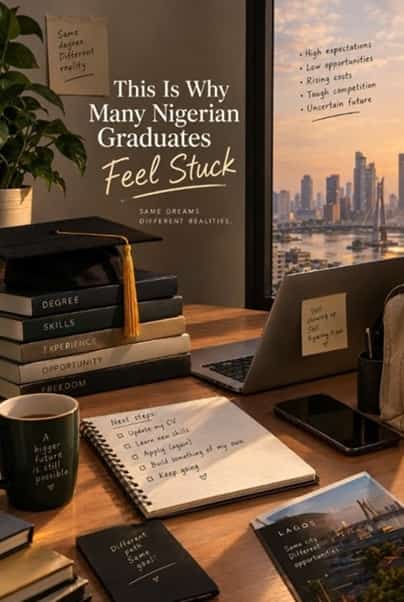
After enduring years of lectures. Assignments pulled off at 2am. Project defences that felt like final judgement day. Convocation, the gown, the photos, the pride on your parents' faces. It feels like you've done everything you were told to do.
For many Nigerian graduates, bagging a university degree was meant to be the gateway to opportunities, financial independence, and a better future. It was a promise repeated by parents, teachers, and society at large.
Then graduation arrives, and reality looks very different. Job applications go unanswered. Entry-level roles demand experience. Bills begin to show up before income does. Months pass, sometimes longer, and the future that once felt just around the corner starts to feel strangely out of reach.
That is the reason why a large number of graduates end up feeling trapped. Not necessarily because they're lazy, unqualified, or doing something wrong, but because they're navigating a difficult mix of economic realities, labour market pressures, and expectations that no longer match the world they're entering.
1. The gap between education and the ability to get a job
A major reason why graduates end up stuck is not because they are lazy or have bad luck but because there is a mismatch. What gets taught in many Nigerian university programs and what employers actually need often don't line up.
Many degree programs are still heavy on theory: memorize this, write the exam, and move on. Real-world problem-solving, hands-on projects, and actual industry exposure – that part gets thin, sometimes skipped entirely. So graduates walk out with a certificate in hand, but not always the technical skills or workplace experience that make an employer say yes.
And the goalposts keep moving. Today's job market wants digital skills, data analysis, communication, project management, and critical thinking; things that show up more in job descriptions than in most lecture halls. A lot of graduates only discover this gap after they're already job hunting, CV in hand, wondering why "First Class" isn't opening doors the way it was supposed to.
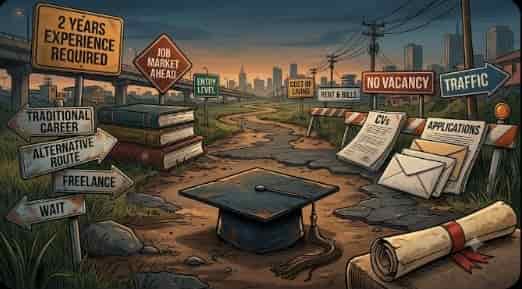
Then there's the line that sums up the whole frustration perfectly: "Eligibility: Graduate. Two years experience." It's almost a joke at this point, except it isn't. Employers want people who've already done the job, while fresh graduates are stuck trying to get their first shot at doing it at all. Oftentimes, nobody explains how you're supposed to gain experience, and most times nobody gives you the chance to gain it.
2. The labour market is so saturated
Every year, Nigerian universities and other higher institutions produce thousands of graduates. The issue is that job creation hasn't kept pace with the growing number of degree holders; this leads to intense competition for a small number of quality jobs.
A single job opening can attract hundreds or even thousands of applications. This means that even highly qualified graduates may spend months, sometimes years, searching for employment without success.
So you're competing in a market where the number of job seekers can far exceed the number of suitable opportunities. And the situation becomes even more difficult when the broader economy slows down. Businesses facing rising costs and economic uncertainty may slow hiring, delay expansion plans, or prioritize experienced candidates over fresh graduates.
This shows up in very specific ways. A graduate trainee opening at a bank might attract thousands of applications for a handful of slots. It's not that you're not good enough; rather, "good enough" now has to clear a bar set by sheer volume, not just by merit, and that is a brutal, exhausting way to job hunt.
3. The increasing cost of living and the resulting financial pressure
Graduation comes with expectations; for many families, getting a degree is supposed to be the beginning of financial independence. In some cases, it's also when relatives expect you to start contributing at home.
The issue here is many graduates are stepping into an economy where rent is rising, transportation is expensive, and everyday necessities cost more than they used to. Getting a job doesn't automatically solve the problem.
Some graduates spend months relying on parents or relatives for support. Others find work only to discover that an entry-level salary doesn't stretch very far. It's hard to feel like you're moving forward when most of your energy goes into simply keeping up.
4. The absence of career guidance and mentorship
A lot of Nigerian students complete their education without receiving proper career guidance. Many choose courses based on societal pressure, parental influence, or limited information about employment opportunities. After graduation, they might struggle to identify clear career paths or understand how to position themselves in the labour market. You can be brilliant on paper and still have no idea how the labour market actually works, what roles exist, what skills matter, how to even start.
"Follow who know road." That's wisdom, and it's true. At times, the difference between taking two years to work out the answers and making real progress in six months is simply having a person who has already travelled the route you're trying to walk.
For many young people, access to such guidance is limited: no uncle in the industry, no professor who is interested in them, and no structured mentorship program at school. Without it, graduates end up learning by trial and error what a mentor could've told them in one honest conversation, repeating avoidable mistakes, missing opportunities that were right there, and staying blind to entire industries where their skills would've actually been valued.
5. Social media leads to continuous comparison.
Open Instagram, open LinkedIn, and there it is. A new job announcement. Someone's Dubai trip. "I got my master's admission." "I'm happy to announce that I just got a new position." Every day, it's another milestone, another achievement, another reminder that everyone else seems to be moving while you're standing still.
These wins are real; nobody's saying they're fake. But social media has a way of showing only the highlight reel. Nobody posts, "I've sent 40 applications and heard nothing back."
Nobody announces the rejection emails, the months of doubt, or the quiet struggle behind that one shiny "excited to announce" post. You're comparing your full, messy, complicated reality to everyone else's carefully edited best moments, and that's not a fair fight for anyone.
What this leads to is a sort of psychological burden that's easy to underestimate. Constant comparison can make you feel like you're falling behind even when you're genuinely making progress, just on your own timeline. And that creeping sense that everyone else has figured it out except you ends up being one of the biggest reasons the "stuck" feeling sticks around, even for people who are actually doing fine.
6. The fear of choosing alternative paths
Many graduates were conditioned to believe that success follows a specific route: graduate, get a corporate job, get promoted, and build a career. The reality is that the economy no longer works the way that career script assumes.
Entrepreneurship, freelancing, remote work, digital services, vocational skills, and the creator economy are becoming viable options for income and wealth creation. Yet some graduates remain fixated on traditional opportunities and overlook alternatives that could provide financial stability and career growth.
Many graduates reject opportunities because they don't look like the version of success they imagined. Fear of uncertainty often keeps them waiting for opportunities that may never arrive.
The Way Forward
If you're a graduate who feels stuck, it's worth remembering that some of what's frustrating you is personal, but a lot of it is structural. You're entering a labour market that is more competitive than the one many of your parents graduated into. You're dealing with rising living costs, fewer entry-level opportunities, and an economy that often demands experience before it offers opportunity.
That doesn't mean you stop trying; you just have to stop treating every setback as proof that you've failed. A degree still matters. But today it's often the beginning of the journey rather than the thing that guarantees the outcome. The graduates who move forward are usually the ones who keep learning, keep adapting, and stay open to opportunities that don't always look the way they expected.
Feeling stuck doesn't mean you're broken, sometimes it simply means you're navigating a system that's harder than anyone prepared you for. You're not behind some imaginary schedule everyone else is quietly keeping to, you're navigating a genuinely difficult system, and recognizing that it is the first real step toward moving through it, one deliberate decision at a time.
Keep reading
Related Topics



Conversation
Comments (0)
Sign in to join the conversation or like this post.

Elizabeth Ayoola
Elizabeth is a finance analyst and writer passionate about making financial markets accessible to everyday readers.
She has a deep interest in global markets, crypto, and everything shaping the financial world. She writes to simplify complex financial topics, turning them into practical, accessible insights for everyday readers.
102
Stories
31703
Reads
1
Likes
0
Comments