
The Average ATM Withdrawal Jumped 54% in a Year. Are Nigerians Going Back to Cash?

Nigeria's payments story for the last three years has been "cashless, cashless, cashless". Transfers for everything, POS on every corner. So one number in the Central Bank's Q1 2026 payment data caught our eye.
The total value of ATM withdrawals in January to March 2026 was ₦26.30 trillion. A year earlier, Q1 2025, it was ₦15.97 trillion. That's up 65%.
Bigger withdrawals, not many more of them
The number of ATM transactions only went up 6.6%, from 411.42 million to 438.59 million. So the growth is almost entirely about how much people take out each time:
| Q1 2025 | Q1 2026 | Change | |
|---|---|---|---|
| ATM transactions | 411.42m | 438.59m | +6.6% |
| ATM value | ₦15.97trn | ₦26.30trn | +64.7% |
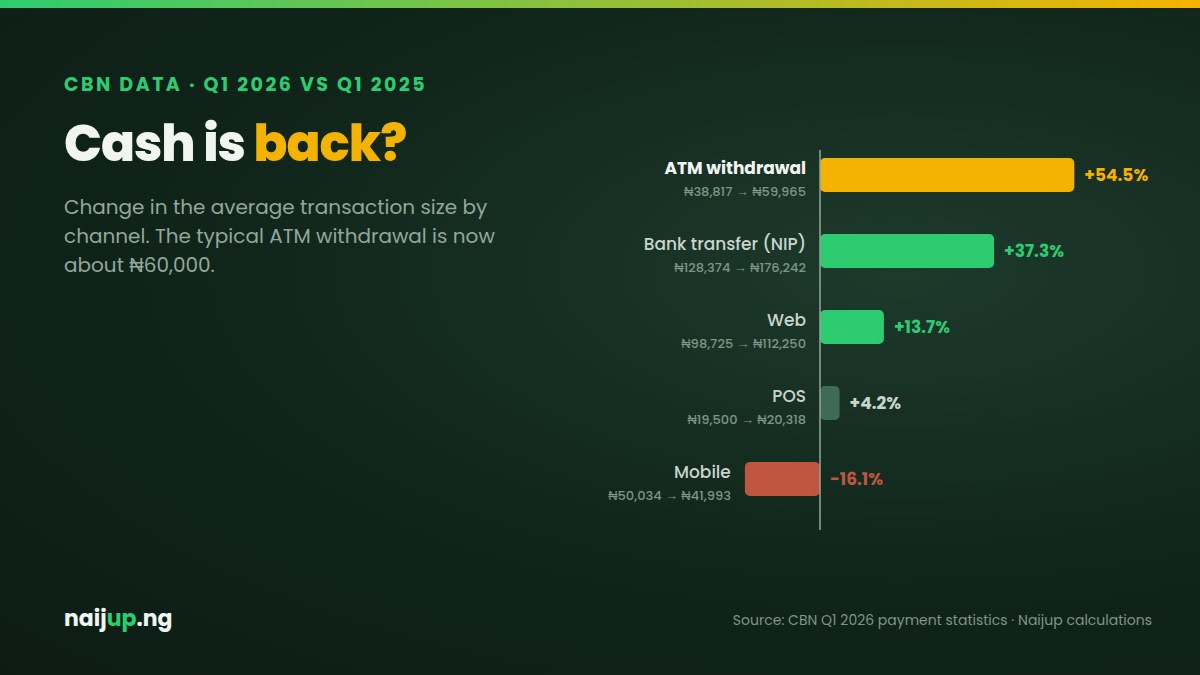
| Average per withdrawal | ₦38,817 | ₦59,965 | +54.5% |
Part of this is simple: inflation means you need more naira for the same things. But headline inflation was 14.63% in September 2026 (NBS), nowhere near 54%. Something else is going on.
Here's the full picture, channel by channel
We worked out the average transaction size for each payment channel from the CBN data:
| Channel | Transactions, change | Value, change | Avg Q1 2025 | Avg Q1 2026 | Avg, change |
|---|---|---|---|---|---|
| ATM | +6.6% | +64.7% | ₦38,817 | ₦59,965 | +54.5% |
| Instant transfers (NIP) | −18.0% | +12.6% | ₦128,374 | ₦176,242 | +37.3% |
| Web | −14.2% | −2.4% | ₦98,725 | ₦112,250 | +13.7% |
| POS | −19.8% | −16.4% | ₦19,500 | ₦20,318 | +4.2% |
| Mobile (USSD/app) | +28.4% | +7.7% | ₦50,034 | ₦41,993 | −16.1% |
| All channels | −9.2% | +2.9% | ₦73,988 | ₦83,795 | +13.3% |
Three patterns stand out.
1. Fewer bank transfers, but bigger ones
The number of instant transfers fell 18% (from 2.22 billion to 1.82 billion), but the money moved went up 12.6%. The average transfer is now about ₦176,000.
That's a strange combination if you think everyone is just doing more transfers. Our best explanation: the small, everyday transfers (₦2,000 for suya, ₦5,000 for transport) are moving off bank transfers and onto mobile and fintech wallets, and some back to cash. What's left on NIP is the bigger stuff: rent, salaries, business payments.
The ₦50 levy on electronic transfers of ₦10,000 and above may also be pushing people to batch payments into fewer, bigger transfers.
2. Mobile is taking the small payments
Mobile transactions were the only big channel that grew in number: +28.4%. But the average mobile transaction got smaller, from ₦50,034 to ₦41,993. That's exactly what you'd expect if mobile apps and wallets are picking up the small, frequent payments that used to go through bank transfers.
3. POS: depends who you ask
The CBN figures show POS falling: 19.8% fewer transactions, 16.4% less value. But other NIBSS-based figures (reported by FDC) show POS value up 62.5% in the first half of 2026 compared with the first half of 2025.
These two series measure POS differently and we can't reconcile them, so we're not going to claim POS is falling. What we can say is that the average POS transaction barely moved in either case, at about ₦20,000.
So are Nigerians going back to cash?
Partly, maybe. The honest answer is:
• People who use ATMs are taking out much bigger amounts. That points to more cash being kept at home or used for bigger payments, possibly to avoid transfer charges, possibly because some traders give discounts for cash, possibly because people don't trust that a transfer will "drop" on time.
• But ATMs are still small next to electronic payments. ₦26.3 trillion in ATM withdrawals against ₦320.8 trillion in instant transfers in the same quarter. Cash isn't winning. It's just not dying as fast as the "cashless" story suggested.
What this means for you
• Check your charges. If you're splitting big payments into many small transfers, the stamp duty / transfer levy on each one adds up. One bigger transfer can be cheaper.
• Large cash at home is a security risk. If you're withdrawing more because transfers fail, report failed transfers to your bank in writing. Reversal timelines are set by CBN rules.
• For small business owners: if your customers prefer cash, a POS terminal still makes sense because many of them withdraw cash at POS agents. Those are counted as POS transactions, not ATM.
Do you carry more cash now than a year ago? Or less? We're curious if this matches what you see.
Quick FAQ
How much was withdrawn from ATMs in Nigeria in Q1 2026?
₦26.30 trillion across 438.59 million transactions, according to the CBN's Q1 2026 data, up from ₦15.97 trillion in Q1 2025.
What is the average bank transfer amount in Nigeria?
About ₦176,242 per NIP instant transfer in Q1 2026, up from ₦128,374 a year earlier (Naijup calculation from CBN data).
Are POS transactions falling in Nigeria?
It depends on the data source. CBN figures show POS value down 16.4% in Q1 2026, while NIBSS-based figures reported by FDC show POS value up 62.5% in H1 2026. The two use different definitions.
Data source: CBN Q1 2026 payment statistics (as reported by Vanguard), and NIBSS-based monthly figures reported by FDC/New Telegraph. Average transaction values are Naijup calculations: value ÷ number of transactions. We haven't been able to access NIBSS's own statistics portal, which requires login.
Found this useful? Share it
Help friends, family and colleagues stay informed on Nigerian finance.
Keep reading
Related Topics

Conversation
Comments (0)
Sign in to join the conversation or like this post.

Mujeeb Olagunju
I am a finance professional with a strong background in economics and financial technology.,My work centers on building systems that support payments, digital banking, and investment solutions in emerging markets.,I have experience with risk management, transaction monitoring, fraud prevention, and the design of scalable financial products tailored to both retail and institutional clients.,With over 8 years of industry experience, I combine financial insight with technical expertise to deliver solutions that balance compliance, security, and business growth.,My goal is to bridge the gap between finance and technology, creating platforms that expand access to modern financial services and strengthen trust in digital finance.
94
Stories
30466
Reads
0
Likes
0
Comments