
PFAs Bought 70% More Treasury Bills This Year. Here's Where Else Your Pension Money Moved

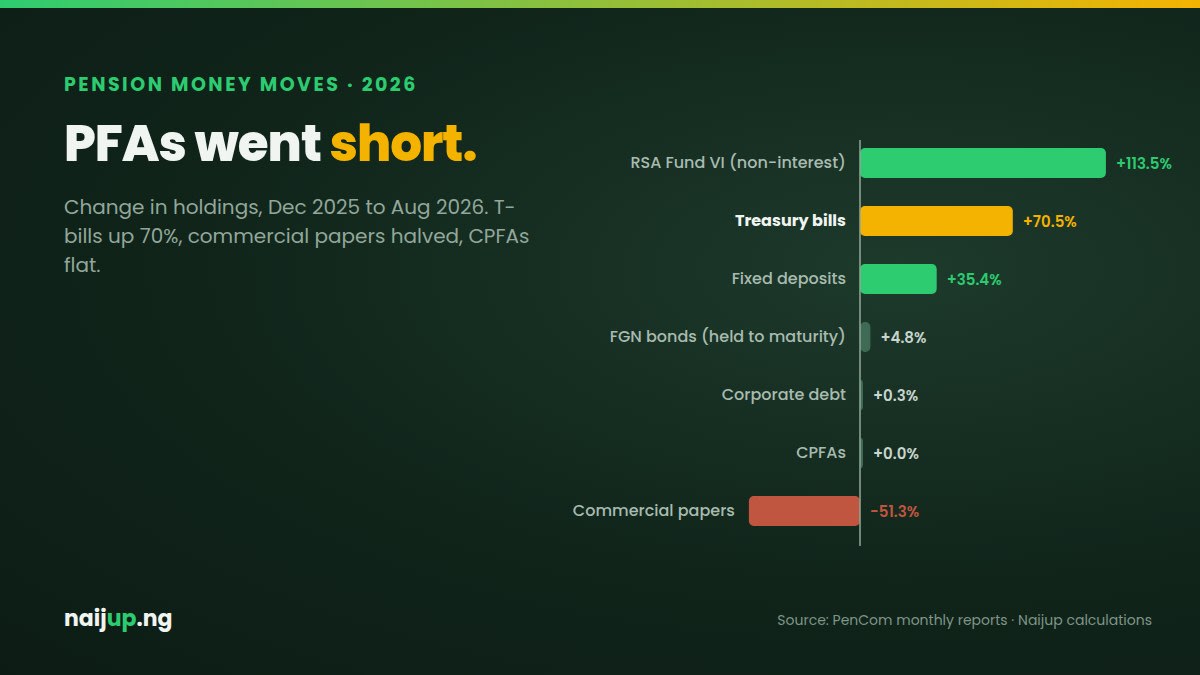
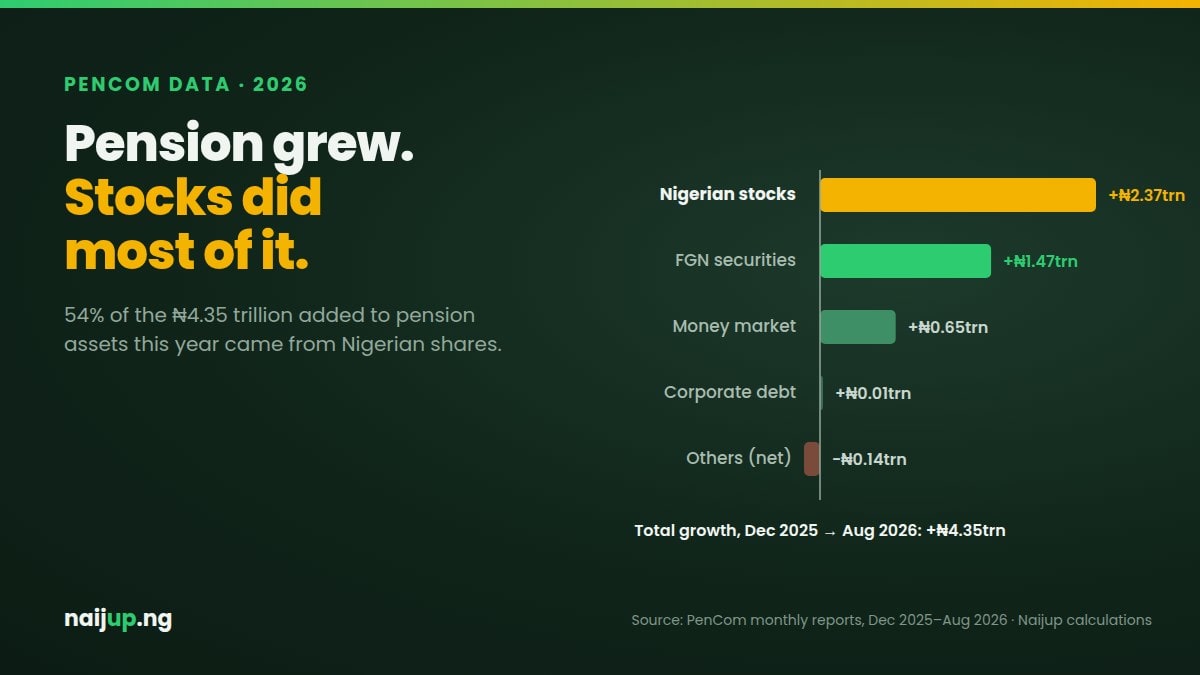
Ask most people where their pension money goes and they'll say "government bonds". And that's mostly true. But inside that big pile, 2026 has seen some quiet but real shifts. We went through PenCom's monthly reports from December 2025 to August 2026 to see what PFAs have actually been doing with ₦31.8 trillion.
Government securities: still king, but shrinking as a share
FGN securities (bonds, treasury bills, sukuk and the rest) are still the biggest home for pension money, ₦17.80 trillion in August. PFAs actually added ₦1.47 trillion of them this year.
But because everything else grew faster (mostly stocks), the government's share dropped:
• December 2025: 59.5% of pension assets
• August 2026: 56.0%
If the share had stayed at 59.5%, pension funds would be holding about ₦1.12 trillion more in government paper today. That's money that went somewhere else instead, mostly into shares.
The interesting bit: short-term over long-term
Within government securities, PFAs have clearly been leaning short.
| Holding | Dec 2025 (₦bn) | Aug 2026 (₦bn) | Change |
|---|---|---|---|
| Treasury bills | 761.09 | 1,297.85 | +70.5% |
| FGN bonds held to maturity | 12,832.89 | 13,443.44 | +4.8% |
| FGN bonds (available for sale) | 2,629.81 | 2,967.69 | +12.8% |
| Sukuk | 85.01 | 78.43 | −7.7% |
| Green bonds | 16.51 | 7.45 | −54.9% |
T-bills mature in a year or less. Long bonds held to maturity lock money in for years. When fund managers pile into short-term paper, it usually means one of two things: they think rates might go higher and don't want to be stuck at today's yields, or they want cash on hand to move into something else quickly, like stocks.
Money market holdings tell a similar story. Fixed deposits and bankers' acceptances went from ₦2.27 trillion to ₦3.07 trillion (+35%). PFAs are keeping a lot more money liquid than they were in December.
Corporate bonds went nowhere
Corporate debt was ₦2,204.52 billion in December and ₦2,210.91 billion in August. That's basically zero growth (+0.3%) while total assets grew 15.9%. Its share fell from 8.0% to 7.0%.
This matters beyond pensions. Nigerian companies that want to borrow long-term money through bonds rely heavily on pension funds to buy. If PFAs aren't adding, companies have a harder time raising that kind of money.
Corporate commercial papers fell even more, from ₦306.99 billion to ₦149.56 billion. That's less than half in eight months.
The one small bright spot: corporate infrastructure bonds roughly doubled, from ₦37.19 billion to ₦76.17 billion. Still tiny next to ₦31.8 trillion, but it's moving.
Two funds tell opposite stories
RSA Fund VI (non-interest) more than doubled: from ₦218.84 billion to ₦467.23 billion (+113%). It's still small, but it's growing faster than any other fund. The rise of Fund VI matches what's happening at Jaiz, Lotus Halal ETF and other non-interest products. More Nigerians want Shariah-compliant options and they're choosing them.
CPFAs didn't grow at all. Closed Pension Fund Administrators manage the pension schemes of a handful of big companies (the ones allowed to run their own). Their assets were ₦2,694.29 billion in December and ₦2,694.55 billion in August, flat for eight months while the rest of the industry grew 15.9%. They hold very little in stocks (5.2% in August), so they missed the equity rally, and they're paying out pensions to retirees steadily.
Which PFAs new workers are choosing
PenCom doesn't publish assets per PFA in its monthly reports, but its Q1 2026 report does show who opened the most new RSAs. Out of 143,248 new accounts in Q1:
| PFA | New RSAs (Q1 2026) | Share |
|---|---|---|
| Stanbic IBTC | 25,024 | 17.5% |
| AccessARM | 15,234 | 10.6% |
| FCMB | 14,542 | 10.2% |
| TangerineAPT | 13,827 | 9.7% |
| Trustfund | 9,638 | 6.7% |
| Leadway Pensure | 9,376 | 6.5% |
The other 14 PFAs shared the remaining 39%. At the bottom, NPF Pensions opened 353 and Parthian 441.
The top five took 54.4% of new accounts in Q1, down from 62.1% in Q4 2025. So smaller PFAs did win a bit more of the new business. Still, Stanbic IBTC alone signed up more new workers than the bottom nine PFAs combined.
One thing that should worry PenCom
The Personal Pension Plan (PPP), the scheme for informal workers, traders and self-employed people, has 219,316 accounts, but only 18,811 of them have any money in them. That's 8.6% funded. In other words, more than 9 in 10 people who signed up for the informal sector pension never made a payment.
A few PFAs do better: Fidelity says 87% of its PPP accounts are funded, GT Pension 54%. But the industry average is terrible. Opening an account isn't the problem. Getting people to put money in is.
What this means for you
• If you're expecting your pension to be "safe in government bonds", that's still the bulk of it, but less than it used to be. Check your fund type.
• If you're self-employed, the PPP exists and you can open one, but it only helps if you actually fund it. Even small monthly amounts add up over 20 years.
• If you want non-interest, Fund VI is now a real option, not a tiny experiment. Ask your PFA about switching.
Quick FAQ
Where do Nigerian pension funds invest most of their money?
About 56% of pension assets (₦17.80 trillion in August 2026) are in Federal Government securities, mostly FGN bonds. Domestic shares are the second largest at about 19.9%.
Which PFA has the most new customers in 2026?
Stanbic IBTC Pension Managers opened 25,024 new RSAs in Q1 2026, 17.5% of all new accounts, according to PenCom.
What is RSA Fund VI?
It's the non-interest (Shariah-compliant) pension fund. Its assets grew from ₦218.84 billion in December 2025 to ₦467.23 billion in August 2026.
Data source: PenCom Monthly Unaudited Reports on the Pension Fund Industry Portfolio (December 2025 to August 2026) and PenCom Q1 2026 Quarterly Industry Report. Percentages and comparisons are Naijup calculations.
Found this useful? Share it
Help friends, family and colleagues stay informed on Nigerian finance.
Keep reading
Related Topics

Conversation
Comments (0)
Sign in to join the conversation or like this post.

Mujeeb Olagunju
I am a finance professional with a strong background in economics and financial technology.,My work centers on building systems that support payments, digital banking, and investment solutions in emerging markets.,I have experience with risk management, transaction monitoring, fraud prevention, and the design of scalable financial products tailored to both retail and institutional clients.,With over 8 years of industry experience, I combine financial insight with technical expertise to deliver solutions that balance compliance, security, and business growth.,My goal is to bridge the gap between finance and technology, creating platforms that expand access to modern financial services and strengthen trust in digital finance.
94
Stories
30466
Reads
0
Likes
0
Comments