
Kano DisCo Got 17.5% More Power in Q2 and Still Collected Less Money

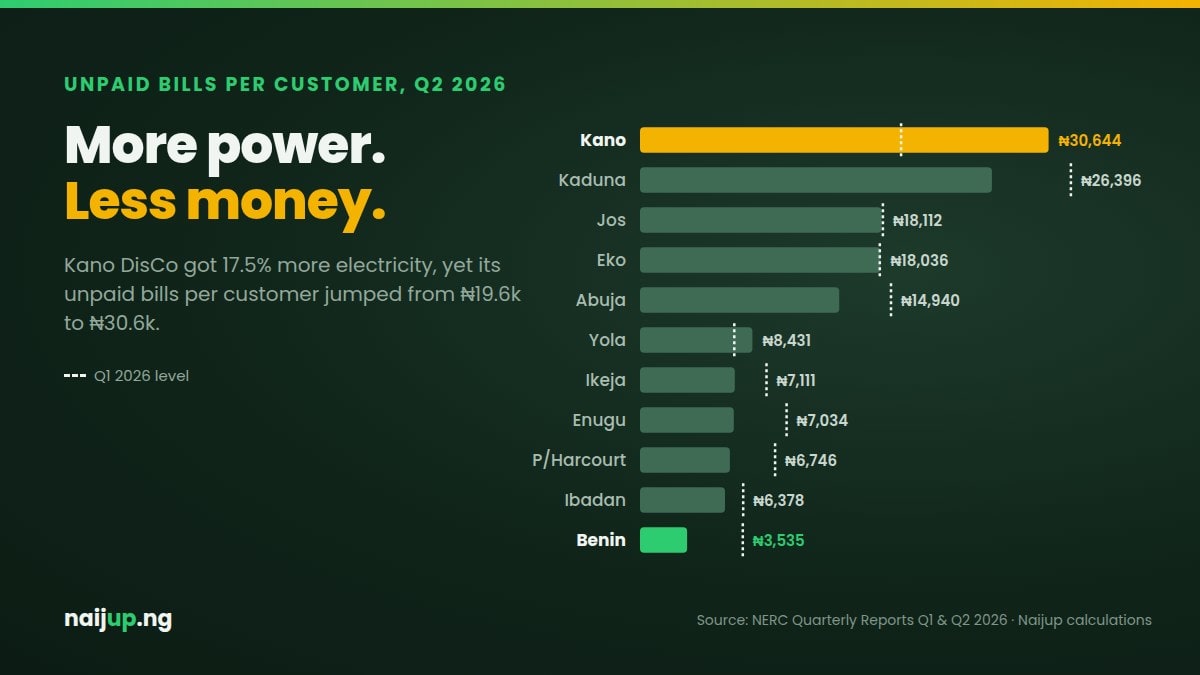
Normally, more electricity should mean more money. The DisCo gets more power, it sells more, customers pay more. Simple.
Kano didn't work like that in Q2 2026.
According to NERC's Q2 2026 report, Kano DisCo's average power offtake went up from 168.95 MWh/h to 198.50 MWh/h between Q1 and Q2. That's about 17.5% more power. The value of energy it received rose from ₦48.02 billion to ₦57.04 billion. It billed customers more too: ₦47.27 billion, up from ₦42.02 billion.
But the cash it collected fell, from ₦26.37 billion to ₦22.57 billion.
Kano went backwards on almost every measure
| Kano DisCo | Q1 2026 | Q2 2026 |
|---|---|---|
| Collection efficiency | 62.76% | 47.74% |
| ATC&C losses | 45.08% | 60.43% |
| Market remittance paid | 85.07% | 67.28% |
| Unpaid bills | ₦15.65bn | ₦24.70bn |
Collection efficiency of 47.74% means that for every ₦100 Kano DisCo billed, it got back less than ₦48. It's the lowest of the 11 DisCos in Q2. The jump in ATC&C losses (the share of power that never turns into cash, from technical loss, theft or unpaid bills) was 15.35 percentage points in one quarter. No other DisCo moved that much in either direction.
The NERC report doesn't explain the drop. But more power going into a network where 59% of customers have no meter is a fair place to start looking. More supply to unmetered customers means bigger estimated bills, and bigger estimated bills tend to go unpaid.
Unpaid bills per customer: the full ranking
Totals favour the big DisCos, so we divided each DisCo's unpaid bills (billed minus collected) by its number of active customers. It's a rough measure because it includes customers who pay in full, but it shows the scale of the problem in each area.
| Rank | DisCo | Unpaid bills Q2 (₦bn) | Per customer, Q1 | Per customer, Q2 |
|---|---|---|---|---|
| 1 | Kano | 24.70 | ₦19,585 | ₦30,644 |
| 2 | Kaduna | 14.66 | ₦32,315 | ₦26,396 |
| 3 | Jos | 15.01 | ₦18,217 | ₦18,112 |
| 4 | Eko | 12.36 | ₦17,985 | ₦18,036 |
| 5 | Abuja | 20.97 | ₦18,826 | ₦14,940 |
| 6 | Yola | 4.33 | ₦7,076 | ₦8,431 |
| 7 | Ikeja | 9.58 | ₦9,487 | ₦7,111 |
| 8 | Enugu | 11.79 | ₦10,993 | ₦7,034 |
| 9 | Port Harcourt | 7.38 | ₦10,129 | ₦6,746 |
| 10 | Ibadan | 16.18 | ₦7,738 | ₦6,378 |
| 11 | Benin | 4.04 | ₦7,712 | ₦3,535 |
Across all 11 DisCos it comes to about ₦11,200 per customer, down from ₦12,866 in Q1. So the sector got slightly better overall. Kano is the main exception.
Eko surprised us. It has the best metering rate in the country (88.7%), but its unpaid bill per customer is 4th highest. That's partly because Eko customers use a lot more power per head, so even an 89% collection rate leaves a big naira gap.
Benin: the quiet winner
If there's a "most improved" DisCo this quarter, it's Benin.
• Collection efficiency went from 85.16% to 92.68%, the highest of all 11 DisCos
• Unpaid bills per customer more than halved, from ₦7,712 to ₦3,535
• ATC&C losses dropped from 39.71% to 33.84%
• It paid 100% of its market invoice
Here's what makes it interesting: 39% of Benin's customers still don't have a meter. That's a worse metering rate than Ikeja, Eko, Abuja or Port Harcourt. Yet Benin out-collected all of them. So meters aren't the whole story. How a DisCo handles billing disputes and enforcement clearly matters too.
Other improvements worth noting:
• Enugu: collection efficiency up 9.03 points (70.49% → 79.52%), unpaid bills down ₦6.38bn
• Ibadan: ATC&C losses down 8.07 points (48.10% → 40.03%), the biggest loss reduction
• Yola: market remittance up from 83.63% to 99.74%
Meter rollout slowed, and Ikeja almost stopped
DisCos installed 350,270 meters in Q2, compared with 426,985 in Q1 (that Q1 figure was revised up in the Q2 report, from 357,495 first reported). The national metering rate is now 61.51%, meaning about 4.85 million active customers still have no meter.
The slowdown was sharpest in Ikeja: from 46,330 meters in Q1 to just 7,842 in Q2. That's an 83% drop. Ikeja is already at 87.9% metered, so maybe it's hitting the hard-to-reach last customers. Eko also slowed a lot, from 39,251 to 17,862.
Meanwhile, the DisCos with the most unmetered customers are still installing slowly:
| DisCo | Unmetered customers | % unmetered | Meters installed Q2 |
|---|---|---|---|
| Ibadan | 1,075,091 | 42.4% | 102,090 |
| Enugu | 805,223 | 48.0% | 17,645 |
| Jos | 535,228 | 64.6% | 9,177 |
| Kano | 478,187 | 59.3% | 18,983 |
| Benin | 445,514 | 39.0% | 59,969 |
At Jos's Q2 pace of about 9,200 meters a quarter, it would take more than 14 years to meter its current customers. And that's without new customers joining. Ibadan is the only big unmetered DisCo installing at real scale.
What to take from this
1. More supply doesn't fix a DisCo's finances by itself. Kano proves it. If billing is on estimates and people don't trust it, extra power just turns into extra debt.
2. Collections can improve without full metering. Benin and Enugu both improved a lot this quarter without being near full metering.
3. If you're unmetered, apply anyway. The meter queue is slow, but you can't get one without applying. In some DisCos, MAP (Meter Asset Provider) meters come faster than the free government ones.
Do you live in the Kano DisCo network (Kano, Jigawa, Katsina)? Has your supply improved since April? We'd like to hear if the extra power reached you.
Quick FAQ
Which DisCo has the worst collection rate in Nigeria?
In Q2 2026, Kano DisCo collected 47.74% of its bills, the lowest of the 11 DisCos, according to NERC.
Which DisCo collected the most efficiently in Q2 2026?
Benin DisCo, at 92.68%, followed by Ikeja at 92.20%.
How many electricity customers in Nigeria have meters?
7.74 million of 12.59 million active customers (61.51%) were metered as at 30 June 2026.
Data source: NERC Quarterly Reports, Q1 2026 and Q2 2026 (billing, collection, ATC&C, remittance and metering tables). Per-customer figures are Naijup calculations: (amount billed − amount collected) ÷ active customers.
Found this useful? Share it
Help friends, family and colleagues stay informed on Nigerian finance.
Keep reading
Related Topics
Conversation
Comments (0)
Sign in to join the conversation or like this post.

Mujeeb Olagunju
I am a finance professional with a strong background in economics and financial technology.,My work centers on building systems that support payments, digital banking, and investment solutions in emerging markets.,I have experience with risk management, transaction monitoring, fraud prevention, and the design of scalable financial products tailored to both retail and institutional clients.,With over 8 years of industry experience, I combine financial insight with technical expertise to deliver solutions that balance compliance, security, and business growth.,My goal is to bridge the gap between finance and technology, creating platforms that expand access to modern financial services and strengthen trust in digital finance.
94
Stories
30466
Reads
0
Likes
0
Comments