
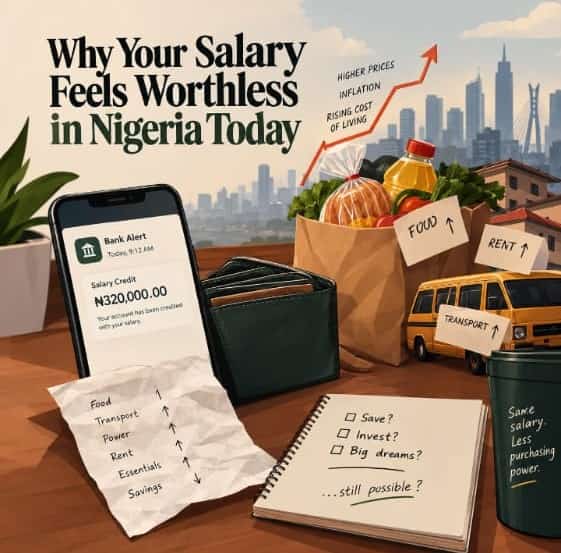
There’s a particular kind of exhaustion that comes with checking your bank balance the day after payday and feeling as though payday happened weeks ago. You didn’t take a pay cut. Your job title didn’t change. Yet your money seems to move differently than it used to, thinner, faster, and less forgiving.
The feeling isn’t in your head. For many workers, a widening gap between how quickly prices rise and how slowly wages catch up has made it harder to keep up financially.
Understanding that gap is the first step toward realizing that the problem is not necessarily your spending habits or financial discipline.
The paycheck illusion
Inflation plays a strange psychological trick on people. The number in your salary alert looks the same as it did before, or perhaps even slightly larger, so part of your brain interprets that as progress.
But a salary figure on its own does not tell you what that income is actually worth. Real value comes from what money can buy. Once the cost of everyday life changes, the meaning of the number changes too.
In practical terms, you are not simply spending naira; you are spending purchasing power. A decline in purchasing power means the same amount of money buys less food, less transportation, less housing, and fewer opportunities.
The gap between what your salary says on paper and what it can actually provide is where the feeling of financial worthlessness begins.
Prices move every day. Salaries don’t.
Timing is one of the biggest problems.
Food prices, transport fares, utility bills, and rent can change almost overnight, influenced by fuel costs, exchange-rate movements, supply-chain disruptions, and broader economic conditions. Salaries, on the other hand, are often reviewed annually, if they are reviewed at all.
By the time a salary increase arrives, prices may have already moved higher. The same salary can then continue losing purchasing power in the meantime, which buys less than it did before.
No dramatic moment announces the shift. Purchasing power simply weakens month after month until the impact becomes impossible to ignore.
Food and rent absorb the shock first
Food and housing are among the biggest household expenses, and both can become significantly more expensive as prices rise. Unlike discretionary spending, neither category can be eliminated. Everyone needs to eat. Everyone needs a place to live.
A larger portion of income goes toward essentials as prices rise. A salary that once supported a comfortable lifestyle begins to support only basic survival. Savings, investments, leisure activities, and long-term goals are often the first casualties.
Transportation follows closely behind. Every commute, delivery, and market trip becomes more expensive, adding another layer of pressure to already strained household budgets. Over time, even the cost of getting to work begins to feel burdensome.
The invisible currency tax
A large share of consumer goods, industrial inputs, and fuel is either imported directly or priced against foreign currencies. When the naira weakens, the resulting increase in costs can feel like an invisible tax on purchasing power.
Higher costs spread through the supply chain whenever the currency weakens. Supermarket shelves, utility bills, and transport fares eventually reflect the increase.
Salaried workers have little direct influence over exchange-rate policy or monetary decisions, yet they experience the consequences daily. A shopping basket that cost a certain amount a year ago may now cost significantly more despite containing exactly the same items.
A slowdown in inflation is not the same as relief
One of the most misunderstood economic concepts is the difference between slower inflation and lower prices.
Many people assume that easing inflation will make goods and services more affordable. Reality works differently. Easing inflation usually means prices are still rising, just not as quickly as before.
A car slowing from 120 km/h to 80 km/h provides a useful comparison. Lower speed does not mean the car has stopped moving forward.
Previous price increases remain in place even when inflation declines. Recovering lost purchasing power requires wages to grow faster than inflation for a period of time.
Many households have yet to experience that recovery.
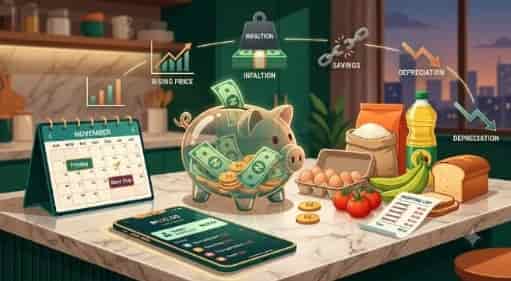
Why comparing yourself to last year no longer works
Many people measure financial progress by comparing current earnings with earnings from the previous year.
Sustained inflation makes that comparison increasingly unreliable.
A grocery budget that seemed reasonable twelve months ago may now cover only a fraction of the same shopping list. A savings target that once felt ambitious may barely cover a minor emergency today.
The familiar calculation, "I earn more than I used to; therefore I should be doing better," often stops reflecting reality.
Structural economic pressures leave many people feeling frustrated, confused, or even ashamed of circumstances that have little to do with personal failure.
The compounding nature of the problem
Perhaps the hardest reality to accept is that inflation’s effects accumulate.
Each year as prices rise faster than wages, it adds another layer of lost purchasing power. Economic stability alone does not erase previous losses. Recovery requires sustained income growth that exceeds the cost of living.
Several years of falling behind cannot be reversed simply because conditions stop worsening. Households need a genuine period of recovery and catch-up.
Salary adjustments may not be enough to restore years of lost purchasing power.
What this means for how people plan and think
Prolonged inflation changes more than what people can afford. It also changes how people need to think about money and financial planning.
Long-term saving can feel discouraging when the purchasing power of saved money keeps falling. That’s why it is important to think beyond the amount sitting in a savings account and consider whether the return on those savings is keeping up with inflation.
The same applies to major life decisions. Starting a family, buying a home, pursuing further education, or changing careers all require planning, but that planning becomes harder when costs are constantly changing. What worked a few years ago may not work the same way now, so budgets, savings targets, and financial goals may need to be reviewed more often.
Financial anxiety can still be real, but understanding what is actually driving it can help. Not every financial setback is a result of poor discipline. When prices rise faster than income, simply spending less may not solve the entire problem. Increasing income, choosing where to keep your savings carefully, and adjusting financial goals as conditions change can become just as important.
Naming the problem is not the same as accepting it
Recognizing these realities does not mean giving up on budgeting, saving, investing, or planning for the future. Those habits remain valuable, especially during difficult economic periods.
Honest recognition of the problem is more useful than internalizing it as personal failure.
Careless spending or poor planning is not the only reason a salary feels less effective than it once did. Purchasing power declines when the cost of living rises faster than wages.
Purchasing power declines when the cost of living rises on a schedule that wages were never designed to match.
Slower inflation is not the same thing as meaningful relief. A salary can feel increasingly inadequate even when economic headlines suggest improvement. Feeling as though your money no longer goes as far as it once did is not irrational. Economic reality has changed, and many workers are experiencing the consequences in real time.
Keep reading
Related Topics






Conversation
Comments (0)
Sign in to join the conversation or like this post.

Elizabeth Ayoola
Elizabeth is a finance analyst and writer passionate about making financial markets accessible to everyday readers.
She has a deep interest in global markets, crypto, and everything shaping the financial world. She writes to simplify complex financial topics, turning them into practical, accessible insights for everyday readers.
104
Stories
31933
Reads
1
Likes
0
Comments