

The moment after collecting your salary is almost a ritual for the average earner. You check the alert, and before you even close the app, you're already asking yourself: "Omo, where the money dey?" Which is funny, because you didn't flex. You didn't "chop life." You didn't buy anything extravagant, travel, or treat yourself, and yet, somehow, it's gone already.
Well, that's life. But instead of just wondering, let's actually break down where the money goes.
Food: The Non-Negotiable
You have to be alive to work. That's the whole logic behind why food sits at the top of every budget, whether you write it down or not. Food isn't a luxury line item; it's fuel for survival, and it shows up as the single biggest expense in most household budgets: groceries, market runs, the occasional restaurant meal, all of it. That's before rent, before transport, before anything else. It's by far the biggest expense on the list, which tells you something important: for most people, the salary isn't disappearing into indulgence. It's disappearing into staying alive so you can show up and earn the next one.
Rent: The Silent Salary Killer
Everyone needs a place they can truly call home because let's face it, no company is going to let you camp out at your desk. Whether it's a comfortable apartment, something suitable, or something barely manageable at all, a roof is not optional. Rent doesn't ask how you're managing either. It usually arrives once a year, as one intimidating lump sum that forces you to plan (or panic) for months. Anyone who's paid rent in Lagos or Abuja knows the "average" figures you see online rarely apply to them. Nigeria has a significant housing shortage, and that scarcity means landlords can charge premium prices for spaces that are, honestly, sometimes far from premium.
Transport: The Cost of Living Far From Work
You have to get to work every day, or on your assigned days if you're a hybrid worker, because unless HR is feeling generous, missing a day without a valid reason can turn into a query, and a query can turn into a salary deduction. And from an already-stretched salary, that's not a risk many people can afford to take. Here's the quiet irony: because rent pushes many people into cheaper, farther-out neighborhoods, transport costs rise to compensate for buses, keke, ride-hailing apps, and fuel. And fuel prices keep climbing, driven by refinery pricing changes and global crude spikes. If you own a car, your real transport cost is likely already outpacing whatever "average" figure you've seen quoted.
Electricity: Paying As You Go, Literally
Then there's the prepaid meter, the one appliance in the house that never lets you forget it's running. Since Nigeria's electricity tariffs were restructured around service bands, what you pay per unit depends entirely on how many hours of power your area is promised. Customers on the higher-hours bands pay a steep premium per unit, which can push a modest household's monthly electricity spend. Customers on the lower-hours bands pay less, because those tiers still carry a government subsidy. Either way, the prepaid meter has turned electricity into a daily budgeting decision rather than a background monthly bill: you watch the units count down the same way you watch data or airtime, and you have to top up before you're plunged into darkness, unless you are willing to stay inside darkness.
Data and Airtime: "Data Is Life"
Airtel's slogan says it best: data is life. It's not just about watching content on social media, though that's part of it. It's how you talk to friends and family, how you receive news, and how you stay aware of what's actually happening in the country. Moreover, lacking data is like living under a rock.
A decade ago, data wasn't a top-ten household expense. Today, it might as well be rent's cousin. Banking, work, school, fintech apps like Opay and Moniepoint none of it runs without data, and prices have climbed sharply after recent tariff increases. Data has quietly become a second utility bill, except most people never budgeted for it.
Education: Paying to Climb the Ladder
For anyone chasing a certificate to move up the career ladder or paying for a child to have that chance, education is a recurring, non-negotiable expense: school fees, tuition, books, and materials. It's an investment in future earning power, but in the short term, it's just another bill competing for the same salary as everything else.
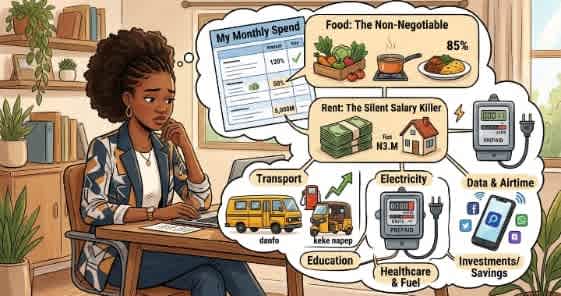
Investing and Saving: The Goal That Keeps Getting Pushed Back
Before anyone can even think about investing or saving in the Nigerian economy, expenses have already choked whatever was left. This is arguably the most painful line item on the list, because it isn't really a cost; it's the thing that keeps getting sacrificed so the other costs can be paid. Food, rent, transport, data, and school fees all come first by necessity. Saving and investing come last by circumstance, not by choice, which is a big part of why building wealth feels so much harder in Nigeria than the finance advice you read online makes it sound. So, before you say "lock it," the money will have said "clock it" to other expenses.
Healthcare, Fuel, and Clothing: The Rest of the List
Round out the picture with healthcare, which is almost entirely out-of-pocket since very few Nigerians have health insurance; fuel, which has become its own runaway cost; and clothing. Clothing isn't just about personal preference either; it's partly a work requirement. You represent the company you work for, and showing up well put together is a quiet way of proving that their investment in you didn't go to waste. As the saying goes, dress the way you want to be addressed. A sharp appearance can shape how seriously you're taken in meetings, how quickly you're trusted with responsibility, and even how you're considered for promotion, so this line item is really an investment in your professional image as much as it is a bill. Add utility bills and religious or family obligations, tithes, donations, "helping out" a relative and you have a full picture of where a salary actually goes before a single naira is set aside for the future.
So Where Did the Money Go?
Add it all up, and it becomes obvious why the alert that felt like relief in the morning feels like nothing by evening. You didn't flex. You didn't chop life. You paid to stay alive, to have a roof over your head, to keep the lights on, to get to work without a query, to stay connected to the people and news around you, to invest in your career, and to meet the obligations that come with being part of a family and a community. Saving and investing, the very things that could change your financial future, are what got choked out in the process. That's not overspending; that's just the actual, unglamorous cost of living in Nigeria today, and it's rising faster than most salaries are.
Understanding where the money goes is the first step to actually managing it. The second step, the harder one, is figuring out which of these costs can be trimmed, and which ones you're simply going to have to earn your way past.
Keep reading
Related Topics


Conversation
Comments (0)
Sign in to join the conversation or like this post.

Elizabeth Ayoola
Elizabeth is a finance analyst and writer passionate about making financial markets accessible to everyday readers.
She has a deep interest in global markets, crypto, and everything shaping the financial world. She writes to simplify complex financial topics, turning them into practical, accessible insights for everyday readers.
108
Stories
36752
Reads
1
Likes
0
Comments