

The dollar to naira exchange rate is the one gist every Nigerian has an opinion on, and some still don't understand it. You'll hear "naira don drop" and "naira has just jumped" in the same day, sometimes in the same week, and both people are right.
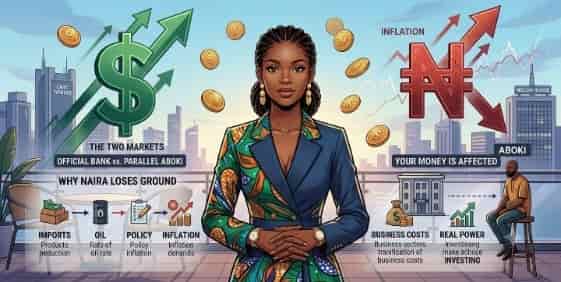
Nigeria doesn't run one exchange rate; it runs two. One rate lives at the bank. The other lives with your Aboki down the road. Both are real; they move differently, and most of what you pay, from garri to JAMB forms to school fees abroad, gets shaped by which one you're dealing with.
Take a businessman who needs dollars to pay a foreign supplier. He checks the rate in the morning, and it's favorable. He gets held up, makes calls, and sorts one or two things, and by the time he's ready to convert in the afternoon, the rate has moved against him. Same day, same transaction, different cost. That's just how this market behaves, and if you don't understand why, you'll keep getting caught off guard by it.
First, There Isn't Just One Exchange Rate
This trips up a lot of people. When someone asks, "How much is the dollar today?" the honest answer is "Which market?"
- The official rate, what you'll see quoted by the Central Bank of Nigeria (CBN) via the Nigerian Foreign Exchange Market (NFEM), is a volume-weighted average of actual dollar transactions done through licensed banks and authorized dealers that day, and it serves as Nigeria's official exchange rate benchmark. As of late July 2026, that rate has been hovering around ₦1,370–₦1,380 per dollar.
- The parallel market rate (the "black market," or what your Aboki down the road quotes) is a different market entirely, driven by street-level demand and supply among Bureau de Change (BDC) operators and independent dealers, often for people who can't easily access dollars through official channels or need cash fast. That rate has been sitting closer to ₦1,410–₦1,420 per dollar, though it can differ slightly depending on location, dealer margins, and transaction volume.
The gap between both, usually called the premium (or FX gap), tells its own story. A wide gap signals dollar scarcity in the formal system and people scrambling for alternatives. A narrow gap, which is roughly where we are now compared to the wild spreads of 2023, suggests the market is functioning a bit more efficiently, reflecting ongoing FX reforms and improved liquidity, even if it's still not perfect. Analysts note that demand from importers and other end-users continues to keep the market on its toes.
Why Does the Naira Keep Losing Ground?
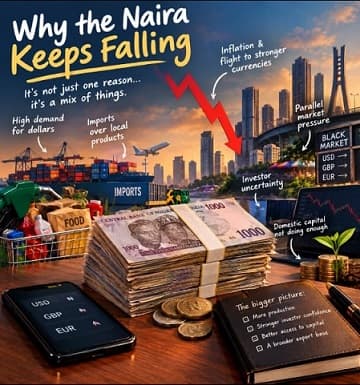
It is a mix of structural and situational pressures:
1. We import more than we export. Nigeria buys a lot of what it consumes (refined fuel, machinery, food items, and raw materials for manufacturing) in dollars. Every import transaction creates dollar demand, while our non-oil exports (agriculture and manufactured goods) haven't grown fast enough to bring in matching dollar supply. When demand consistently outpaces the dollar coming in, the naira weakens against it.
2. Oil earnings don't always show up as expected. Crude oil is still Nigeria's biggest foreign exchange earner, and for decades it's been the main source of dollars entering the country. When output dips due to pipeline vandalism, OPEC quota adjustments, oil theft, or a slide in global prices, the dollar inflow that's supposed to support the naira shrinks too. And because Nigeria hasn't fully diversified its export base, there's no strong second earner to cushion the fall when oil underperforms.
3. Portfolio investors watching from the sidelines. Foreign investors move money in and out of Nigerian markets: treasury bills, bonds, and equities based on returns, policy stability, and risk appetite. When confidence dips (a policy U-turn, political uncertainty, a ratings downgrade), capital flows out fast, and that outflow pressures the currency further. The reverse is also true: when Nigeria looks attractive again, inflows help support the naira.
4. CBN policy and market reforms. Since 2023, the CBN has pursued significant reforms, unifying multiple exchange rate windows into one, letting the market play a bigger role in price discovery instead of defending an artificial rate, and clearing a backlog of FX obligations owed to banks and businesses. These moves were designed to build confidence and shrink the gap between official and parallel rates, and to some extent, they have. But reforms take time to fully stabilize a currency that's absorbed years of pressure.
5. Structural dollar demand from fuel importers. Even with local refining capacity growing (Dangote refinery being the big example), petroleum-related dollar demand remains one of the heavier weights on the naira in any given week, since Nigeria still imports a chunk of its refined products.
6. Inflation eats currency strength from the inside. Countries with lower inflation tend to have stronger currencies, because inflation erodes what money can actually buy, both at home and in the eyes of anyone holding or trading that currency. Nigeria's inflation has stayed elevated for a while now, and high inflation also makes the naira less attractive to hold, which adds more pressure on the exchange rate.
Why This Isn't Just "News"
- If you import anything for resale (clothes, phones, spare parts, or cosmetics), your costs are influenced by the exchange rate when you pay your supplier and, in some cases, when you clear your goods at the port. A weaker naira means higher landing costs, which either eats into your profit margin or gets passed on to your customers.
- If you earn in naira but have dollar-denominated expenses—foreign tuition, streaming services, cloud subscriptions, travel, or medical treatment abroad—every naira depreciation makes those expenses more expensive. Your salary may not change, but what it can buy certainly does.
- If you're sending or receiving remittances, the exchange rate at the point of conversion determines how much value actually reaches the recipient. A weaker naira means each dollar sent home converts into more naira, which is good news for the receiver. But it also reflects a currency that has lost value.
- If you're a saver, naira-denominated savings lose purchasing power over time when inflation and currency depreciation move together, which has largely been the pattern in Nigeria over the past few years.
- If you're an investor or aspiring one, understanding this dynamic is foundational; it affects everything from equity valuations of import-dependent companies to the real return on your fixed-income investments.
How to Actually Protect Yourself
You don't need to be a forex trader to make smarter decisions. A few practical habits go a long way:
- Don't panic-buy dollars on rumors. Reactive buying during scare periods is usually how people buy at the worst possible rate. If you genuinely need dollars for a real expense (school fees, travel, business), plan ahead instead of scrambling.
- Use licensed channels for anything significant. Bank transfers, licensed BDCs (Bureau de Change), and regulated fintech platforms offer more protection and better traceability than random street transactions, especially for large amounts.
- Diversify where sensible. If your income and expenses are entirely naira-based, that's fine, but if you have dollar-denominated obligations (tuition, subscriptions), consider whether holding some savings in dollar-linked instruments (domiciliary accounts, dollar-denominated treasury products, or Eurobond funds where accessible) makes sense for you.
- Watch the trend, not just the day. A single day's rate movement tells you very little. What matters is whether the gap between official and parallel rates is narrowing over months (a sign of stabilizing confidence) or widening (a sign of stress).
- Understand your own exposure before reacting to headlines. Ask yourself: Does this actually affect what I buy, earn, or owe? Many people react emotionally to exchange rate news that has zero bearing on their actual financial life.
The Bigger Picture
Nigeria's external reserves, the dollar buffer the CBN holds to defend the currency and settle international obligations, have been on an upward trend, sitting around $52 billion as of late July 2026. This gives the CBN more room to intervene in the market when needed, rather than watching the naira slide unchecked.
None of this means the naira's challenges are solved. Currency stability is a long game, tied to oil revenue, non-oil export growth, investor confidence, and disciplined fiscal policy, none of which change overnight. But understanding why the rate moves and how it touches your specific financial life puts you in a much stronger position than simply reacting to whatever number is trending on Twitter today.
The dollar-naira story isn't going away. The least you can do is understand the plot.
Keep reading
Related Topics





Conversation
Comments (0)
Sign in to join the conversation or like this post.

Elizabeth Ayoola
Elizabeth is a finance analyst and writer passionate about making financial markets accessible to everyday readers.
She has a deep interest in global markets, crypto, and everything shaping the financial world. She writes to simplify complex financial topics, turning them into practical, accessible insights for everyday readers.
102
Stories
31719
Reads
1
Likes
0
Comments