
Clothing Prices Rose Just 1.08% in a Year: The Six Things Inflation Almost Forgot in Nigeria
Most inflation stories are about what's getting more expensive. This one is about what isn't.
Inside the NBS September 2026 CPI tables, a handful of spending groups have quietly gone almost flat. That gives you a bit of breathing room in your budget, if you know where to look.
The slow lane: six groups under 5%
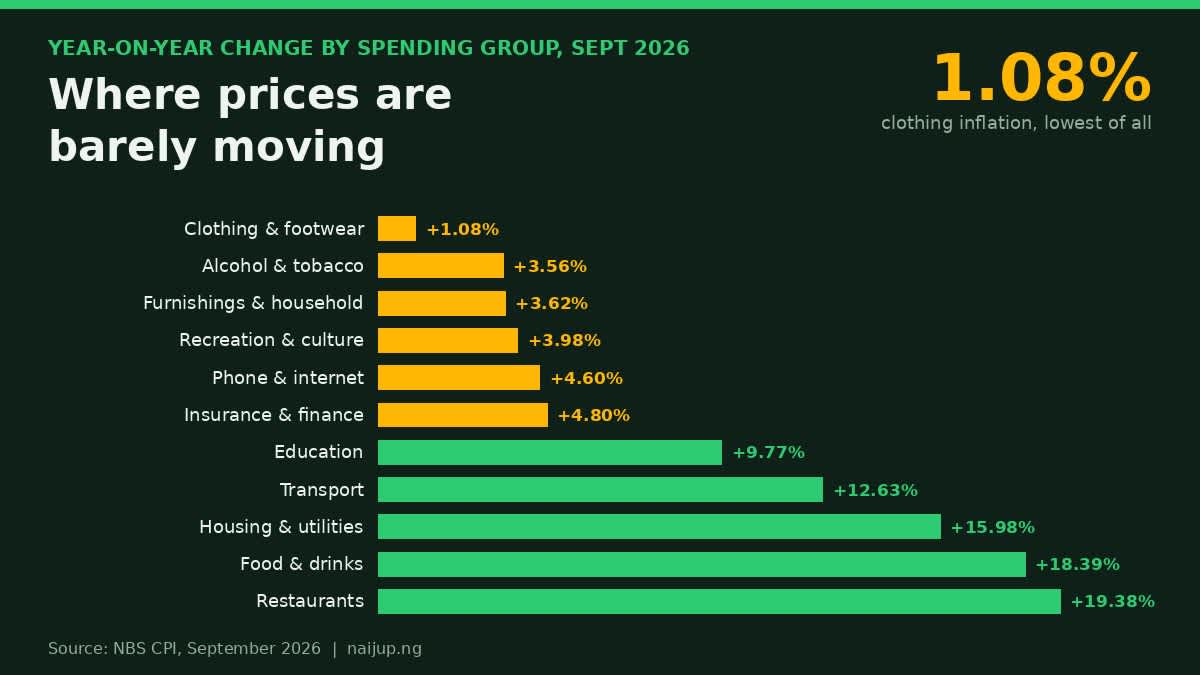
Headline inflation is 14.63%. Here are the spending groups rising at less than a third of that pace:
| Spending group | Yearly change (Sept 2026) |
|---|---|
| Clothing and footwear | 1.08% |
| Alcoholic beverages and tobacco | 3.56% |
| Furnishings and household equipment | 3.62% |
| Recreation, sport and culture | 3.98% |
| Information and communication (phone, data, internet) | 4.60% |
| Insurance and financial services | 4.80% |
At the other end, restaurants (19.38%), food and drinks (18.39%) and housing and utilities (15.98%) are where the real pressure still is.
Clothing: the most dramatic slowdown
Clothing and footwear deserves its own section. Look at how its yearly rate has fallen through 2026:
• February: 16.14%
• April: 6.37%
• July: 4.04%
• August: 1.91%
• September: 1.08%
That's a drop of 15 percentage points in seven months. The clothing index has actually gone down slightly since March, from 125.32 to 124.70.
Why? The NBS doesn't say. The most likely reason is weak demand. When food and rent take a bigger share of the pay packet, new clothes and shoes are the first thing families postpone. Traders in places like Balogun, Aba or Kantin Kwari can't push prices up if fewer people are buying.
There's a rural twist too. In villages, clothing and footwear is up just 0.73% in a year.
Furniture and household items: cooling fast
Furnishings, household equipment and routine maintenance rose 7.66% in the year to August. A month later it was 3.62%. In rural areas the group is actually cheaper than a year ago, down 1.53%.
If you've been waiting to replace that tired mattress, fridge or set of plastic chairs, the numbers say prices aren't running away from you right now.
Data and airtime: steady for now
Information and communication, which covers phones, data and call costs, is up only 4.60% in a year. For something most of us spend on every week, that's a relief.
One caution: urban phone and internet costs rose 2.12% in September alone. That's a sharp single-month move, so keep an eye on your data plan prices in the coming months.
Before you rush to the shops
Let's be balanced. These groups are probably low partly because people are buying less of them. And they're small. Together these six groups make up only about 12.4% of the CPI basket, by our sum of the NBS weights. Food and drinks alone is 40%.
So this isn't a sign that the cost of living is easing across the board. Your money still goes mostly on food, rent, transport and eating out, and those are still rising fast.
But it does mean:
1. Non-urgent clothing and household purchases aren't getting much more expensive. There's less pressure to "buy now before price go up" for these items.
2. Bargaining power is on your side. When a category is this flat, sellers often have room to drop the price a bit more. Price a few shops before you pay.
3. Your real money goes further here. With overall prices up 14.63% and clothing up 1.08%, a pair of shoes now costs you less of your income than it did a year ago, if your income has kept up.
The bottom line
Not everything in Nigeria is getting more expensive at the same speed. Clothing, furniture, phone and data, recreation, insurance and drinks have all slowed to single digits, and clothing is almost flat. The heavy lifting in inflation is still being done by food, rent and eating out.
Know the difference and plan your spending around it.
Quick FAQ
Which prices are rising slowest in Nigeria?
According to NBS September 2026 data, clothing and footwear (1.08%), alcoholic beverages and tobacco (3.56%) and furnishings and household equipment (3.62%) had the lowest yearly increases.
Are clothes getting cheaper in Nigeria?
The clothing and footwear index has dipped slightly since March 2026 and is only 1.08% higher than a year ago.
Is the cost of living in Nigeria falling?
Not overall. Headline inflation is 14.63%, and food, rent and restaurants are still rising much faster than average.
Data source: National Bureau of Statistics, Consumer Price Index, September 2026 (Base 2024 = 100). Calculations by Naijup.
Keep reading
Related Topics



Conversation
Comments (0)
Sign in to join the conversation or like this post.

Mujeeb Olagunju
I am a finance professional with a strong background in economics and financial technology.,My work centers on building systems that support payments, digital banking, and investment solutions in emerging markets.,I have experience with risk management, transaction monitoring, fraud prevention, and the design of scalable financial products tailored to both retail and institutional clients.,With over 8 years of industry experience, I combine financial insight with technical expertise to deliver solutions that balance compliance, security, and business growth.,My goal is to bridge the gap between finance and technology, creating platforms that expand access to modern financial services and strengthen trust in digital finance.
75
Stories
22695
Reads
0
Likes
0
Comments
Latest by Mujeeb Olagunju
Village Prices Fell in September, But Not Where It Counts: Transport and School Fees Shot Up
general
Imported Food Is Now Rising Half as Fast as Food Grown in Nigeria. Here's What the NBS Numbers Show
general
Clothing Prices Rose Just 1.08% in a Year: The Six Things Inflation Almost Forgot in Nigeria
general