
School Fees Climbed Again in September, and Rural Parents Got the Biggest Shock
Every Nigerian parent knows the September feeling. New session, new uniform, new booklist, and that one line on the school bill that somehow went up again since July.
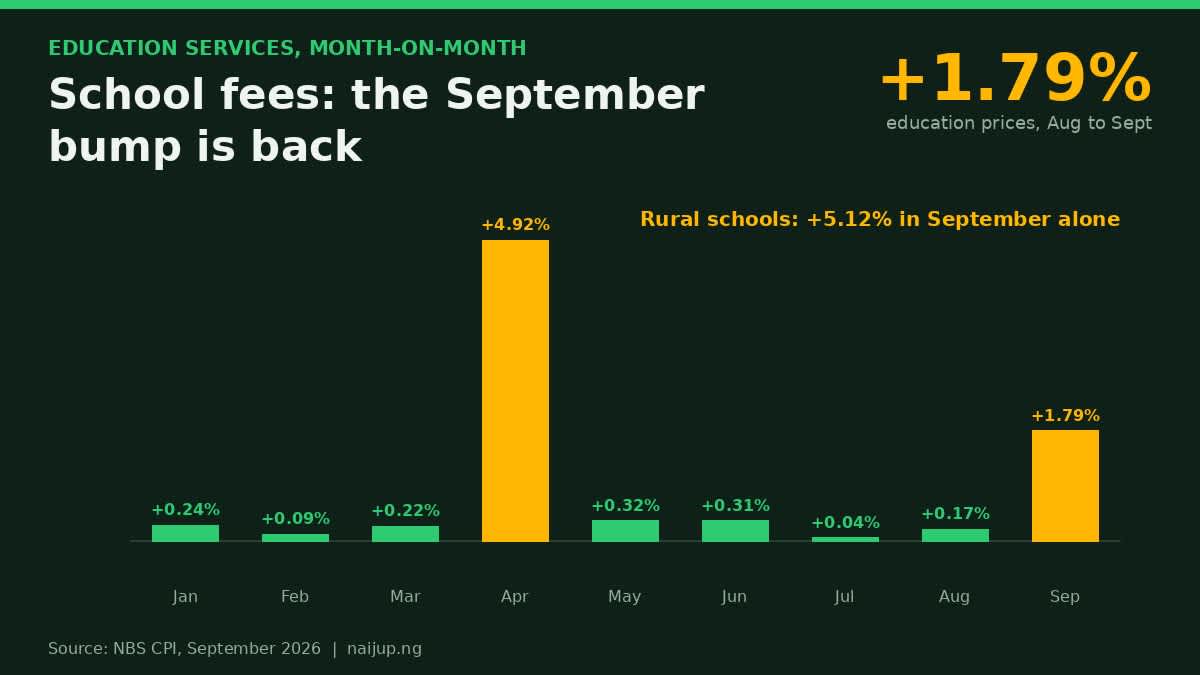
The NBS September 2026 Consumer Price Index puts a number on it. Prices for education services rose 1.79% between August and September. That might sound small. For context, the overall price level barely moved that month (0.06%). Education was rising about 30 times faster than average.
A pattern you can almost set your calendar by
When you line up the monthly education numbers for 2026, you can almost see the school calendar in them:
• January to March: tiny moves, all under 0.25% a month
• April: +4.92% (third term resumption)
• May to August: quiet again, between 0.04% and 0.32%
• September: +1.79% (new academic session)
Schools don't usually increase fees in the middle of a term. They do it when a new session or term starts. And that's exactly what the CPI is picking up.
The rural surprise
What surprised us most is where the September increase landed.
| Area | Education, Aug to Sept 2026 |
|---|---|
| Urban | +1.15% |
| Rural | +5.12% |
Rural education costs jumped more than four times as much as urban ones in a single month. This happened while rural food prices were falling. Rural parents got cheaper garri and yam at the market, then gave most of the savings to the school.
Why would village schools increase faster? We don't have a breakdown from the NBS, but a few explanations make sense:
• Many rural private schools kept fees flat for a long time and are now catching up in one go.
• Costs like teachers' transport, generator fuel and textbooks don't care whether a school is in Ikeja or a small town in Kogi.
• Rural increases are starting from a lower base, so the percentage looks bigger even if the naira amount is modest.
Over the full year, though, the picture flips. Rural education costs are up only 3.65% compared with September 2025. Urban education is up 11.07%. So the city parent has had the heavier load over 12 months. The rural parent just got hit all at once this September.
Good news hiding in the data
Education inflation has actually cooled a lot this year. Look at the yearly rate:
• January 2026: 22.48%
• April 2026: 7.44%
• September 2026: 9.77%
The September 2025 jump was also bigger than this year's. Last year, education prices rose about 2.7% from August to September. This year it was 1.79%. So yes, fees went up. But they went up less than they did at this time last year.
Education still matters for the overall inflation number. It contributed 0.91 percentage points to September's 14.63% headline rate. That makes it the fifth-biggest driver, ahead of health and clothing.
Practical tips for parents (from the numbers)
1. Plan for two hits a year, not three. The data shows the big increases come in April and September. January (second term) has been calm in 2026. Save ahead for those two.
2. Ask for the breakdown. "School fees" often bundles tuition, development levy, PTA, ICT, lesson fee and more. The tuition part may not have moved much. The extras often do.
3. Compare against 9.77%. If your child's school raised fees by 25% or 30% this session, that's well above the national average for education. It's a fair question to ask the proprietor or PTA why.
4. Watch the extras outside the school gate. Transport to school rose too. Rural transport costs jumped 4.01% in September, which hits children who travel to school in the next town.
The bottom line
The September school fees bump is real, and it is very predictable. Rural families felt a sharp one-month jump of 5.12%. Over the full year, though, city families are carrying more. The silver lining is that education inflation is a lot calmer than it was at the start of 2026.
Did your child's school increase fees this session? By how much? Drop it in the comments. It helps other parents know what's normal.
Quick FAQ
How much did school fees increase in Nigeria in September 2026?
NBS data shows education services prices rose 1.79% from August to September 2026 nationally, 1.15% in urban areas and 5.12% in rural areas.
What is the yearly education inflation rate in Nigeria?
Education services prices were 9.77% higher in September 2026 than in September 2025.
When do school fees usually go up in Nigeria?
The 2026 CPI data shows the largest monthly increases in April (third term) and September (new session).
Data source: National Bureau of Statistics, Consumer Price Index, September 2026 (Base 2024 = 100). Calculations by Naijup.
Keep reading
Related Topics



Conversation
Comments (0)
Sign in to join the conversation or like this post.

Mujeeb Olagunju
I am a finance professional with a strong background in economics and financial technology.,My work centers on building systems that support payments, digital banking, and investment solutions in emerging markets.,I have experience with risk management, transaction monitoring, fraud prevention, and the design of scalable financial products tailored to both retail and institutional clients.,With over 8 years of industry experience, I combine financial insight with technical expertise to deliver solutions that balance compliance, security, and business growth.,My goal is to bridge the gap between finance and technology, creating platforms that expand access to modern financial services and strengthen trust in digital finance.
75
Stories
22695
Reads
0
Likes
0
Comments
Latest by Mujeeb Olagunju
Village Prices Fell in September, But Not Where It Counts: Transport and School Fees Shot Up
general
Imported Food Is Now Rising Half as Fast as Food Grown in Nigeria. Here's What the NBS Numbers Show
general
Clothing Prices Rose Just 1.08% in a Year: The Six Things Inflation Almost Forgot in Nigeria
general