
The World Built 22.4 Million Vehicles in Q1 2026. Africa Built 1.3% of Them

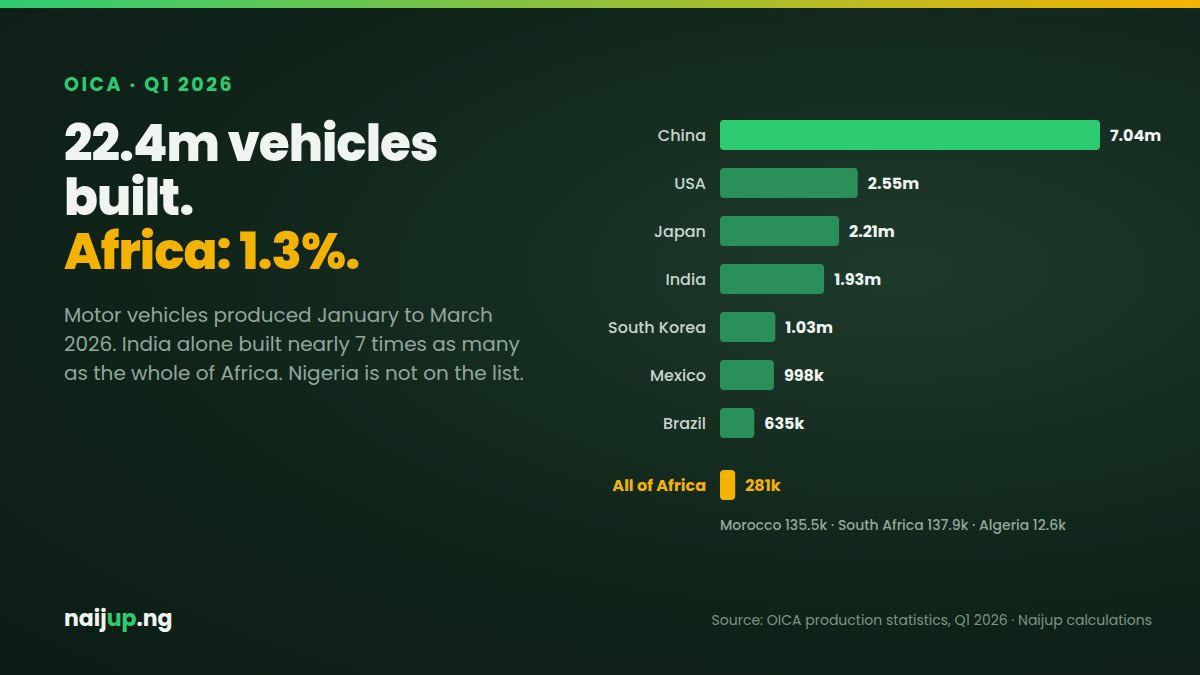
Between January and March 2026, factories around the world built 22,360,148 cars, vans, trucks and buses. That's roughly 248,000 vehicles every single day.
Africa's share, according to the latest production figures from OICA (the international association of carmakers), was about 281,000. That's 1.3% of the world total, or roughly 3,100 vehicles a day for a continent of more than 50 countries.
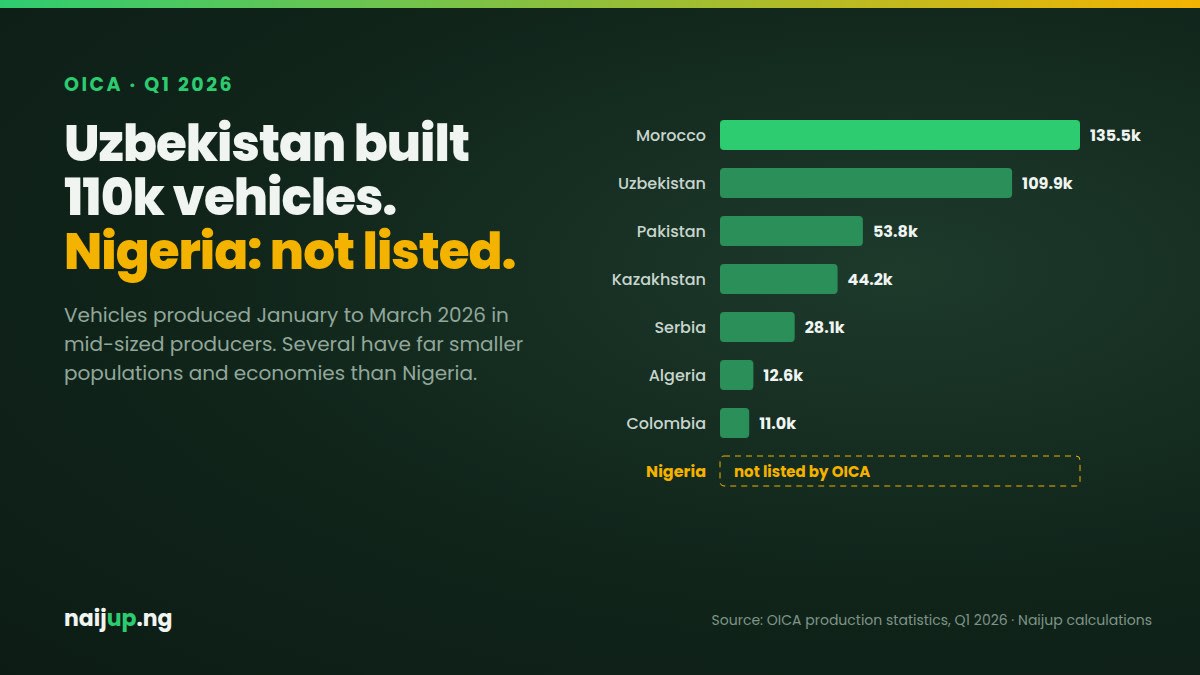
And Nigeria? It isn't on the list at all. Only three African countries show up in OICA's quarterly survey: Morocco, South Africa and Algeria. (Egypt reports once a year, so it's left out of the quarterly numbers.)
Who builds the world's vehicles
| Country | Vehicles built, Q1 2026 | Change vs Q1 2025 |
|---|---|---|
| China | 7,039,187 | -6.9% |
| USA | 2,552,630 | +1.5% |
| Japan | 2,205,695 | +3.1% |
| India | 1,929,181 | +12.8% |
| Germany (cars only) | 1,068,952 | -1.2% |
| South Korea | 1,025,117 | +1.2% |
| Mexico | 998,044 | -0.8% |
| Brazil | 634,665 | +6.0% |
| All of Africa | 281,011 | +5.6% |
| World | 22,360,148 | -0.8% |
China alone built 31.5% of every vehicle made in the world. Even after a 6.9% drop, China's quarter was 25 times Africa's.
The fall in China was big in absolute terms: it built 521,612 fewer vehicles than in Q1 2025. That one drop is almost twice what the whole of Africa produced in the quarter. It's also why world production slipped 0.8% even though most big producers grew.
India is the one to watch
India is the clearest growth story in the data. It built 1.93 million vehicles in Q1 2026, up 12.8% in a year and up 45% since Q1 2019.
India and Nigeria were once mentioned in the same breath as large, young, import-hungry markets. Today India builds nearly seven times as many vehicles as the entire African continent. Its local industry supplies its own huge market and exports too.
That's the gap: Africa's production in Q1 2026 was only 3.3% higher than in Q1 2019 (272,024). India grew 45% over the same period.
Morocco has quietly overtaken South Africa in cars
For decades, "car manufacturing in Africa" meant South Africa. That's no longer the full story.
| Country | Q1 2025 | Q1 2026 | Change |
|---|---|---|---|
| South Africa | 145,660 | 137,911 | -5.3% |
| Morocco | 119,833 | 135,500 | +13.1% |
| Algeria | 6,795 | 12,560 | +84.8% |
In total vehicles, South Africa is still ahead, but only just: 137,911 to Morocco's 135,500. Look at passenger cars alone and the picture flips.
| Passenger cars, Q1 | Morocco | South Africa |
|---|---|---|
| 2019 | 91,439 | 81,630 |
| 2022 | 83,654 | 80,649 |
| 2023 | 118,017 | 74,630 |
| 2024 | 129,745 | 77,479 |
| 2025 | 117,684 | 81,983 |
| 2026 | 134,000 | 78,838 |
Morocco built 70% more passenger cars than South Africa in Q1 2026. Its car output is up 46.5% since 2019, while South Africa's is down 3.4%. Morocco now accounts for about 61% of the cars OICA records as made in Africa.
Morocco's rise is mostly about export plants. Global carmakers such as Renault and Stellantis build cars there for sale in Europe, helped by its location, trade deals and an industrial policy that pushed suppliers to set up locally. South Africa's strength is different: it builds a lot of bakkies (pickups) and commercial vehicles, which is why it's still ahead on the total count.
One caution: Morocco's light commercial vehicle figure collapsed from 18,811 in Q1 2024 to 1,500 in Q1 2026. That may partly be a change in how vehicles are classified rather than a real drop, so we'd treat it carefully.
Trucks and buses: even thinner
Africa's share is lowest exactly where it matters for moving goods and people.
| Vehicle type | World, Q1 2026 | Africa, Q1 2026 | Africa's share |
|---|---|---|---|
| Passenger cars | 16,030,116 | 220,438 | 1.4% |
| Light commercial vehicles | 5,209,780 | 52,362 | 1.0% |
| Heavy trucks | 1,045,584 | 8,012 | 0.8% |
| Heavy buses | 74,668 | 199 | 0.3% |
All 8,012 heavy trucks and all 199 heavy buses OICA recorded in Africa were built in South Africa. In the same quarter India built 125,243 heavy trucks and 24,115 buses. China built 580,590 heavy trucks.
Think about what that means for Nigeria. The trucks carrying food from the North to Lagos, the BRT buses, the danfos and the trailers at Apapa: virtually all of them were built outside Africa.
Why Nigeria isn't on the list
Nigeria has had a National Automotive Industry Development Plan since 2013, and there are local assembly plants. But assembly volumes are small enough that Nigeria doesn't appear in OICA's quarterly production figures. Most vehicles on Nigerian roads are imported, and a large share of them are used ("tokunbo").
That matters for your pocket in a few ways:
• Car prices follow the naira. When nearly every vehicle and spare part is imported, a weaker naira shows up directly in prices at the car lot and the mechanic's shop.
• Transport fares follow too. Buses, trucks and their parts are imported, so the cost of moving people and goods carries an exchange-rate premium.
• Jobs go elsewhere. Morocco's car industry employs a large workforce in factories and parts suppliers. Every vehicle Nigeria imports supports those jobs in another country.
What this means for you
• Buying a car? Watch the exchange rate, not just the sticker price. With almost no local production, vehicle prices in Nigeria move with the naira.
• Spare parts are part of the cost. Before buying, check how easy and expensive parts are for that model. Popular imported models usually have cheaper, more available parts.
• Morocco shows it can be done in Africa. It went from a small producer to rivalling South Africa in about 15 years by building for export, not just its home market. That's a useful benchmark when you hear new announcements about Nigerian auto policy.
Would you buy a Nigerian-assembled car if the price was right? Let us know in the comments.
Quick FAQ
How many vehicles were produced worldwide in Q1 2026?
22,360,148 motor vehicles, according to OICA, down 0.8% from 22,531,653 in Q1 2025.
How many vehicles did Africa produce in Q1 2026?
281,011 (excluding Egypt, which reports yearly), about 1.3% of world production and up 5.6% from Q1 2025.
Which country produces the most cars in Africa?
In Q1 2026 Morocco built 134,000 passenger cars and South Africa 78,838. Counting all vehicle types, South Africa was slightly ahead with 137,911 vehicles to Morocco's 135,500.
Does Nigeria manufacture cars?
Nigeria has local assembly plants, but volumes are too small to appear in OICA's quarterly production statistics. Most vehicles in Nigeria are imported.
Which country produced the most vehicles in Q1 2026?
China, with 7,039,187 vehicles (31.5% of the world total), followed by the USA (2,552,630), Japan (2,205,695) and India (1,929,181).
Data source: OICA (International Organization of Motor Vehicle Manufacturers), world motor vehicle production by country and type, Q1 2026 (correspondents survey). Germany reports cars only; France and Argentina report cars and LCVs only. OICA's Africa total excludes Egypt and Algeria's light commercial vehicles. Shares, multiples and growth since 2019 are Naijup calculations.
Found this useful? Share it
Help friends, family and colleagues stay informed on Nigerian finance.
Keep reading
Related Topics
Conversation
Comments (0)
Sign in to join the conversation or like this post.

Mujeeb Olagunju
I am a finance professional with a strong background in economics and financial technology.,My work centers on building systems that support payments, digital banking, and investment solutions in emerging markets.,I have experience with risk management, transaction monitoring, fraud prevention, and the design of scalable financial products tailored to both retail and institutional clients.,With over 8 years of industry experience, I combine financial insight with technical expertise to deliver solutions that balance compliance, security, and business growth.,My goal is to bridge the gap between finance and technology, creating platforms that expand access to modern financial services and strengthen trust in digital finance.
97
Stories
30958
Reads
0
Likes
0
Comments