
Uzbekistan Built 110,000 Vehicles in Three Months. Nigeria Isn't Even on the List

When people talk about car manufacturing, they think of China, Japan, Germany and the US. Those countries are huge, rich and have been building cars for decades. It's easy to say Nigeria can't compete with them.
So let's not compare Nigeria with them. Let's compare it with countries that are smaller, landlocked, or were not car producers at all a few years ago.
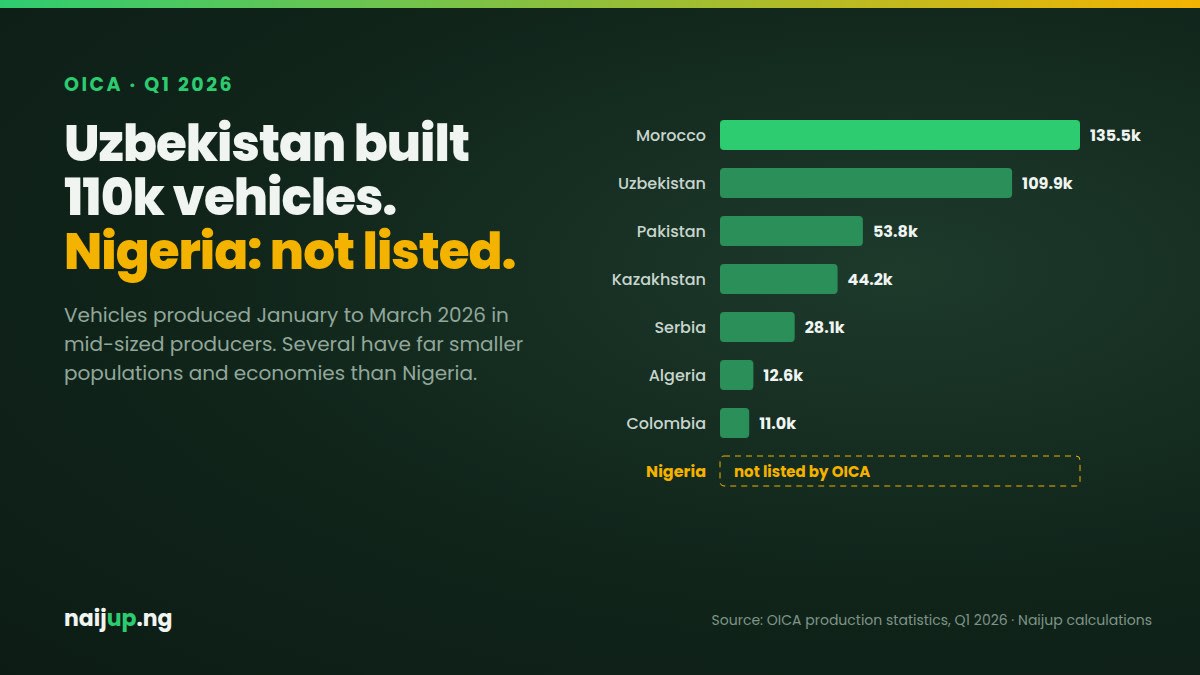
According to the latest OICA production figures, between January and March 2026:
• Uzbekistan built 109,947 vehicles
• Kazakhstan built 44,245
• Serbia built 28,120
• Algeria built 12,560
Nigeria doesn't appear in OICA's figures at all.
The mid-sized producers
| Country | Vehicles built, Q1 2026 | vs Q1 2025 | vs Q1 2019 | Population (approx.) |
|---|---|---|---|---|
| Morocco | 135,500 | +13.1% | +37.0% | 38 million |
| Uzbekistan | 109,947 | +12.0% | +84.8% | 37 million |
| Pakistan | 53,801 | +33.8% | -19.5% | 250 million |
| Kazakhstan | 44,245 | +37.5% | 5.1x | 20 million |
| Serbia | 28,120 | 12x | 3.0x | 6.6 million |
| Algeria | 12,560 | +84.8% | -36.3% | 47 million |
| Colombia | 11,009 | +90.8% | -39.1% | 53 million |
| Nigeria | not listed | – | – | 220+ million |
Every one of these countries grew its output in the last year. Some of them grew a lot.
Uzbekistan: a landlocked car producer
Uzbekistan has no coastline. It's actually doubly landlocked, meaning even its neighbours have no sea access. And yet in Q1 2026 it built almost 110,000 vehicles, nearly all of them passenger cars (108,769).
That's up 84.8% since Q1 2019. For a country of roughly 37 million people, it works out to about 3,000 vehicles per million people in a single quarter.
Uzbekistan's industry grew out of a long partnership with a global carmaker (GM, with its Chevrolet brand) and a state-owned local company. The government protected the local market and pushed for local parts production. It isn't a perfect model, and Uzbek buyers have often complained about prices, but the factories are real and the volume is real.
Kazakhstan: five times bigger than in 2019
Kazakhstan built 8,658 vehicles in Q1 2019. In Q1 2026 it built 44,245, more than five times as many. Output rose 37.5% in just the last year.
Kazakhstan mostly assembles models from foreign brands, many of them Chinese and Korean, for its own market and its neighbours'. It started with simpler assembly and has been adding local content over time.
Serbia: from almost nothing to 28,000
In Q1 2023 and Q1 2024 Serbia built fewer than 50 vehicles per quarter. In Q1 2026 it built 28,120, almost all of them cars.
That's what one big plant can do. Serbia's car factory in Kragujevac was retooled by Stellantis to build a new model for the European market. One investment decision turned a near-zero into a real export industry within about two years.
Pakistan and Algeria: proof it can swing both ways
Pakistan is the closest comparison to Nigeria: a big, young, lower-middle-income country. It built 53,801 vehicles in Q1 2026, up 33.8% in a year. But it's still 19.5% below Q1 2019, and in Q1 2023 it fell to just 26,253 as a currency crisis and import restrictions on parts hit the industry.
Algeria tells a similar story. It built 19,725 cars in Q1 2019, then production collapsed to zero after its assembly policy changed. It's now back to 12,560.
The lesson for Nigeria: assembly plants that depend on imported kits are very exposed to foreign exchange shocks and policy changes. A local industry needs stable rules and access to forex for parts, or it stalls.
So why not Nigeria?
Nigeria has had a National Automotive Industry Development Plan since 2013, and there are assembly plants in the country. But volumes have stayed small enough that Nigeria doesn't appear in OICA's quarterly figures.
Looking at the countries above, the ones that grew had at least one of these:
• A big foreign carmaker committed to a large plant, usually to export (Morocco, Serbia).
• A protected home market with a clear local-content push over many years (Uzbekistan, Kazakhstan).
• Stable access to forex for parts and components. When this failed, output crashed (Pakistan 2023, Algeria after 2019).
Nigeria has the market size that Serbia and Kazakhstan can only dream of. What has been missing is volume, stable policy, and affordable finance for buyers. Most Nigerians can't buy a new car outright, and without car loans at reasonable rates, local plants struggle to sell enough to grow.
What this means for you
• Don't assume "made in Nigeria" cars are impossible. Countries with a fraction of our population are doing it at real scale.
• Forex stability matters for car prices either way. Whether a car is imported whole or assembled locally from imported kits, the naira decides much of the price.
• Watch auto financing. If affordable car loans grow in Nigeria, local assembly has a much better chance. Without buyers who can pay, plants can't scale.
Which country do you think Nigeria should learn from: Morocco, Uzbekistan or Serbia? Tell us in the comments.
Quick FAQ
How many vehicles did Uzbekistan produce in Q1 2026?
109,947 vehicles, according to OICA, up 12.0% from Q1 2025 and 84.8% from Q1 2019. Almost all (108,769) were passenger cars.
How many vehicles did Kazakhstan produce in Q1 2026?
44,245, up 37.5% from 32,179 in Q1 2025 and more than five times the 8,658 built in Q1 2019.
Does Nigeria appear in OICA's vehicle production statistics?
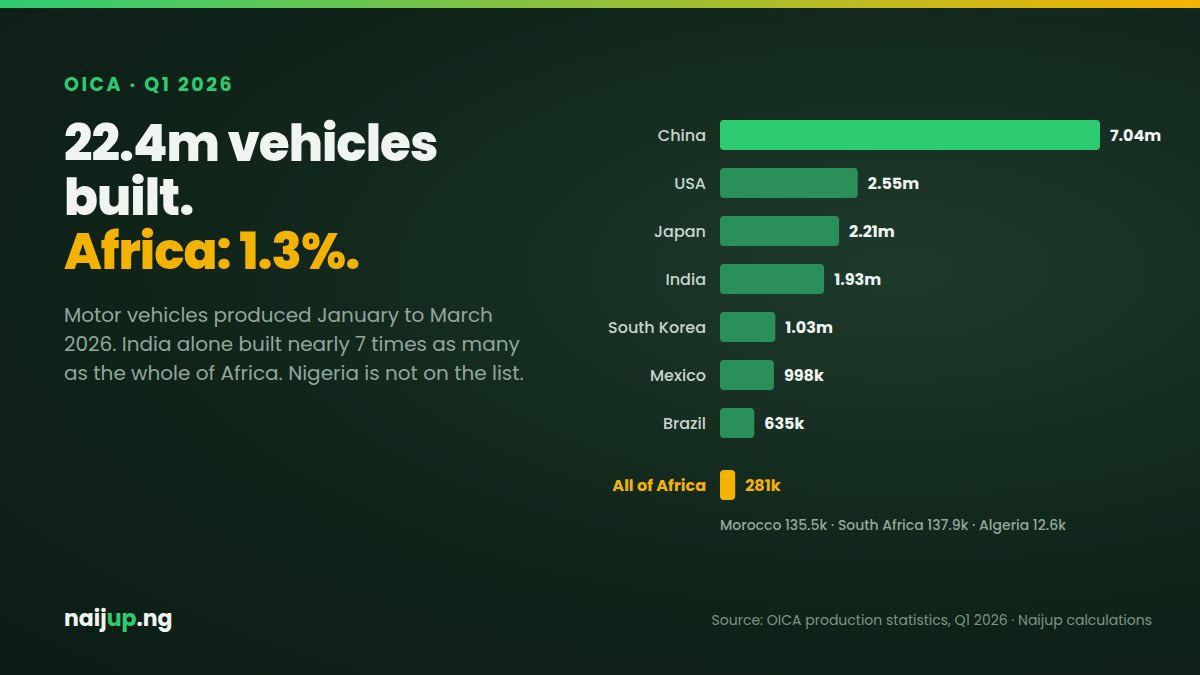
No. Only Morocco, South Africa and Algeria are listed for Africa in OICA's quarterly figures (Egypt reports yearly). Nigeria's assembly volumes are too small to be included.
Which African countries manufacture cars?
In OICA's Q1 2026 figures: South Africa (137,911 vehicles), Morocco (135,500) and Algeria (12,560). Egypt also produces vehicles but reports only yearly.
Data source: OICA (International Organization of Motor Vehicle Manufacturers), world motor vehicle production by country and type, Q1 2026. Population figures are rounded public estimates added by Naijup for context and are not from OICA. Growth rates and multiples are Naijup calculations.
Found this useful? Share it
Help friends, family and colleagues stay informed on Nigerian finance.
Keep reading
Related Topics



Conversation
Comments (0)
Sign in to join the conversation or like this post.

Mujeeb Olagunju
I am a finance professional with a strong background in economics and financial technology.,My work centers on building systems that support payments, digital banking, and investment solutions in emerging markets.,I have experience with risk management, transaction monitoring, fraud prevention, and the design of scalable financial products tailored to both retail and institutional clients.,With over 8 years of industry experience, I combine financial insight with technical expertise to deliver solutions that balance compliance, security, and business growth.,My goal is to bridge the gap between finance and technology, creating platforms that expand access to modern financial services and strengthen trust in digital finance.
97
Stories
30958
Reads
0
Likes
0
Comments