
Nigeria's 20 Richest Local Governments Are All in Lagos (Here's the Full Top 30)

Local governments are the tier of government closest to the people. They're meant to handle primary healthcare, local roads, markets, primary schools and sanitation. They're also the tier we know least about.
So we did something we haven't seen done much: we added up FAAC allocations for all 774 local government councils over 10 sharing months (September 2025 to July 2026) and ranked them.
The headline numbers
• Total allocated to all 774 councils: ₦5.21 trillion
• Richest council: Alimosho, Lagos, ₦33.81 billion
• Poorest council: Ifedayo, Osun, ₦4.06 billion
• Gap: Alimosho received 8.3 times what Ifedayo received
• Typical (median) council: about ₦5.94 billion, roughly ₦594 million a month
All 20 Lagos councils are in the top 20
| Rank | Council | State | 10-month allocation |
|---|---|---|---|
| 1 | Alimosho | Lagos | ₦33.81bn |
| 2 | Ajeromi/Ifelodun | Lagos | ₦27.53bn |
| 3 | Kosofe | Lagos | ₦27.22bn |
| 4 | Mushin | Lagos | ₦26.92bn |
| 5 | Oshodi/Isolo | Lagos | ₦26.82bn |
| 6 | Ojo | Lagos | ₦26.60bn |
| 7 | Ikorodu | Lagos | ₦26.20bn |
| 8 | Surulere | Lagos | ₦25.65bn |
| 9 | Agege | Lagos | ₦25.21bn |
| 10 | Ifako/Ijaye | Lagos | ₦24.89bn |
| 11 | Somolu | Lagos | ₦24.59bn |
| 12 | Ikeja | Lagos | ₦23.78bn |
| 13 | Eti-Osa | Lagos | ₦23.73bn |
| 14 | Amuwo-Odofin | Lagos | ₦23.71bn |
| 15 | Lagos Mainland | Lagos | ₦23.67bn |
| 16 | Badagry | Lagos | ₦23.14bn |
| 17 | Apapa | Lagos | ₦22.67bn |
| 18 | Epe | Lagos | ₦22.59bn |
| 19 | Lagos Island | Lagos | ₦22.56bn |
| 20 | Ibeju-Lekki | Lagos | ₦21.67bn |
Even Lagos's "smallest" council (Ibeju-Lekki, ₦21.67bn) received more than any council outside Lagos.
Ranks 21 to 30: Abuja and Rivers
| Rank | Council | State | 10-month allocation |
|---|---|---|---|
| 21 | Abuja Municipal | FCT | ₦17.88bn |
| 22 | Port Harcourt | Rivers | ₦13.14bn |
| 23 | Bwari | FCT | ₦12.27bn |
| 24 | Obio/Akpor | Rivers | ₦12.18bn |
| 25 | Gwagwalada | FCT | ₦11.38bn |
| 26 | Kwali | FCT | ₦10.98bn |
| 27 | Kuje | FCT | ₦10.94bn |
| 28 | Khana | Rivers | ₦10.57bn |
| 29 | Ogba/Egbema/Ndoni | Rivers | ₦10.51bn |
| 30 | Obua/Odual | Rivers | ₦10.47bn |
The first council outside Lagos, the FCT and Rivers is Bauchi LGA (Bauchi State) at number 32, with ₦10.29 billion.
Why Lagos councils earn so much: VAT
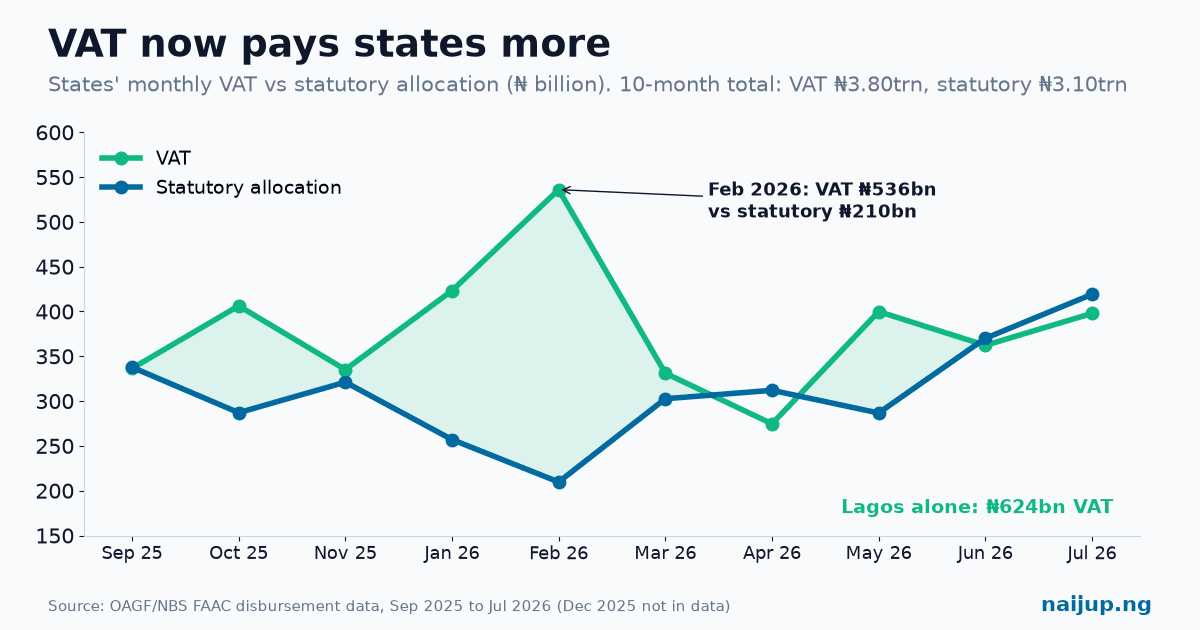
The secret is VAT. For Lagos councils, VAT made up 70% to 86% of their FAAC money. For the councils at the bottom of the table, it was 44% to 49%.
• Lagos's 20 councils received ₦502.9 billion, which is 9.7% of all LG allocations, although they're only 2.6% of the 774 councils.
• Of that, ₦402.6 billion was VAT, or 15.7% of all VAT shared to local governments.
Lagos has only 20 councils, while the state has a huge population and economy. More VAT is generated and shared there, but it is split among relatively few councils, so each one gets a big slice.
Kano has 44 councils. Lagos has 20.
Here's an interesting comparison:
• Kano's 44 councils together received ₦266.9 billion
• Lagos's 20 councils together received ₦502.9 billion
That's almost twice as much, shared among less than half the number of councils. On average, a Lagos council got ₦25.2bn and a Kano council about ₦6.1bn.
Average council allocation by state
| State | No. of councils | Average per council (10 months) |
|---|---|---|
| Lagos | 20 | ₦25.15bn |
| FCT | 6 | ₦12.29bn |
| Rivers | 23 | ₦9.85bn |
| Bayelsa | 8 | ₦8.69bn |
| Kaduna | 23 | ₦7.15bn |
| ... | ... | ... |
| Ekiti | 16 | ₦5.52bn |
| Akwa Ibom | 31 | ₦5.41bn |
| Imo | 27 | ₦5.33bn |
| Osun | 30 | ₦4.98bn |
Osun stands out at the bottom. It has 30 councils, more than most states of its size, so its share is divided into smaller pieces. Eight of the 15 lowest-earning councils in Nigeria are in Osun: Ifedayo, Atakumosa West, Ila, Atakumosa East, Ede North, Ola-Oluwa, Egbedore and Boluwaduro.
The bottom 10
| Council | State | 10-month allocation |
|---|---|---|
| Ifedayo | Osun | ₦4.06bn |
| Ilejemeji | Ekiti | ₦4.31bn |
| Bakassi | Cross River | ₦4.32bn |
| Atakumosa West | Osun | ₦4.43bn |
| Ewekoro | Ogun | ₦4.44bn |
| Ukwa East | Abia | ₦4.46bn |
| Ila | Osun | ₦4.46bn |
| Atakumosa East | Osun | ₦4.46bn |
| Ogun Waterside | Ogun | ₦4.49bn |
| Ede North | Osun | ₦4.49bn |
So, what is your council doing with it?
Even the lowest council in the country received about ₦400 million a month on average. The median council got close to ₦600 million a month. In July 2026 alone, 81 councils received ₦1 billion or more each.
That's real money. Ask your local government chairman:
1. How much did our council actually receive this year?
2. How much went to salaries, and how much to projects?
3. Where are the projects, and can we see them?
Final takeaway
FAAC money to local governments isn't small, and it isn't evenly shared. Lagos councils dominate because of VAT, Abuja and Rivers councils come next, and states with many small councils like Osun sit at the bottom.
Find your LGA, note the number, and start asking questions. Local government is where accountability is easiest, because the people in charge live down the road.
Data source: OAGF FAAC disbursement tables (Table IV, Local Government Councils), September 2025 to July 2026, as reported by the NBS. December 2025 was not in the data set we reviewed. Figures are "Total Net Allocation" per council as shown in the FAAC tables. These are amounts allocated to each council, not necessarily what reached council accounts after any state-level handling. We've checked our numbers carefully, but if you spot something off, please tell us.
Keep reading
Related Topics


Conversation
Comments (0)
Sign in to join the conversation or like this post.

Mujeeb Olagunju
I am a finance professional with a strong background in economics and financial technology.,My work centers on building systems that support payments, digital banking, and investment solutions in emerging markets.,I have experience with risk management, transaction monitoring, fraud prevention, and the design of scalable financial products tailored to both retail and institutional clients.,With over 8 years of industry experience, I combine financial insight with technical expertise to deliver solutions that balance compliance, security, and business growth.,My goal is to bridge the gap between finance and technology, creating platforms that expand access to modern financial services and strengthen trust in digital finance.
68
Stories
18561
Reads
0
Likes
0
Comments