
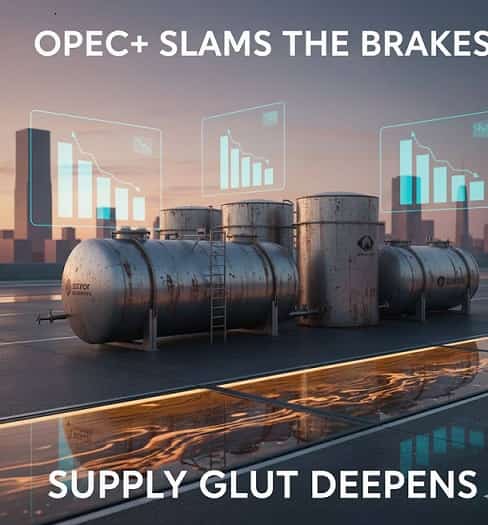
OPEC+ has paused its planned oil supply increases, keeping production steady through the first quarter of 2026 as a growing global surplus and uncertainty around Venezuela cloud the outlook.
The decision was reached at a brief virtual meeting on Sunday led by heavyweight producers Saudi Arabia and Russia, according to Bloomberg. The meeting reportedly lasted under 10 minutes - short, sharp, and decisive.
Why OPEC+ Is Playing It Safe
Oil markets are already awash with supply, while demand growth continues to lose momentum. Crude futures fell about 18% last year, their worst annual performance since the COVID-19 crash of 2020 and forecasts for 2026 point to an even wider supply glut.
Against this backdrop, OPEC+ is choosing caution over aggression.
Key producers confirmed that collective output will remain unchanged at least until the end of March 2026. Delegates said it would be premature to alter supply policy in response to recent political developments in Venezuela, following reports of U.S. action involving President Nicolás Maduro.
Several forces are driving the group’s cautious stance:
• Oversupply reality: Non-OPEC producers, particularly U.S. shale, continue to pump near record levels.
• Demand drag: China’s economic slowdown and high global interest rates are weighing on fuel consumption.
• The Venezuela wildcard: Despite headline noise, Venezuela produces only about 800,000 barrels per day, less than 1% of global supply.
Any meaningful recovery in Venezuelan output, analysts say, would take years even with renewed foreign investment.
Venezuela: Big Headlines, Limited Impact
Markets briefly reacted to fears that U.S. actions could disrupt Venezuelan supply, pushing oil prices higher. That reaction faded quickly.
With Venezuela’s current production so low, the immediate impact on global supply remains minimal. Bloomberg reports that key oil facilities were not damaged during the operation, reducing the risk of near-term disruptions.
President Donald Trump has said U.S. oil companies could invest billions to rebuild Venezuela’s energy infrastructure, but that remains a long-term possibility rather than an immediate market driver.
Oil Prices: Holding Up, But Barely
West Texas Intermediate (WTI) crude futures are hovering near one-week highs. The counter traded at $58.61 per barrel, up half a percent on the day after a volatile prior session that ended nearly 2% higher, supported by falling U.S. crude inventories and expectations of Federal Reserve rate cuts.
However, gains remain capped by:
• Persistent global oversupply
• Weak demand signals, particularly in Asia
• Saudi Arabia cutting crude selling prices to Asia for the third consecutive month.
From Market Share to Market Stability
The pause marks a clear shift in strategy. In April 2025, OPEC+ began rapidly restoring production cuts introduced in 2023 in an effort to reclaim market share lost to rivals such as U.S. shale producers.
Before Sunday’s decision, the group had agreed to restore about two-thirds of the 3.85 million barrels per day previously cut, leaving roughly 1.2 million barrels per day still offline. Even then, actual increases lagged due to production constraints and efforts to compensate for earlier overproduction.
Now, with demand softening and surplus building, price stability appears to have taken priority over aggressive output growth.
What This Means for Nigeria
For Nigeria, the implications are hard to ignore.
As Africa’s largest oil producer and a key OPEC member, Nigeria’s fiscal health remains tightly linked to oil prices and export volumes. By freezing output increases in an already oversupplied market, OPEC+ is signaling that crude prices may stay stable but subdued in the near term.
That’s bad news for a country where oil provides the bulk of foreign exchange earnings and a large share of government revenue. Limited price upside means tighter fiscal space, weaker buffers, and continued pressure on the naira.
Nigeria’s challenges are compounded by persistent oil theft, pipeline vandalism, and years of underinvestment, which have made it difficult to meet its OPEC production quota even when caps are relaxed.
If low prices persist, budget deficits could widen further, debt servicing costs could rise, and currency pressures could intensify.
The Bigger Picture
OPEC+, which includes the 13-member OPEC bloc and allies such as Russia, controls a significant share of global oil supply. Its decisions continue to shape oil prices and the economic fortunes of oil-dependent nations.
With forecasts pointing to a wider supply glut in 2026, the group’s cautious stance sends a clear message: market stability now matters more than pumping more barrels.
For countries like Nigeria, the takeaway is blunt but unavoidable: optimize existing output, fix structural production problems, and accelerate diversification.
Oil alone won’t save the budget anymore.
Keep reading
Related Topics





Conversation
Comments (0)
Sign in to join the conversation or like this post.