
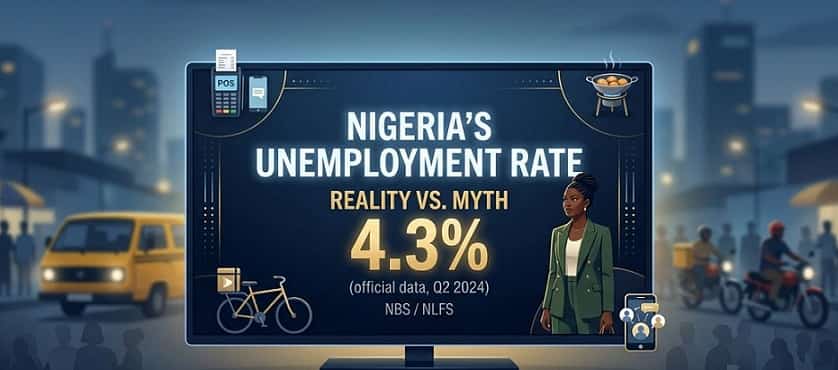
The government says Nigeria's unemployment rate is 4.3%. So why does it feel like everyone is either underpaid, underemployed, or already booking flights out?
If you only glance at the official unemployment figures in Nigeria, you might think you understand the job market. But spend a day talking to graduates, small business owners, or even employed workers and the story quickly falls apart.
There’s a gap. A big one. And it sits right between what the data says and what people are actually living.
The “Real Numbers” (On Paper)
Nigeria’s unemployment data is typically released by the National Bureau of Statistics (NBS). According to them, Nigeria’s unemployment rate dropped to around 4 – 5% in 2023 after the methodology change. A dramatic fall from the 33.3% peak recorded in Q4 2020 to 4.3% in Q2 2024
At first glance, that looks like a miracle recovery.
Except it wasn't really that. The jobs didn't come. The definition did.
One Hour. That's All It Takes
The new Nigeria Labour Force Survey (NLFS), introduced to align with International Labour Organization (ILO) international standards, defines the "employed" as anyone who worked one hour or more for pay or profit in the last seven days.
One hour. Per week. And you're counted as employed.
So that graduate who gets random gigs once in a while? Employed. The woman selling akara at the bus stop on a Monday morning? Employed. The guy doing occasional POS runs between job applications? Also employed.
This method, controversially, defines individuals working at least one hour per week as employed, raising concerns that it underrepresents unemployment and distorts economic realities, despite the change being technically consistent with global standards.
The switch was made in the name of international comparability. That's a fair goal. But Nigeria's labour market is not comparable to the countries these standards were originally built around. When the baseline for "employment" is one hour, the number looks clean, but the story underneath doesn't.
The Numbers Behind the Number
Even taking the 4.3% headline at face value, what sits just beneath it tells the real story.
93% of Nigerian workers are in the informal sector. As of 2024, 92.7% of the Nigerian labour force is engaged in informal employment, only 7.3% hold formal jobs, according to the NBS. Traders, artisans, okada riders, freelancers, petty hustlers. No pension. No health insurance. No guaranteed income. Technically employed. Practically on their own.
Only 1 in 7 workers earns a salary. Just 14.4% of employed Nigerians are in paid employment, meaning the remaining 85%+ are self-employed in some form. Which, in most cases, means scraping together income from wherever they can find it.
Underemployment is the real headline. About 12.2% of employed Nigerians were underemployed, working less than 40 hours per week but willing and available to work more. Another 7.2% were employed but actively searching for additional work , a sign of deep dissatisfaction with what their current "job" actually pays.
The misery index is climbing. Despite the fall in the unemployment rate, Nigeria's misery index (the sum of unemployment and inflation) rose to 38.3% in Q2 2024, up from 26.7% in Q2 2023. People may be more "employed" on paper. But they are feeling the economic pressure more intensely, not less.
The Youth Problem Nobody Wants to Talk About
The NBS reported a youth unemployment rate of 6.5% among 15- to 24-year-olds in 2024. But in 2020, under the old methodology, that same figure was 53.4% , and 37.2% for 25- to 34-year-olds. Experts say those earlier numbers are far more reflective of conditions on the ground.
The numbers changed. The conditions didn't.
Nigeria ranks 172nd out of 183 countries in the 2023 Global Youth Development Index, coming in second-to-last specifically on youth employment and opportunity. That's not a ranking you earn while posting 4–5% youth unemployment. Something doesn't add up.
And then there's japa, the single most honest economic data point Nigeria has produced in years. Six in ten Nigerian youth say they have considered emigrating, mostly to find jobs or escape economic hardship. (Afrobarometer)
That's not the behaviour of a generation that feels like the labour market is working for them. You don't plan your exit from a country with a healthy job market.
Why Low Unemployment Can Coexist With High Poverty
This is where it gets almost counterintuitive, and the World Bank puts it plainly.
In poor countries like Nigeria, unemployment stays low not because people are thriving, but because they simply cannot afford not to work. Without social protection safety nets, "if you do not work, you cannot eat." (World Bank)
So they work. They sell. They work hard. The unemployment rate stays low.
By 2025, about 139–140 million Nigerians (about 61%–63% of the population) were living below the poverty line.
Low unemployment. High poverty. Both true at the same time.
This is the core problem with using a single statistic to describe a complex labour market. A country can have near-full "employment" by ILO definition while its people are economically suffocating. The number doesn't lie, exactly, it just doesn't tell the whole truth.
What We Should Actually Be Watching
If the headline unemployment rate isn't the full picture, here's what gives a more honest read on Nigeria's labour market:
- Underemployment rate: Consistently in double digits, this captures everyone who is technically working but not nearly enough.
- Informal employment rate: At 93%, this tells you how many workers have zero stability, zero protection, and zero guaranteed income.
- Real wages vs. inflation: You can be employed and still be poorer than you were two years ago. With inflation above 25%, that's exactly what's happening to millions.
- Labour underutilisation: The broadest measure, combining unemployment, underemployment, and the people who have simply given up looking.
- The misery index: It is calculated by adding the seasonally adjusted unemployment rate to the annual inflation rate, because what ordinary Nigerians feel isn't just whether they have a job. It's whether having that job lets them actually live.
The Bottom Line
Nigeria's unemployment statistics have improved, technically. But the lived experience of financial precarity, underemployment, and career frustration has not improved at the same pace, especially for young people.
Policymakers should not focus indiscriminately on creating any kind of job. The economy needs to generate productive jobs and meaningful work that can sustain households and actually lift people out of poverty.
A percentage on a dashboard is not the same as a life that works. The stats aren't exactly wrong, they're just incomplete. And when data and lived reality move in opposite directions, that's not just a statistical problem. It's a development problem.
Keep reading
Related Topics




Conversation
Comments (0)
Sign in to join the conversation or like this post.