
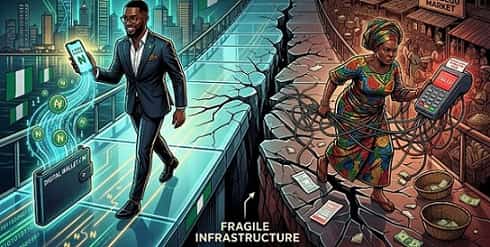
The idea was sound. The ground it landed on wasn't.
When the Central Bank of Nigeria first pushed its cashless policy, the idea sounded simple: reduce cash usage, modernise payments, and bring more Nigerians into the formal financial system.
On paper, it made perfect sense.
In reality? The story has been complicated. Because depending on who you ask, the fintech founder or the garri seller. Nigeria's cashless push is either a necessary leap forward or an everyday frustration that is slowly eating into their margins.
What the Cashless Policy Is Actually Trying to Fix
Nigeria has historically been a cash-heavy economy. Large volumes of transactions happen outside the banking system, making it harder to track economic activity, reduce fraud, or implement effective monetary policy.
The cashless policy, launched in 2012 and gradually extended nationwide, was built around a few goals: reduce the volume of physical naira in circulation, promote digital payments (transfers, POS, mobile banking), improve financial inclusion by bringing the unbanked into the system, and strengthen transparency by reducing corruption enabled by untraceable cash.
These are not bad goals. In fact, they are the right goals. The problem, as we will get into, is not the destination, it is how Nigeria has been trying to get there.
Where It Is Actually Working
Digital adoption has genuinely surged. Nearly 15 years after the policy launched, around 60% of Nigeria's population participated in digital payments in 2023, with electronic transfers now dominating the market through platforms like NIBSS Instant Payments (NIP). Sending money today, for those with reliable smartphones and internet is dramatically easier than it was in 2010.
Fintech growth is a direct dividend. The cashless policy helped create the conditions that allowed Nigeria's fintech ecosystem to explode. Payments infrastructure, agency banking, digital wallets, businesses built around these have grown rapidly and attracted global investment. That means jobs, innovation, and economic activity that did not exist before. Large corporations like the Nigerian Bottling Company adopted digital payments early and reported faster capital access, lower cash handling costs, and reduced revenue leakage.
Better money trails, cleaner records. Digital transactions create records. For businesses, this means better financial tracking, easier access to credit, and a cleaner audit trail. For the government, it means better visibility into economic activity and, in theory, more tax revenue from previously invisible transactions.
Where It Is Hurting
The 2023 naira redesign was a policy disaster. In October 2022, CBN Governor Emefiele announced that newly redesigned banknotes would replace existing ones. Nigerians had until January 31, 2023 to swap old notes. Banks could not keep up with demand. New notes barely entered circulation. People queued for hours and went home empty-handed.
For market traders, the effect was immediate and brutal. Women who had spent years building small, steady businesses selling fruit, garri, provisions saw sales collapse within weeks because customers simply had no cash to spend. Those who tried to adapt by accepting bank transfers ran into a different wall: failed transactions, disabled options, and fake payment alerts that left them out of pocket with no recourse. For many, the losses were not abstract. They were the difference between eating two meals a day or one.
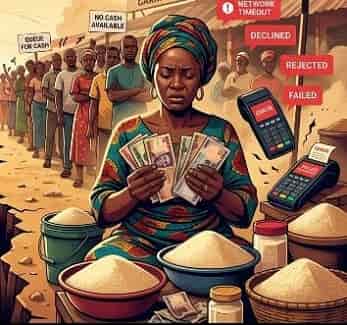
Failed transactions are a systemic problem. "Transfer failed but money deducted" is practically a national experience at this point. It is almost a meme, except it is not funny when it happens on a Monday morning and you are trying to pay for petrol or settle a hospital bill. The issues are structural: poor network infrastructure, overloaded banking systems, and a refund process that can take days or weeks. Business owners have described waiting eight or more hours for payments confirmed as sent that never arrived.
Transaction charges are a hidden tax on the poor. Every digital transaction in Nigeria carries a stack: the Electronic Money Transfer Levy (EMTL), commission on transfers, VAT, stamp duty on deposits, account maintenance fees, USSD charges even when the transaction fails, ATM withdrawal fees, and card maintenance costs.
For an average earner keeping track, monthly bank charges can quietly climb to figures that would otherwise cover a family's food budget for weeks. Traders have started refusing digital payments above certain amounts because by the time the charges stack up, the margin on the sale is gone.
What was once hailed as progress has become, in the words of economists, a hidden tax on the poor.
The informal sector is being left behind. A large part of Nigeria's economy operates informally; market traders, artisans, roadside vendors, the akara seller, the ogi woman. These are not people resistant to change for the sake of it. They depend on daily cash flow to restock and survive, do not fully trust digital systems after repeated failures, lack reliable smartphones or consistent internet, and cannot absorb the cost of failed transactions or protracted disputes.
The healthcare system took a direct hit. Over 90% of Nigerians pay for healthcare out of pocket. When the 2023 cash crunch hit, patients could not access money to pay for treatment. In an economy where health insurance barely exists and the safety net is thin, limiting access to cash is not just an economic inconvenience, it is a health risk.
The Core Contradiction: Vision Without Infrastructure
The cashless policy was introduced without adequate accounting for Nigeria's real conditions: inadequate payment infrastructure, persistent financial exclusion, low digital and financial literacy, unreliable power and internet, and a population with deep and often justified mistrust of the banking system.
Research confirms e-payment systems have a positive relationship with economic growth in theory. But the data also shows that in Nigeria's current state, they do not yet significantly drive it. The infrastructure to make digital payments cheap, reliable, and trustworthy is still catching up.
The result is a policy that has delivered its upside primarily to those already well-positioned; urban, banked, digitally literate, formally employed. The downside has been absorbed almost entirely by small traders, rural communities, the unbanked, and low-income earners. That is a serious equity problem.
What Needs to Change
The cashless direction is correct. The execution needs serious repair.
First, fix the infrastructure. Fewer failed transactions is not optional, it is the foundation of public trust. No amount of policy ambition survives a population that has been debited without receiving value one too many times.
Second, make it affordable. Low-value, everyday transactions should not carry the same charge burden as large transfers.
Third, enforce refund timelines. The 72-hour resolution rule exists, it just isn't enforced consistently. That needs to change. Banks that repeatedly fail to meet it should face real consequences, not just guidelines.
Fourth, invest in the people. Digital and financial literacy programmes are not a nice-to-have. For the policy to work equitably, traders, market women, and informal sector workers need to understand the system well enough to use it, and to demand accountability when it fails them.
Finally, protect the informal sector. The people who keep this economy moving at the grassroots level deserve more than being forced to adapt on their own.
The Bottom Line
Nigeria is not choosing between cash and cashless. It is navigating the messy, painful, necessary middle, and right now, the people carrying the most weight in that navigation are the ones who can least afford to.
The cashless policy is not wrong in principle. The problem is sequencing: the CBN tried to force cashless behaviour onto an economy that did not yet have reliable internet, trustworthy infrastructure, affordable transaction costs, or strong fraud protection to make it work fairly.
Until charges drop, infrastructure stabilises, and failed transactions stop being a daily reality, calling this policy a win is premature.
The average Nigerian is not asking for a fully digital economy. They are asking for one that actually works.
Keep reading
Related Topics



Conversation
Comments (0)
Sign in to join the conversation or like this post.