
Nigeria’s Cashew Industry: A $10 Billion Opportunity Waiting to Be Harvested
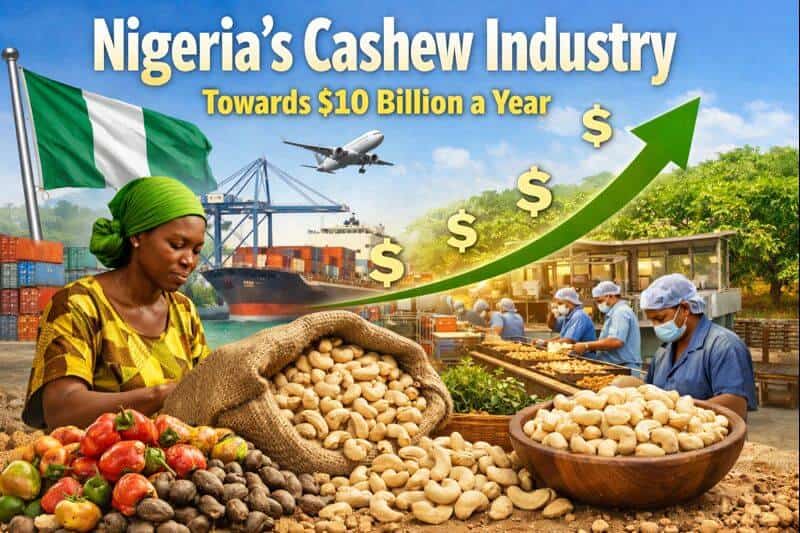
Nigeria’s cashew sector is stepping out of the shadows of casual farming and entering the spotlight as one of the country’s fastest‑growing agricultural success stories. Once considered just another rural crop, cashew is now increasingly recognised as a strategic driver of foreign exchange earnings, jobs, and non‑oil economic growth. Industry leaders now argue that Nigeria could generate up to $10 billion annually from the cashew value chain, provided the right investments and policies come together.
This shift from marginal activity to headline‑worthy economic opportunity didn’t happen overnight. A confluence of export growth, emerging policy coordination, private sector engagement, and renewed interest in agricultural value chains has thrust the cashew industry into the national conversation. For Nigeria, which continues to seek alternatives to oil revenue, cashew is quickly being positioned as a strategic “agro‑industrial pivot” with real potential.
Exports Are Surging, Nigeria Is Competing Globally
One of the most striking indicators of Nigeria’s emergence in the global cashew market is export growth. Data from 2025 shows cashew exports reaching nearly $400 million in the first half of the year, an approximately 80% increase compared with the same period in 2024. This level of performance catapulted cashew into the top three of Nigeria’s non‑oil exports, among more than 230 products.
This isn’t just about raw nuts. Kernels,the processed form of cashew also recorded significant export growth, climbing in export rankings and suggesting that buyers around the world are increasingly receptive to higher‑value Nigerian cashew products.
These hard numbers are meaningful for Nigeria’s broader economic diversification efforts. As non‑oil exports expand,with agricultural commodities such as cashew and cocoa growing rapidly,the country’s foreign exchange profile becomes more balanced and resilient. Cashew’s performance is now being watched alongside other major non‑oil earners, signalling a potential structural shift in export composition.
Nigeria Is Among the World’s Leading Cashew Producers
Nigeria currently ranks among the top global producers of cashew nuts, a position reflecting productive capacity across multiple states. Farmers in regions such as Kogi, Imo, and the North Central belt contribute to the national output, with some states recording millions of dollars in export earnings from cashew alone in recent years.
Production fundamentals are strong in Nigeria:
• Cashew thrives in a variety of soil types and climatic zones, making it suitable for cultivation across much of the country.
• Smallholder farmers have decades of experience with the crop, forming a large base of labour and knowledge.
• Domestic demand remains robust, even as exports rise.
In neighbouring West African countries like Côte d’Ivoire and Ghana, collaboration on cashew processing and marketing strategies has helped strengthen regional competitiveness. Nigeria’s engagement in such continental developments positions it to benefit as part of a pan‑African cashew growth story.
The $10 Billion Vision: From Potential to Reality
In early 2026, the National Cashew Association of Nigeria (NCAN) renewed one of the sector’s most ambitious goals: positioning the cashew value chain as a $10 billion‑a‑year contributor to the Nigerian economy. This figure reflects not just raw nut exports but the entirety of value‑added products from processed kernels to specialty cashew items like oils and snacks.
To understand the significance of this number, it helps to unpack what “value chain” really means.
• Raw nuts contribute the baseline export value.
• Processed kernels generate higher prices in global markets.
• By‑products and innovations,such as cashew apples, juices, oils, and processed snacks represent emerging markets with premium pricing.
Advocates argue that Nigeria’s current exports capture only a fraction of the total income possible along these layers. With improved processing, logistics, and market development, the value captured per nut exported could multiply, driving significantly higher revenues.
Policy and Institutional Momentum Is Building
Another key driver behind recent progress is growing institutional focus and coordination. Public and private actors, from government agencies to industry associations,are working to strengthen policy frameworks backing the industry.
Initiatives such as the Cashew Processors Directory designed to map out local processors and connect them with investors and international buyers, are helping to professionalise Nigeria’s cashew ecosystem. This directory also improves transparency and market access, two critical bottlenecks previously cited by traders and exporters.
State governments are also stepping into the frame. For example, Kogi State announced plans to boost national production by planting millions of hybrid cashew trees and expanding processing capacity as part of its agricultural development agenda. This kind of sub‑national initiative highlights how local leadership can contribute meaningfully to national targets.
Strategic forums and investor meetings convened by commerce ministries, research institutions, and export promotion councils further signal a collective push toward deeper engagement with investors, technology partners, and value‑chain innovators.
Jobs and Inclusive Growth: The Social Dimension
Beyond export values and headline figures, the cashew industry’s most transformative impact could be social. Nigeria’s agricultural labour force is sizeable, with millions of smallholder farmers already participating in cashew cultivation. Analysts estimate that the sector employs over five million Nigerians directly, and with expanded processing and industrial activity, that figure could grow substantially.
Jobs in cashew are not limited to farming. The industry ecosystem includes:
• Harvesting and sorting
• Processing and packaging
• Quality control and certification
• Logistics and export operations
• Marketing and brand development
For rural communities, these job pathways can mean greater economic stability and diversified income sources. Cashew’s seasonal rhythm also complements other crops, allowing farmers to hedge against risks like climate fluctuations, market shocks, and crop failures in other staples.
From Raw Material Exporter to Value‑Added Producer
Nigeria’s cashew story today is less about raw nut export alone and more about moving up the value chain. Historically, limited local processing capacity meant that most cashew nuts were sold abroad in unprocessed form, leaving much of the global market value with processors in importing countries.
Today, that dynamic is shifting. Export figures show growth not only in raw nuts but in kernel exports, indicating increasing domestic processing and international competitiveness.
The improvement is slow but visible. As more processing plants come online,supported by private sector investment and targeted financing,the gap between raw nut export and finished product export is expected to narrow. In some cases, international partners are providing technology transfer, capacity building, and expertise to accelerate Nigeria’s technical competence in value addition.
Challenges Still on the Table
Despite noticeable progress, the cashew industry still faces structural challenges that will need sustained attention:
• Processing bottlenecks: Many existing facilities are under‑capitalised or lack modern technology, limiting local value addition.
• Finance access: Farmers and processors often struggle to secure affordable credit to expand operations.
• Infrastructure gaps: Poor rural roads and logistics networks increase cost of moving nuts from farms to factories and ports.
• Competition: Foreign investors with deeper resources sometimes crowd out local enterprises in processing and export markets.
Addressing these gaps requires coordinated action both at the policy level and across the private sector including incentives for manufacturing, improved access to credit, and infrastructure investments tailored to agricultural supply chains.
The Road Ahead: A Strategic Growth Phase
As Nigeria enters 2026, the cashew industry stands at a crossroads:
• It can continue to grow incrementally as an export commodity, or
• It can break through to become a major value‑added agro‑industry with global relevance.
The difference lies in how stakeholders harness recent momentum. Scaling processing capacity, improving product quality, expanding market access, and creating enabling policy environments are all critical steps. The recent focus on the cashew sector from export records to strategic directories and international partnerships, shows that stakeholders are increasingly thinking in those terms.
For everyday Nigerians, the cashew industry’s rise offers a real economic opportunity,not just for farmers, but for workers, entrepreneurs, and communities seeking sustainable income streams in a diversifying economy.
If Nigeria can successfully turn its cashew potential into tangible outcomes, the industry may no longer be a marginal agricultural sector but a key pillar of national economic strategy, contributing billions of dollars annually, creating jobs, and enhancing rural livelihoods.
Keep reading
Related Topics






Conversation
Comments (0)
Sign in to join the conversation or like this post.