
Nigeria’s Biggest Airlines in 2026: Passengers, Fleet, Routes and Business Size
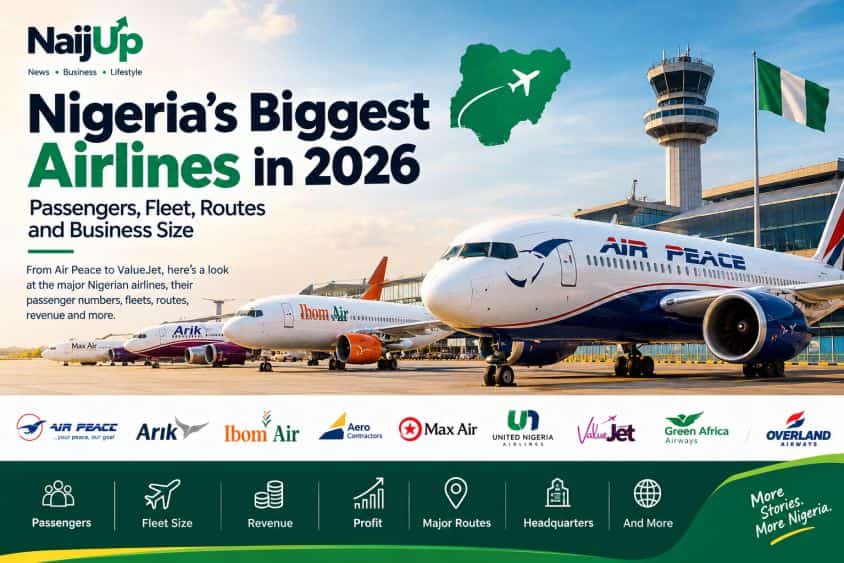
Nigeria’s aviation industry is one of the most important parts of the country’s transport and business economy. Millions of passengers travel by air every year, connecting Lagos, Abuja, Port Harcourt, Kano, Enugu, Uyo and other Nigerian cities, while Nigerian airlines also connect the country to destinations across Africa, Europe, the Middle East, Asia and the Caribbean.
But which airlines are the biggest in Nigeria?
Passenger numbers provide one way of measuring an airline’s size, but fleet size, revenue, profitability, international routes and aircraft investment can tell a different story.
Using the latest available passenger data, airline disclosures and 2026 fleet and route information, here is a look at some of the major airlines operating in Nigeria.
Nigeria’s Major Airlines at a Glance
The latest full-year domestic passenger figures reported from NCAA data show Air Peace leading the market, followed by Arik Air, Ibom Air, Aero Contractors and Max Air.
| Airline | 2024 Passengers | Headquarters/Base | Major Market |
| Air Peace | 3.11 million | Lagos | Domestic, regional and international |
| Arik Air | 2.24 million | Lagos | Domestic |
| Ibom Air | 1.32 million | Uyo | Domestic and regional |
| Aero Contractors | 964,900 | Lagos | Domestic and aviation services |
| Max Air | 915,918 | Kano | Domestic and northern Nigeria |
| Green Africa | 389,399 | Lagos | Domestic |
| Dana Air | 299,040 | Lagos | Domestic |
The figures show how concentrated Nigeria’s domestic airline market is around a relatively small number of carriers.
1. Air Peace
Air Peace is Nigeria’s largest airline by recent domestic passenger traffic and has developed the country’s most extensive international network among locally owned carriers.
The airline is headquartered in Lagos and uses the city as its principal operating hub.
In 2024, Air Peace carried more than 3.1 million passengers, representing approximately 27% of the domestic market.
Its domestic network connects Lagos and Abuja with numerous Nigerian cities, including Port Harcourt, Enugu, Kano, Uyo, Owerri, Calabar, Benin, Asaba, Warri, Yola and other destinations.
Air Peace has also expanded significantly outside Nigeria.
Its international and regional network includes destinations such as London, Johannesburg, Mumbai, Jeddah, Accra, Abidjan, Dakar, Banjul, Freetown, Monrovia, Lomé, Cotonou and Douala.
The airline has continued investing in aircraft. Its fleet includes Boeing and Embraer aircraft, while the company has also announced additional Boeing 737 and Embraer aircraft acquisitions.
However, there is no reliable publicly disclosed market valuation for Air Peace because it is privately owned.
Aircraft order values should also not be confused with company valuation. An aircraft order worth hundreds of millions of dollars does not mean the airline itself is worth the same amount.
2. Arik Air
Arik Air remains one of the most important names in Nigerian aviation.
The Lagos-based airline carried approximately 2.24 million passengers in 2024, making it the second-largest domestic carrier by passenger traffic according to the reported NCAA figures.
Arik has historically operated an extensive Nigerian network, with Lagos and Abuja serving as major operating centres.
However, the airline's financial position is very different from its passenger numbers.
Arik Air has been under AMCON receivership since 2017. This makes it an important example of why passenger traffic alone cannot be used to determine an airline's financial strength or company value.
An airline can carry millions of passengers while simultaneously dealing with substantial debt or other financial obligations.
3. Ibom Air
Ibom Air is owned by the Akwa Ibom State Government and is headquartered in Uyo.
The airline started operations in 2019 and has grown into one of Nigeria's major domestic carriers.
Ibom Air transported approximately 1.32 million passengers in 2024.
One of the most interesting aspects of Ibom Air is that the company has publicly disclosed recent financial results.
For 2024, Ibom Air reported:
- Revenue: ₦96 billion
- Operational profit: ₦16.6 billion
- Net profit: ₦6.8 billion
The airline had reported a net loss in 2023, making the move to profitability in 2024 particularly notable.
Ibom Air's network includes important Nigerian cities such as Lagos, Abuja, Uyo, Calabar, Enugu and Port Harcourt. It has also expanded into regional West African operations.
The airline has been investing in newer aircraft, including Airbus A220 aircraft, as it develops its fleet.
4. Aero Contractors
Aero Contractors is one of Nigeria's oldest aviation companies.
Established in 1959, the company is headquartered in Lagos and has played a major role in Nigerian aviation for decades.
Aero Contractors transported approximately 965,000 passengers in 2024.
Unlike airlines focused exclusively on scheduled passenger flights, Aero Contractors has historically operated a broader aviation business involving passenger services, charter operations, helicopter services and aviation support.
Its passenger network has included Lagos, Abuja, Port Harcourt, Kano, Benin, Calabar, Asaba, Sokoto and Yola.
Its long operating history also makes Aero Contractors an important part of the development of Nigeria's aviation industry.
5. Max Air
Max Air is one of Nigeria's major northern-based airlines.
The airline is headquartered in Kano and has an important operating presence at Mallam Aminu Kano International Airport.
Max Air carried approximately 916,000 passengers in 2024.
Its network has connected northern Nigerian cities with Abuja and Lagos, as well as destinations including Yola, Katsina, Maiduguri, Bauchi and Port Harcourt.
Max Air has also been involved in international and pilgrimage operations, giving it a business model that differs from airlines focused primarily on domestic scheduled flights.
6. United Nigeria Airlines
United Nigeria Airlines is one of the newer Nigerian carriers.
The airline began commercial operations in 2021 and has expanded considerably since then.
In February 2026, the airline reported that it had reached 10 aircraft and served 16 Nigerian cities, while also expanding into regional West African operations with Ghana as its first international destination.
Its network includes cities such as Lagos, Abuja, Enugu, Asaba, Owerri, Port Harcourt, Benin, Kano, Ilorin and other Nigerian destinations.
United Nigeria demonstrates the growing competition among newer privately owned airlines in the Nigerian market.
7. ValueJet
ValueJet is another relatively young Nigerian airline headquartered in Lagos.
The airline operates domestic and regional services and has expanded its fleet since beginning commercial operations.
Its network has included routes linking Lagos and Abuja with Nigerian destinations such as Port Harcourt, Owerri, Jos and other cities.
ValueJet is part of the growing segment of Nigerian airlines attempting to increase regional connectivity while operating relatively smaller aircraft.
8. Green Africa Airways
Green Africa Airways is a Lagos-based airline that entered the Nigerian market with a low-cost business model.
The airline carried approximately 389,000 passengers in 2024.
Its network has included Lagos, Abuja, Ibadan, Ilorin, Akure, Benin, Enugu, Owerri and Port Harcourt.
Green Africa's model focuses on domestic connectivity using smaller aircraft, allowing it to target routes where operating larger aircraft may be less economical.
9. Overland Airways
Overland Airways is another established Nigerian airline headquartered in Lagos.
The airline has historically focused on connecting major Nigerian cities with underserved domestic and regional destinations.
Its network has included Lagos, Abuja, Ibadan, Ilorin, Akure, Jalingo, Warri, Minna and other destinations.
Overland has also operated regional aircraft, which can be useful for routes where passenger volumes do not justify larger Boeing or Airbus aircraft.
Passenger Traffic Does Not Equal Airline Value
One of the most important points when comparing Nigerian airlines is that passenger traffic should not be confused with company valuation.
There are several different ways to measure an airline's size.
Passenger volume
This measures how many passengers an airline transports.
By this measurement, Air Peace was the largest Nigerian domestic airline in the latest full-year data.
Fleet size
This measures the number of aircraft an airline has available or operates.
However, fleet figures need to be treated carefully because aircraft can be active, parked, undergoing maintenance, stored or awaiting delivery.
Revenue
Revenue measures the amount of money generated from operations before expenses.
Ibom Air, for example, reported ₦96 billion in revenue in 2024.
Profit
Profit provides another perspective because an airline can generate high revenue while still making a loss.
Ibom Air reported a ₦6.8 billion net profit in 2024.
Company valuation
Company valuation is different from all of the above.
Most Nigerian airlines are privately held, meaning there is no continuously traded market price for their shares.
As a result, reliable public valuations are not available for many of the country's major airlines.
Why Lagos Dominates Nigerian Aviation
Lagos remains the most important aviation hub in Nigeria.
The city's importance is driven by its position as Nigeria's largest commercial centre and a major destination for business, tourism, finance and international travel.
Many domestic routes either originate from or connect through Lagos.
Abuja is another major hub because of its position as Nigeria's political and administrative capital.
Other important aviation centres include Port Harcourt, Kano, Enugu and Uyo.
The growth of airlines such as Ibom Air and United Nigeria is also helping to improve direct connections between secondary Nigerian cities instead of forcing passengers to travel through Lagos or Abuja.
The Future of Nigerian Airlines
Nigeria's airline industry is undergoing significant changes.
Several airlines are investing in newer aircraft, expanding domestic routes and seeking opportunities in regional and international markets.
Air Peace has developed a substantial international network, while Ibom Air has been investing in newer aircraft and United Nigeria has expanded its fleet and route network.
At the same time, airlines continue to face major challenges.
These include:
- High aviation fuel costs
- Foreign exchange volatility
- Aircraft acquisition and leasing costs
- Maintenance expenses
- Airport charges
- Infrastructure limitations
- High operating costs
- Access to financing
- Currency exposure on international aircraft and maintenance contracts
For Nigerian airlines, growing passenger numbers are therefore only one part of the challenge. Sustainable profitability will depend on controlling costs, improving aircraft utilisation, maintaining reliable schedules and developing routes with sufficient passenger demand.
Final Takeaway
Nigeria has a diverse airline industry made up of established carriers, newer private airlines, regional operators and state-backed aviation companies.
Air Peace currently leads the domestic market by passenger traffic and has developed an extensive international network. Arik Air remains a major carrier by passenger numbers despite its long-running financial and receivership situation. Ibom Air has demonstrated strong recent financial performance, while newer operators such as United Nigeria and ValueJet are expanding their presence.
The most important lesson is that the biggest airline by passenger numbers is not automatically the most valuable or profitable airline.
Passenger traffic, fleet size, revenue, profit, assets and company valuation are separate measurements and should be analysed independently.
As Nigeria's economy, tourism, business travel and regional trade develop, the airlines that can combine fleet investment with efficient operations and sustainable routes will remain important players in the country's economy.
Data note: Passenger figures in this article are based primarily on the latest full-year NCAA traffic data available for 2024. Fleet and route information reflects available 2026 airline disclosures and aviation fleet information. Because most Nigerian airlines are privately held, reliable current company valuations are not publicly available. Aircraft purchase or order values should therefore not be presented as the valuation of an airline.
Keep reading
Related Topics


Conversation
Comments (0)
Sign in to join the conversation or like this post.

Mujeeb Olagunju
I am a finance professional with a strong background in economics and financial technology.,My work centers on building systems that support payments, digital banking, and investment solutions in emerging markets.,I have experience with risk management, transaction monitoring, fraud prevention, and the design of scalable financial products tailored to both retail and institutional clients.,With over 8 years of industry experience, I combine financial insight with technical expertise to deliver solutions that balance compliance, security, and business growth.,My goal is to bridge the gap between finance and technology, creating platforms that expand access to modern financial services and strengthen trust in digital finance.
62
Stories
17900
Reads
0
Likes
0
Comments