
Nigeria Beats Its 2025 Inflation Target as Headline Rate Falls to 14.45%
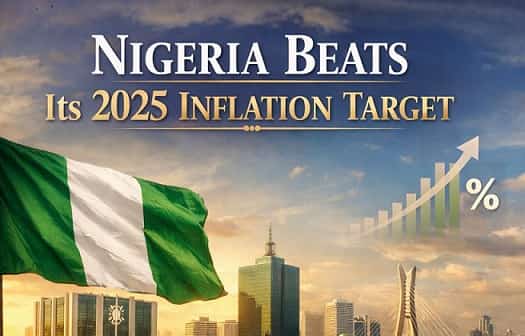
Nigeria’s inflation story just took a rare, welcome turn.
Headline inflation eased to 14.45% in November 2025, down from 16.05% in October, per the National Bureau of Statistics (NBS) Consumer Price Index (CPI) report. That’s a 1.6 percentage-point drop month-on-month, marking the eighth consecutive monthly decline this year and crucially, beating President Bola Tinubu’s 15% target for 2025.
For an economy battered by persistent inflation over the past two years, this decline offers more than data relief: it brings renewed confidence.
The Big Picture: Inflation Is Cooling, But Not Evenly
On a year-on-year (YoY) basis, headline inflation hit 14.45%, a 20.15 percentage-point drop from 34.60% in November 2024. Much of this reflects the 2024 CPI rebasing, which resets the base year and mechanically lowers annual readings.
Still, the direction matters. Inflation has fallen for eight straight months, hitting its lowest level in five years (last seen in October 2020 amid COVID-19).
Prices continue to rise, they are just rising more slowly. Month-on-month (MoM), headline inflation ticked up to 1.22% from 0.93% in October, signaling a slight acceleration in the pace of increases.
CPI Update: Prices Are Still Climbing
The CPI rose to 130.5 points in November, up 1.6 points from 128.9 in October.
This confirms what consumers feel: inflation is slowing, but prices aren't falling.
Urban vs. Rural Inflation: The Gap Narrows
Trends varied by location:
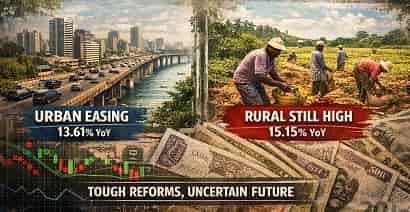
1. Urban: 13.61% YoY (down from 37.10% a year ago); MoM eased to 0.95% from 1.14%.
2. Rural: 15.15% YoY (down from 32.27%); higher than urban but still sharply lower YoY.
Price pressures are cooling faster in cities, leaving rural households under more strain.
Food Inflation: Lower on Paper, Higher at the Market
Nigeria’s most sensitive gauge, food inflation dropped to 11.08% YoY from 39.93% in November 2024. Again, much of this is technical, thanks to the CPI rebasing.
MoM, jumped to 1.13% from -0.37% in October, driven by festive demand, insecurity in farm belts, and supply disruptions.
Key items driving increases:
- Dried Tomatoes
- Cassava Tubers
- Ground Pepper
- Eggs
- Crayfish
- Unshelled egusi
- Oxtail
- Fresh Onions
Food looks better in headlines than at the market.
Core Inflation: Still Elevated
Core inflation, which strips out volatile food and energy prices stood at 18.04% YoY, down from 28.75% a year ago.
On a MoM basis, core inflation eased slightly to 1.28%, from 1.42%, hinting at moderation in underlying pressures.
Inflation Across States: A Mixed Picture
Inflation varied widely across states. Here's a snapshot:
Category: Highest YoY All-Items & Lowest YoY All-Items
| Highest YoY All-Items Inflation | Lowest YoY All-Items Inflation |
| Rivers: 17.78% | Plateau: 9.13% |
| Ogun: 17.65% | Kebbi: 10.32% |
| Ekiti: 16.77% | Katsina: 10.60% |
Food inflation followed a similar pattern:
| Highest YoY food inflation | Lowest YoY food inflation |
| Kogi (17.83%) | Imo (3.52%) |
| Ogun (16.52%) | Katsina (3.65%) |
| Rivers (16.11%) | Akwa Ibom (4.52%) |
On a MoM basis, food inflation surged in
Yobe (9.52%), Katsina (6.61%), and Ondo (6.04%), while states like Imo, Nasarawa, and Enugu recorded outright declines.
This shows that inflation relief is occurring, but unevenly.
Festive Pressure Is Creeping Back
Analysts attribute the MoM uptick to year-end demand, insecurity in food-producing regions, and rising transport costs.
Expect December inflation to remain elevated, with moderation likely only in early 2026 if security and supply conditions improve.
This slowdown paves the way for rate cuts, potentially lifting equities and growth.
Politics Meets Policy: Tinubu Claims the Win
President Bola Tinubu had pledged to bring inflation down to 15% by the end of 2025, a target many openly questioned at the time.
With inflation now at 14.45%, Daniel Bwala, Special Adviser to the President on Policy Communication, described the outcome as the result of:
“Tough, radical reforms and disciplined economic management.”
Whether this momentum can be sustained into 2026 remains the real test.
The Bottom Line
Nigeria progressed on inflation in 2025: targets met, core easing, headline down. But high food prices make it feel statistical, not personal.
Numbers can fall, but until market prices do, the pressure lingers.
Keep reading
Related Topics




Conversation
Comments (0)
Sign in to join the conversation or like this post.