

Most people think of government policy as something distant, bills being passed in the National Assembly, long speeches, complicated documents filled with jargon. It sounds like something for economists, politicians, and people on Twitter who love to argue. But in reality, government policy is one of the most powerful forces shaping your everyday life.
And we're not talking in theoretical terms. Government policy is literally why you are charged ₦800 for tomatoes that cost ₦200 two years ago. It's why your salary feels like it shrinks every month even when the number on your payslip hasn't changed. It's why fuel that was ₦184/litre is now over ₦1,000. From the price of bread to the cost of data, from job opportunities to the quality of roads you drive on, policy decisions quietly dictate the rhythm of daily living.
You may not follow politics closely, but politics is definitely following you.
The Cost of Living Isn't Random. It's Policy in Motion
If food prices suddenly spike or transport fares double overnight, it's easy to blame "the economy" in a vague, frustrated way. But behind every price increase are specific decisions made by specific people in specific rooms.
When governments adjust fuel subsidies, raise taxes, or change import regulations, the effects ripple fast. Businesses don't absorb those costs, they pass them to you. And suddenly, the things you buy every single day become more expensive.
Inflation doesn't just happen. It's usually policy in motion.
The Fuel Subsidy Removal: The Policy That Changed Everything
In May 2023, on the day of his inauguration, President Tinubu said "subsidy is gone." A few words. Millions of consequences.
Fuel subsidies were the government's way of keeping petrol prices artificially low, using public money to cover the gap between what fuel actually costs and what Nigerians paid at the pump. The argument for removing it was real: the subsidy was eating trillions of naira yearly that were supposed to go into infrastructure, education, and healthcare, and it disproportionately benefited richer Nigerians who own cars and run generators, not the woman selling Ogi in the market.
The argument against? Nobody was ready. Transport fares jumped overnight. Logistics costs spiked. Manufacturers who rely on diesel generators pass those costs straight to consumers. By mid-2024, inflation had surged to 34.19%, with food inflation exceeding 40%.
That's the gap between good policy theory and good policy execution. The economics made sense. The rollout didn't.
Your Money Is Losing Value, and the CBN Is Involved
Foreign exchange policy sounds like a boardroom conversation. But the naira-to-dollar rate affects what you pay for everything from your phone to your groceries, because Nigeria imports heavily, and importers price in dollars
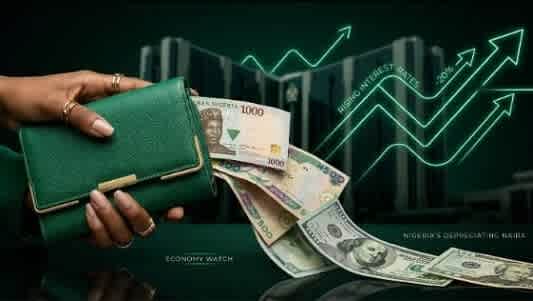
For years, the CBN kept the official exchange rate artificially strong while a parallel black market rate told the real story. This scared off foreign investors and made business planning a nightmare. In 2023, the government floated the naira. It depreciated sharply, from around ₦460/$ to well above ₦1,500/$ at its worst.
At the same time, to fight inflation, the CBN has been aggressively raising the Monetary Policy Rate, the benchmark interest rate for the entire economy. Here's what higher interest rates actually mean for your life:
- Getting a bank loan becomes more expensive.
- Small business owners face higher costs to access credit.
- Renting or buying property becomes even more expensive.
- On the upside, savings and fixed-income investments yield better returns.
Every CBN decision about rates and the exchange rate is felt in your pocket, usually before you even realise what happened.
Tax Policy: The Bill Is Coming
The government has been loudly trying to grow its non-oil revenue, which means it needs more of yours. In October 2024, the Presidential Committee on Fiscal and Tax Reform presented four major tax bills to the National Assembly, aimed at overhauling how Nigeria collects taxes from individuals and businesses.
VAT (Value Added Tax) is the one most people already feel directly. Every time you buy something from a VAT-registered business, a percentage goes to the government. When VAT goes up, businesses either raise prices (your problem immediately) or absorb the cost (their problem, which usually becomes your problem eventually).
PAYE (Pay As You Earn) is deducted from your salary before you even see it. If you're salaried, your employer handles this every month. But for the vast majority of Nigerians in the informal sector, tax compliance is still low which is exactly why the government is building systems to capture more people through BVN-linked accounts and digital payment trails.
Agriculture and Food: Why Your Market Bill Keeps Climbing
The reason your food bill keeps climbing isn't just the market. It's the decisions made long before anything reaches your plate.
Security crises in farming regions, bandit attacks, kidnappings, farmer-herder conflicts have made it dangerous for farmers to work their own land. When farmers can't farm safely, supply drops. When supply drops, prices rise.
In 2024, the government tried to ease food inflation by temporarily lifting import duties on key agricultural commodities. The intent was right. But poor implementation meant the policy had almost no real-world impact on prices, most of the benefit was swallowed somewhere between the policy document and the market stall.
Until security in farming communities is treated as the economic emergency it is, food prices will stay unpredictable.
Power Policy: NEPA's Wahala Has a Price Tag
Nigeria's electricity crisis isn't just frustrating, it's expensive. Businesses of every size, from your local pharmacy to large manufacturers, spend billions naira generating their own power via diesel generators because the national grid cannot be relied on.
That cost doesn't stay with the business. It gets baked into the price of everything they sell you. Unreliable electricity is one of the clearest reasons why doing business in Nigeria costs more than it should, why Nigerian-made goods can't always compete on price, and why investment that should be coming here goes elsewhere.
Power sector reform has been "ongoing" for decades. Privatisation of distribution companies, generation upgrades, regulatory changes, all in progress, all moving slowly. Until it's actually fixed, Nigerians continue to pay a hidden generator tax on almost everything they consume.
Labour Policy: What Your Work Is Actually Worth
The national minimum wage was recently raised to ₦70,000, up from ₦30,000. On paper, that's progress. In real purchasing power terms, with inflation where it has been, ₦70,000 in 2024 bought significantly less than ₦30,000 did a few years earlier. The number went up. The value didn't keep pace.
Beyond wages, labour policy shapes your entire working environment, maternity and paternity leave entitlements, workplace safety standards, protections against unfair dismissal, and the frameworks that govern whether employers can exploit workers or not. In Nigeria, many of these protections exist on paper but enforcement is weak, especially in the informal and creative sectors.
When workers don't know their rights, or when institutions don't enforce them, the employer wins by default.
Healthcare and Education: The Long Game Nobody Is Winning
Government investment in public education and healthcare determines the quality of services available to the people who cannot afford private alternatives.
When public universities are chronically underfunded, you get ASUU strikes, deteriorating infrastructure, and lecturers leaving the country for better conditions abroad. When public hospitals are under-resourced, middle-class Nigerians go to private clinics, upper-class Nigerians fly abroad for treatment, and the poor just manage with whatever is available.
This is not just a social problem, it's an economic one. A poorly educated, unhealthy population is less productive, earns less, and contributes less to the broader economy. Government spending on health and education isn't charity. It's one of the highest-return investments a country can make.
Nigeria's per-capita spending on both remains embarrassingly low compared to peers. The consequences are long-term and compound over time; quietly, invisibly, until they aren't.
Even Your Digital Life Is Regulated
Your online experience isn't as free as it feels.
Policies govern data pricing, internet access, telecom competition, and what platforms can operate in Nigeria. The Twitter ban of 2021/2022, which lasted over seven months showed exactly how a single policy decision can instantly disrupt communication, kill business operations, and reshape public discourse for millions of people overnight.
Digital regulation is only going to become more significant. Data localisation requirements, cybercrime laws, digital service taxes, these are all areas where government decisions will increasingly determine the terms on which you live and work online.
So What Do You Do With All This?
Understanding how policy works doesn't give you control over it. But it changes how you prepare.
When you know the naira is under pressure, you think differently about holding all your savings in naira. When you know inflation consistently eats purchasing power, you take investing more seriously. When you know power costs are structurally baked into business expenses, price increases stop being a surprise.
The macroeconomic picture in Nigeria is genuinely improving in some areas, growth is projected to continue, inflation has started to moderate, and some reforms are beginning to bear fruit. But the gains so far have not yet translated into meaningfully better living standards for most Nigerians. That gap between what the numbers say and what you feel at the market is exactly what you should be paying attention to.
Keep reading
Related Topics


Conversation
Comments (0)
Sign in to join the conversation or like this post.

Elizabeth Ayoola
Elizabeth is a finance analyst and writer passionate about making financial markets accessible to everyday readers.
She has a deep interest in global markets, crypto, and everything shaping the financial world. She writes to simplify complex financial topics, turning them into practical, accessible insights for everyday readers.
108
Stories
36463
Reads
1
Likes
0
Comments