
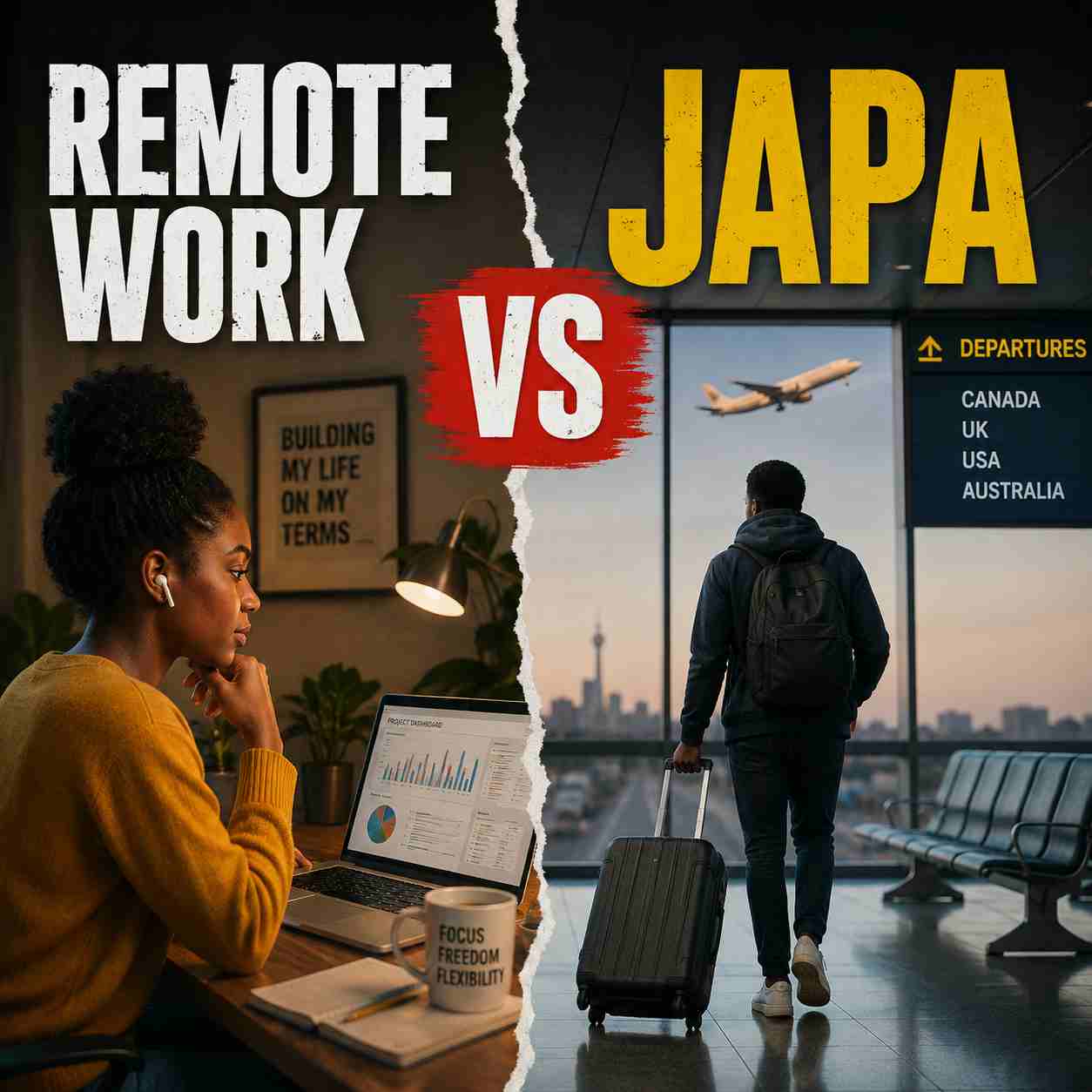
For many Nigerians today, there are two major dreams that seem to come up again and again. The first is to get a well-paying remote job and earn from outside Nigeria without leaving the country. The second is to japa. To relocate. Start again somewhere else. Find better opportunities. Earn in a stronger currency. Experience a different system and hopefully build a more stable life.
Both options can change a person's life. Both can also disappoint people who go into them with unrealistic expectations. That is why the conversation is no longer as simple as, "Should I japa?" or "How can I get a remote job?" The bigger question is: if you had the opportunity to do either one, which option would actually make more sense for your life?
Because remote work and relocation solve different problems. One allows you to earn globally while remaining in Nigeria. The other gives you the opportunity to physically enter another country's economy, work environment and system. But neither is automatically better.
There are Nigerians earning good salaries remotely from their bedrooms in Lagos, Enugu, Abuja and other parts of the country. At the same time, there are Nigerians abroad earning wages that may look impressive when converted to naira but struggling with rent, taxes, childcare and the high cost of living.
There are also people who relocated and genuinely changed their lives. And there are remote workers who lost international jobs and suddenly realised that earning in dollars does not automatically mean financial security.
So, before deciding that one path is better than the other, it is important to understand what each one really looks like.
What Remote Work Actually Means for Nigerians
Remote work sounds like the perfect solution. You stay in Nigeria. You earn from an international company. Your salary comes in dollars, pounds or another foreign currency. You avoid the huge cost of relocation. You remain close to your family and familiar environment.
On paper, it sounds almost unbeatable. And for some people, it genuinely is.
A Nigerian earning a strong international salary while living in Nigeria may have significant financial advantages. Depending on their income and lifestyle, they may be able to cover local expenses more comfortably than someone earning the same amount in a country with very high rent and living costs.
Imagine someone earning $3,000 monthly remotely while living in Nigeria. The value of that income in naira could provide a very different lifestyle from someone earning $3,000 and living in a major foreign city where rent alone may take a large portion of their income.
This is one of the biggest arguments in favour of remote work. You can potentially earn from a stronger economy while spending in a weaker one.
But this is where many people misunderstand remote work. Remote work is not simply "get a laptop and start earning dollars." The jobs are competitive. Companies hiring internationally are often looking for skills that can be measured. They want developers, designers, marketers, product managers, customer support professionals, project managers, writers, analysts and other professionals who can actually solve problems.
Having a laptop is not the skill. Internet access is not the skill. The value you can provide is what matters.
The Biggest Advantage of Remote Work Is Financial Flexibility
One major advantage of remote work is that you may not need to spend millions of naira relocating before you start earning. Relocation can involve visa fees, language tests, professional assessments, application costs, proof of funds, tuition in some cases, flights and settlement expenses.
Remote work can allow you to focus more of your money on building skills, improving your work setup and creating financial stability. You can also keep building your career without immediately uprooting your entire life.
For someone who has family responsibilities in Nigeria, this can be a major advantage. You may be able to support your family without physically leaving them behind. You may also avoid the emotional difficulty of arriving in a completely new country and having to build everything from the beginning.
However, remote work has one major weakness that people do not discuss enough. Your location may be Nigeria, but your job is still dependent on an employer or client somewhere else. If the company restructures, reduces its workforce or decides it can no longer hire workers in your location, your income can disappear.
This is why remote workers need to think beyond salary. Emergency savings matter. Multiple skills matter. Professional networks matter. A good remote career is not only about getting the first foreign job. It is about remaining employable when the first job ends.
Japa Is More Than Just Moving Abroad
When Nigerians say they want to japa, they often mean much more than travelling. They are talking about leaving behind a difficult economic environment and trying to build a life in a place where systems may feel more predictable. They want better infrastructure. More stable electricity. Better healthcare systems. Clearer career structures. More predictable working conditions. A stronger currency. Better public services.
But relocating is not a magical reset button. You do not enter an airport in Nigeria and suddenly arrive abroad as a wealthy person. For many people, the first few years can be extremely difficult. There is rent. There are taxes. There are transportation costs. There may be childcare costs. You may need to start from a lower position than the one you held in Nigeria.
Some people with impressive qualifications in Nigeria arrive in another country and discover that they need additional certification, licensing or local experience. This can be emotionally difficult. Imagine spending years building a career in Nigeria, only to move abroad and discover that you cannot immediately work in the same role. That is the reality some people face.
But for many others, the sacrifice is still worth it. Why? Because they are not only thinking about what life looks like in the first year. They are thinking about what life could look like in five, ten or fifteen years.
This Is Why Many Nigerians Still See Japa as an Investment
Relocation can be expensive, stressful and difficult. But many people still go because they see it as a long-term investment. They understand that the first year may not be glamorous. They may share accommodation. They may work jobs that are different from what they originally planned. They may struggle to settle. But they believe the structure around them gives them a better chance of eventually moving forward.
This is one of the strongest arguments for japa. For many people, the attraction is not simply the salary they will earn immediately. It is the possibility of building within a more structured system. A person may be willing to struggle for the first few years if they believe that consistent work, career growth and better systems can improve their situation over time.
This does not mean every country guarantees success. It does not. People can struggle abroad for years. Jobs can be difficult to find. Immigration rules can change. Living costs can rise.
But the hope many Nigerians are investing in is long-term stability. That is why comparing a ₦500,000 Nigerian salary with a foreign salary after converting it to naira does not tell the full story. You have to look at the entire life being built around that income.
The Cost of Japa Is Not Only Financial
When people calculate the cost of relocation, they usually think about money. But there is another cost. Loneliness. Missing family events. Starting without close friends. Living in a place where you may not understand the culture. Racism or discrimination. The pressure of having to succeed because people at home believe you are now "doing well."
These things can affect a person deeply. You may be earning more money and still be emotionally exhausted. You may have access to better infrastructure and still miss home. You may have more opportunities and still feel like you do not belong.
This does not mean people should not relocate. It simply means that japa should be viewed as a major life decision, not just a financial transaction.
Remote Work Can Also Give You a Global Career Without Leaving
One of the strongest cases for remote work is that it can open international doors. A Nigerian who starts with one remote role can gain experience working with global teams, clients and systems. That experience can make future opportunities easier to access.
Remote work can also become a stepping stone. Someone may work remotely for two or three years, build savings and later decide to relocate with more experience and stronger finances. This can be a more strategic route for some people. Instead of relocating first and hoping to figure everything out later, they build an international career before moving.
For example, a software developer, product designer or digital marketer could gain remote experience, earn in foreign currency, build a portfolio and later apply for international opportunities with a stronger profile. In this situation, remote work and japa are not enemies. One can support the other.
Remote Work Is Not Available to Everyone
This is another important reality. Remote work opportunities are often concentrated in certain types of skills and industries. Technology is one. Digital marketing is another. Design. Writing. Customer support. Finance. Data. Project management.
Some jobs require physical presence and cannot easily be done remotely. A nurse cannot perform most clinical duties from a bedroom in Nigeria. A construction worker cannot build a house through Zoom. A driver cannot transport people remotely.
So for some professionals, relocating may create opportunities that remote work cannot provide. Your career matters when choosing between the two. A software engineer may have many remote options. A healthcare professional may find that international relocation offers a clearer path to higher earnings. A person working in hospitality may benefit more from physically entering another labour market.
This is why there is no universal answer.
So, Which One Makes More Financial Sense?
The answer depends heavily on your situation.
Remote work may make more sense if you already have a skill that is in demand internationally. If you can earn a strong income while living in Nigeria, you may be able to avoid the huge upfront costs of relocation and build savings faster. But you need to think about job stability. What happens if the contract ends? Do you have savings? Can you find another client? Are you building skills that will remain valuable?
Japa may make more sense if your profession has strong demand abroad and your long-term goals involve permanent residency, citizenship, family opportunities or building a life in another country. But you must be financially and mentally prepared for the transition. Do not calculate your potential foreign salary alone. Calculate rent. Taxes. Transportation. Food. Insurance. Immigration costs. Professional licensing where necessary. The lifestyle you imagine should be based on your expected take-home income, not the salary figure you see in an offer letter.
The Smartest Option
For many Nigerians, the best strategy may not be choosing immediately between remote work and japa. It may be building yourself first. Build a valuable skill. Build work experience. Build savings. Build professional relationships. Build an emergency fund. Then decide.
A person with no savings and no globally relevant skills may find both options difficult. But a person who spends the next two years becoming more valuable can create more choices. This is important because freedom often comes from having options. When you have strong skills, you can apply for remote jobs. You can apply for foreign jobs. You can explore relocation programmes. You can work locally while building something internationally.
The goal should not always be to chase the trend. The goal should be to put yourself in a position where you can choose.
What Many Nigerians Are Doing Now
Interestingly, more people are no longer looking at this as an either-or decision. Some are working remotely from Nigeria while preparing for relocation. Others relocated first and later moved into remote or hybrid roles. Some have decided they do not want to relocate at all because remote work provides the international exposure and income they were looking for. Others tried remote work and still chose to leave because money was not their only reason for wanting to relocate. They wanted a different environment. They wanted access to different opportunities. They wanted a long-term future for their children.
This is why the answer is deeply personal. Two people can earn the same amount and make completely different decisions. One may prefer staying close to family and building wealth in Nigeria. Another may be willing to sacrifice the next five years for the possibility of permanent residency and a different future abroad. Neither decision is automatically wrong.
Final Thoughts
If your only goal is to earn more money, remote work can be an incredibly powerful option. You may be able to earn internationally without taking on the full cost and emotional pressure of relocation.
But if your goal goes beyond income and includes long-term residency, a different working environment, better public infrastructure, career opportunities that require physical presence or a future in another country, then japa may offer something remote work cannot.
The truth is simple. Remote work gives you the opportunity to earn globally while staying home. Japa gives you the opportunity to build physically inside another system. One may save you the cost of relocation. The other may give you access to opportunities you cannot fully access from Nigeria.
The better option is not the one that is trending online. It is the one that matches your skills, finances, career, responsibilities and long-term goals.
And for some Nigerians, the smartest answer may be neither "remote work" nor "japa." It may be this: build the kind of skills and experience that give you the freedom to do both.
Keep reading
Related Topics




Conversation
Comments (0)
Sign in to join the conversation or like this post.

Maramercii
Maramercii contributes reporting and analysis for NaijUp, covering the stories, markets, and business trends shaping Nigeria.
67
Stories
38760
Reads
0
Likes
0
Comments