
Before Your State Gets a Kobo: The ₦10.9 Trillion FAAC Takes Off the Top
Every month, the headlines say the same thing: "FAAC shares ₦X trillion to FG, states and LGs." The big number gets the attention. What most people don't notice is how much of that money never reaches the three tiers of government at all.
We went through every FAAC disbursement sheet from September 2025 to July 2026 (10 months; December 2025 was not in the set we reviewed). The total moving through the Federation Account in that period was ₦31.19 trillion.
The Federal Government, the 36 states and the 774 local councils together received ₦20.32 trillion of it. That is about 65 kobo of every ₦1.
So where did the other ₦10.9 trillion go?
The short answer
Before the FG, states and LGs share anything, FAAC takes out "first-line charges." Some are normal and set by law. Others are new, big, and growing fast.
| Where the money went (Sep 2025 to Jul 2026) | Amount | Share of pool |
|---|---|---|
| FG, states and LGCs (incl. augmentation) | ₦20.32trn | 65.1% |
| Saved into the Non-Oil Excess Revenue Account | ₦4.15trn | 13.3% |
| 13% derivation fund (oil states) | ₦1.43trn | 4.6% |
| Security funds | ₦1.38trn | 4.4% |
| Cost of collection (NRS/FIRS, Customs, NUPRC) | ₦1.13trn | 3.6% |
| Infrastructure Development Fund to States | ₦777bn | 2.5% |
| Tax and VAT refunds to revenue agencies | ₦600bn | 1.9% |
| Other derivation refunds (NLNG, JVC, subsidy) | ₦492bn | 1.6% |
| NEDC, MDGIF, RMAFC and others | ₦610bn | 2.0% |
| NSIA transfers | ₦150bn | 0.5% |
| WHT refunds to states and FCT | ₦147bn | 0.5% |
Figures may not add up exactly because of rounding.
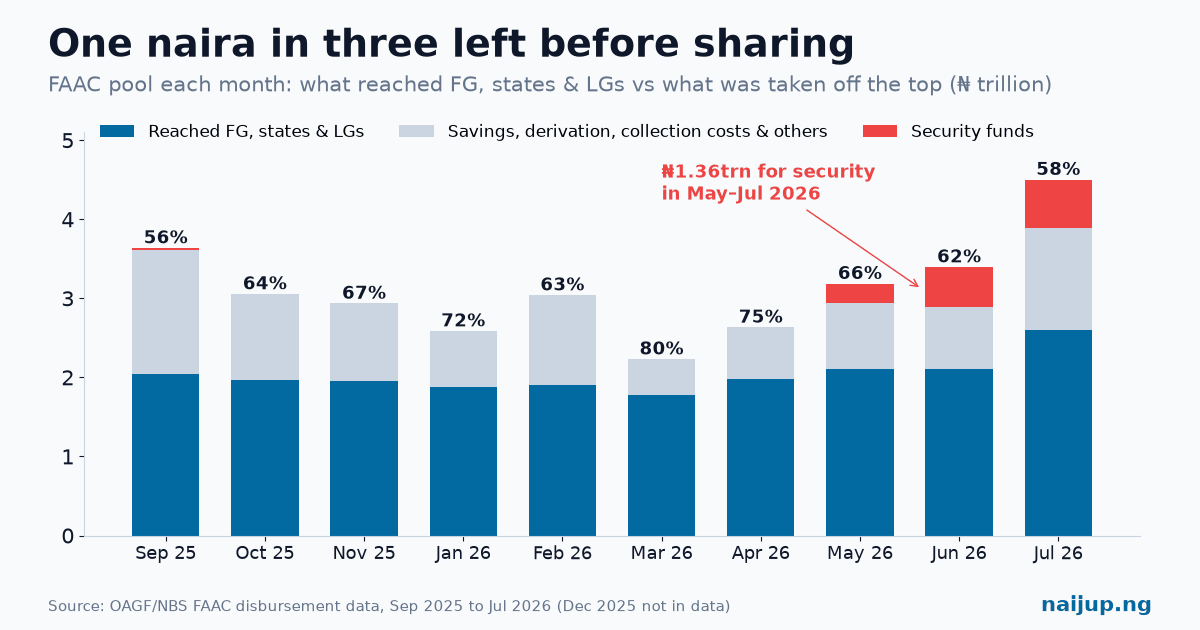
1. ₦1.36 trillion for security in just three months
This is the line that jumped out at us.
From September 2025 to April 2026, the only security-type deduction was a one-off ₦25 billion for the NEC Ad-Hoc Committee on Crude Oil Theft (September 2025).
Then, from May 2026, things changed:
• May 2026: ₦250 billion "Military Intervention Fund"
• June 2026: ₦500 billion "National Security Emergency Fund"
• July 2026: another ₦500 billion for the National Security Emergency Fund, plus ₦108 billion "Intervention for State Security"
That is ₦1.358 trillion in three months. To put it in perspective, it is more than all 774 local governments in Nigeria received in May and June put together (₦1.07 trillion).
We are not saying the money isn't needed. Insecurity is real, and it costs lives and livelihoods. But money taken off the top of the Federation Account belongs to all three tiers. When it is deducted before sharing, it reduces what every state and LG gets. Residents and state assemblies should be asking how it is spent and who accounts for it.
2. The ₦4.15 trillion "savings" account
The biggest single deduction is the transfer to the Non-Oil Excess Revenue Account: ₦4.15 trillion over the 10 months.
| Month shared | Transfer to excess account |
|---|---|
| Sep 2025 | ₦851.2bn |
| Oct 2025 | ₦700.0bn |
| Nov 2025 | ₦500.0bn |
| Jan 2026 | ₦402.6bn |
| Feb 2026 | ₦850.6bn |
| Mar 2026 | ₦200.0bn |
| Apr 2026 | ₦200.0bn |
| May 2026 | ₦200.0bn |
| Jun 2026 | nil |
| Jul 2026 | ₦250.0bn |
Some of it comes back. FAAC paid out "augmentation" from non-oil revenue four times: ₦100bn (February), ₦200bn (April), ₦250bn (May) and ₦250bn (July), ₦800 billion in total.
So the account kept roughly ₦3.35 trillion more than it gave back over the period. Saving in good months to smooth out bad months is sensible. The problem is that the public hardly ever sees the balance of that account, what it earns, or the rules for drawing on it.
3. Paying the tax collectors: ₦1.13 trillion
Revenue agencies get a percentage of what they collect as "cost of collection." Over 10 months, that came to ₦1.13 trillion for the tax service (FIRS, now the Nigeria Revenue Service, NRS), the Nigeria Customs Service and NUPRC.
It is not a scandal. Agencies need money to collect taxes. But note this: in July 2026 alone, cost of collection hit ₦165.7 billion, the highest in the period. The NRS also received ₦500 billion in "tax refunds" over the 10 months, with ₦250 billion of that in July.
4. The share reaching government swings a lot
The share of the pool that actually got to the FG, states and LGs moved around a lot:
• Highest: March 2026, 79.9%
• Lowest: September 2025, 56.2%
• July 2026: 57.8%, even though the total pool was a record ₦4.50 trillion
So a bigger FAAC headline doesn't always mean a bigger share for the tiers. July's pool was the biggest in the period, but almost ₦1.9 trillion of it was taken out before sharing.
Why this should matter to you
Your state's FAAC money pays salaries, pensions, roads, schools and clinics. When ₦10.9 trillion is taken out before sharing, there is less for all of that.
Three questions worth asking:
1. Who controls the security funds, and will there be a public report on how the ₦1.36 trillion was used?
2. What is the balance in the Non-Oil Excess Revenue Account, and what are the rules for releasing it?
3. Will states and LGs get a say before new first-line charges are created?
Final takeaway
FAAC headlines tell you how big the pot is. They don't tell you how much of it reaches the people's governments. Over 10 months, about one naira in every three went somewhere else first. Some of that is normal. The sudden ₦1.36 trillion security deduction and the ₦4.15 trillion parked in the excess account deserve more attention than they've had.
Data source: Office of the Accountant-General of the Federation (OAGF), FAAC disbursement tables (Table I), September 2025 to July 2026, as reported by the National Bureau of Statistics. December 2025 was not included in the data set we reviewed. "Pool" means the total shown in Table I for each month, including augmentation. Categories are NaijUp's grouping of the line items. If you spot an error, let us know and we'll fix it.
Keep reading
Related Topics



Conversation
Comments (0)
Sign in to join the conversation or like this post.

Mujeeb Olagunju
I am a finance professional with a strong background in economics and financial technology.,My work centers on building systems that support payments, digital banking, and investment solutions in emerging markets.,I have experience with risk management, transaction monitoring, fraud prevention, and the design of scalable financial products tailored to both retail and institutional clients.,With over 8 years of industry experience, I combine financial insight with technical expertise to deliver solutions that balance compliance, security, and business growth.,My goal is to bridge the gap between finance and technology, creating platforms that expand access to modern financial services and strengthen trust in digital finance.
68
Stories
18561
Reads
0
Likes
0
Comments