
Lagos Got More VAT Than 8 States Combined, and VAT Now Beats Statutory Allocation
Ask most Nigerians where state governments get their money and they'll say "oil." For a long time, that was mostly true.
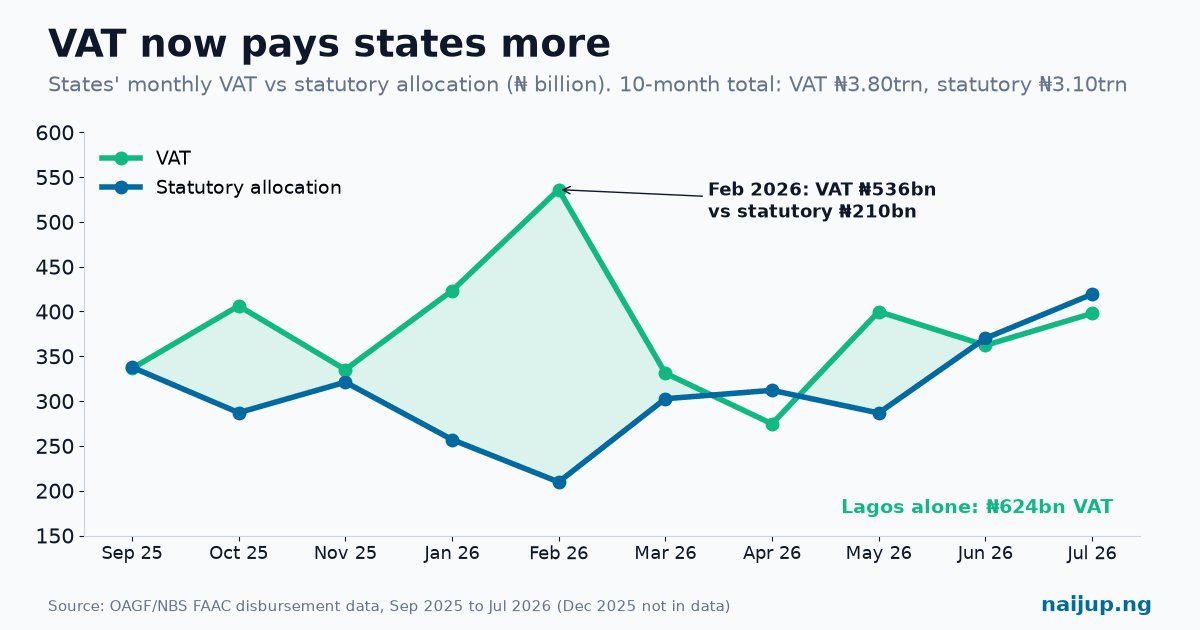
Now look at the numbers for the last 10 FAAC sharing months (September 2025 to July 2026):
• States' VAT allocation: ₦3.80 trillion
• States' statutory allocation: ₦3.10 trillion
Over this period, VAT paid states ₦700 billion more than the main statutory allocation from the Federation Account. (Statutory allocation is the regular share of oil and non-oil revenue such as company tax and customs duties, not counting the 13% derivation that goes only to oil states.)
How the gap moved month by month
| Month shared | Statutory | VAT | VAT bigger? |
|---|---|---|---|
| Sep 2025 | ₦337.8bn | ₦336.5bn | Almost level |
| Oct 2025 | ₦287.1bn | ₦406.3bn | ✅ |
| Nov 2025 | ₦321.1bn | ₦335.2bn | ✅ |
| Jan 2026 | ₦257.0bn | ₦423.3bn | ✅ |
| Feb 2026 | ₦209.7bn | ₦536.0bn | ✅ (2.6x) |
| Mar 2026 | ₦302.6bn | ₦331.1bn | ✅ |
| Apr 2026 | ₦312.0bn | ₦274.6bn | ❌ |
| May 2026 | ₦286.7bn | ₦399.9bn | ✅ |
| Jun 2026 | ₦370.1bn | ₦362.2bn | Almost level |
| Jul 2026 | ₦419.2bn | ₦397.9bn | ❌ |
February 2026 stands out. States got ₦536 billion of VAT, more than 2.5 times their statutory share that month. VAT made up 62% of everything states received in February.
But VAT is not shared evenly
This is where it gets interesting. Across all 36 states, VAT beat statutory allocation. But when you check state by state, only 16 of the 36 received more from VAT than from statutory allocation over the 10 months.
That's because a big chunk of VAT goes to a few states, and one in particular.
Lagos: ₦624 billion of VAT in 10 months
• Lagos received ₦624.1 billion in gross VAT
• That's 16.4% of all VAT shared to states
• Its VAT was about 5.7 times its statutory allocation (₦109.6bn)
• In February 2026 alone, Lagos received ₦111.2 billion of VAT, its biggest month
Here's how big that is. The eight states with the smallest VAT allocations over the same period were:
| State | VAT (10 months) |
|---|---|
| Nasarawa | ₦70.8bn |
| Ebonyi | ₦72.4bn |
| Yobe | ₦72.7bn |
| Taraba | ₦73.9bn |
| Abia | ₦74.4bn |
| Cross River | ₦74.7bn |
| Gombe | ₦74.9bn |
| Ekiti | ₦75.0bn |
| All 8 combined | ₦588.8bn |
Lagos alone got ₦35 billion more VAT than these eight states put together.
The rest of the VAT top 5
| State | VAT (10 months) | VAT ÷ statutory |
|---|---|---|
| Lagos | ₦624.1bn | 5.7x |
| Rivers | ₦223.2bn | 2.5x |
| Oyo | ₦154.5bn | 1.7x |
| Kano | ₦134.0bn | 1.0x |
| Delta | ₦105.9bn | 1.3x |
Where statutory allocation still matters more
For 20 states, statutory allocation was still bigger than VAT over the 10 months. They include Kaduna, Katsina, Borno, Niger, Bauchi, Sokoto, Kebbi, Kogi and Benue. For these states, a fall in oil prices or oil output still hurts more than a slowdown in spending.
Why this matters
1. States now depend on Nigerians spending money
VAT rises when people and businesses buy things. As it becomes a bigger part of state income, state budgets depend more on the real economy (trade, services, consumption) and less on crude oil alone.
2. VAT is volatile too
Don't assume VAT is "stable money." States' VAT ranged from ₦274.6 billion (April 2026) to ₦536.0 billion (February 2026). A state that plans around a big VAT month could be in trouble in the next one.
3. Big cities win
Lagos, Rivers (Port Harcourt), Oyo (Ibadan) and Kano have big markets, lots of companies and dense populations. As VAT grows, the gap between commercial states and the rest is likely to grow too, unless the sharing formula keeps a strong equality component.
Final takeaway
For the last 10 sharing months, VAT, not statutory allocation, was the biggest single source of FAAC money for Nigeria's states as a group. But most of the gain went to a handful of commercial states, led by Lagos with ₦624 billion.
If you live in a state where VAT is now bigger than statutory allocation, your state's income depends more on local businesses and consumers than on oil. That's a good reason to watch how your state treats its small businesses.
Data source: OAGF FAAC disbursement tables (Table III), September 2025 to July 2026, as reported by the NBS. December 2025 was not in the data set we reviewed. VAT figures are gross VAT allocations to the 36 states (Lagos's monthly "VAT deduction" not subtracted). Statutory allocation excludes the 13% derivation. If any figure looks off to you, please reach out and we'll check it again.
Keep reading
Related Topics


Conversation
Comments (0)
Sign in to join the conversation or like this post.

Mujeeb Olagunju
I am a finance professional with a strong background in economics and financial technology.,My work centers on building systems that support payments, digital banking, and investment solutions in emerging markets.,I have experience with risk management, transaction monitoring, fraud prevention, and the design of scalable financial products tailored to both retail and institutional clients.,With over 8 years of industry experience, I combine financial insight with technical expertise to deliver solutions that balance compliance, security, and business growth.,My goal is to bridge the gap between finance and technology, creating platforms that expand access to modern financial services and strengthen trust in digital finance.
68
Stories
18558
Reads
0
Likes
0
Comments