
Nigeria’s 45% CRR: How the Country’s Monetary Policy Compares With China, the US, UK, Germany, Kenya and South Africa
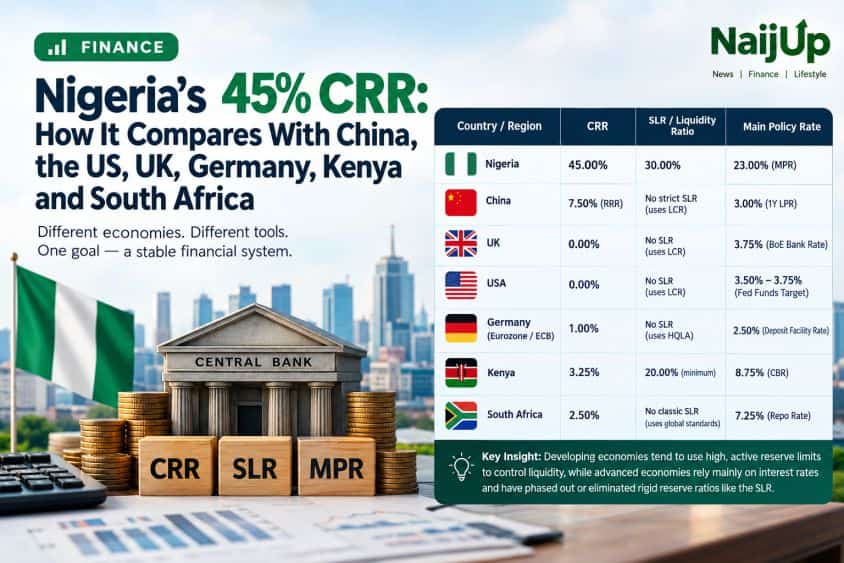
Nigeria uses one of the most aggressive reserve-based approaches to monetary policy among the major economies compared in this analysis. While the United States, United Kingdom and euro area rely heavily on interest rates and market-based liquidity management, the Central Bank of Nigeria combines a very high Cash Reserve Requirement (CRR), a high Liquidity Ratio and a high Monetary Policy Rate (MPR) to influence inflation, credit creation and banking-system liquidity.
The difference is important because monetary policy does not operate the same way in every economy.
For a Nigerian bank, the amount of money it can deploy as loans is significantly affected by regulatory reserve requirements. In the United States or United Kingdom, banks operate in an environment where statutory reserve requirements play little or no direct role in day-to-day monetary policy, with greater emphasis placed on interest rates, central-bank operations, capital requirements and liquidity standards.
This raises an important question:
Why does Nigeria need such a high CRR, and what does the Nigerian approach mean for banks, businesses, borrowers and the wider economy?
The three numbers that matter
Before comparing countries, it is important to understand the three main policy tools.
1. Cash Reserve Ratio — CRR
The CRR determines the percentage of certain bank deposits that must be maintained as reserves with the central bank.
A higher CRR generally means banks have less of their deposits available for lending and other uses.
For example, if a bank has ₦100 billion in deposits and faces a 45% CRR, roughly ₦45 billion is required to be maintained as reserves under the applicable rule, leaving a smaller pool for lending and other banking activities.
The actual mechanics are more complicated because banks have other liquidity, capital and regulatory requirements, but the basic relationship is straightforward:
Higher CRR = less immediately deployable liquidity.
2. Liquidity Ratio / SLR
A liquidity requirement requires banks to maintain a specified proportion of their liabilities or deposits in liquid assets.
Nigeria refers to this as the Liquidity Ratio, rather than using the exact SLR terminology common in countries such as India.
The CBN has maintained Nigeria's Liquidity Ratio at 30%. Its monetary-policy decisions also show that the CRR for Deposit Money Banks is currently 45%.
3. Monetary Policy Rate — MPR
The MPR is the central bank's main policy interest rate.
Unlike the CRR, which directly affects the quantity of liquidity available to banks, the policy rate works primarily through the price of money.
When the policy rate rises, borrowing generally becomes more expensive and monetary conditions become tighter. When it falls, borrowing conditions can become less restrictive.
Nigeria: A High-Reserve, High-Interest-Rate System
Nigeria stands out in this comparison because it is using both quantity-based and price-based monetary policy tools aggressively.
Following its September 21–22, 2026 meeting, the CBN reset the MPR at 23% and retained the CRR for Deposit Money Banks at 45%. The Liquidity Ratio remains 30%.
That means Nigerian banks are operating under three significant constraints simultaneously:
- 45% CRR for Deposit Money Banks
- 30% Liquidity Ratio
- 23% MPR
The combination is more important than any individual number.
The CBN itself explains the basic transmission mechanism: a higher CRR reduces funds available for banks to create credit, while reducing the CRR can provide banks with more room for productive lending.
Nigeria has not always operated at this level. The CRR for commercial banks was raised from 32.5% to 45% in February 2024 and subsequently moved to 50% in September 2024. It was later reduced to 45% in September 2025.
This shows how strongly the CBN has used reserve requirements as a monetary-policy instrument.
How Does Nigeria Compare With the United States?
The difference with the United States is dramatic.
The Federal Reserve reduced reserve requirement ratios to zero percent effective March 26, 2020, eliminating statutory reserve requirements for U.S. depository institutions.
The Fed explained that this was consistent with its transition to an ample-reserves framework, in which reserve requirements no longer play a significant role in implementing monetary policy.
Instead, U.S. monetary policy is heavily centered around interest rates and the Federal Reserve's management of financial-system liquidity.
As of September 17, 2026, the Federal Reserve's target federal funds rate range is 3.75%–4.00%.
The contrast is striking:
Nigeria:45% CRR + 30% Liquidity Ratio + 23% MPR
United States:0% statutory reserve requirement + 3.75%–4.00% federal funds target range
This does not mean American banks have no liquidity or safety requirements. They remain subject to extensive capital, liquidity, supervisory and stress-testing requirements.
The difference is where the regulatory emphasis is placed.
The U.S. framework places much less emphasis on forcing banks to lock a fixed percentage of deposits away as statutory reserves.
United Kingdom: Interest Rates and Liquidity Standards
The United Kingdom also provides a useful contrast.
The Bank of England's principal monetary-policy rate is Bank Rate, which stood at 3.75% in September 2026.
Rather than relying on a Nigerian-style high statutory CRR and Liquidity Ratio combination, the UK banking system places significant emphasis on prudential liquidity requirements.
For example, authorised UK banks are expected to meet the Liquidity Coverage Requirement (LCR) and other liquidity requirements established through the prudential framework.
The Bank of England reported that the major UK banks had an aggregate three-month-average LCR of 142% in May 2026, illustrating how liquidity protection can be achieved through a risk-sensitive framework rather than simply requiring banks to hold a very large percentage of deposits as central-bank reserves.
The distinction is important.
Nigeria's CRR is primarily a reserve requirement against deposits.
The LCR, by contrast, is designed around whether a bank has sufficient high-quality liquid assets to withstand a defined period of liquidity stress.
They are not identical instruments.
Germany and the Eurozone: The ECB Model
Germany does not independently set its monetary policy rate.
As a member of the euro area, Germany operates under the European Central Bank (ECB) monetary-policy framework.
The ECB maintains a minimum reserve requirement, but it is dramatically lower than Nigeria's CRR.
The reserve ratio for determining minimum reserve requirements has remained at 1%.
The ECB also steers monetary policy primarily through its policy interest rates, particularly the deposit facility rate.
As of 16 September 2026, the ECB's:
- Deposit facility rate: 2.50%
- Main refinancing operations rate: 2.65%
- Marginal lending facility: 2.90%
Compare this with Nigeria:
| Indicator | Nigeria | Eurozone |
| Reserve requirement | 45% CRR for Nigerian DMBs | 1% |
| Main policy benchmark | 23% MPR | 2.50% deposit facility rate |
| Liquidity approach | CRR + Liquidity Ratio + market operations | Minimum reserves + market-based liquidity framework |
The difference demonstrates two very different monetary-policy environments.
Nigeria uses reserve requirements as a major instrument for controlling banking-system liquidity.
The ECB operates in a financial system where interest rates, refinancing operations and market-based liquidity management play a much greater role.
China: A Different Form of Reserve-Based Monetary Policy
China sits somewhere between the two broad models.
The People's Bank of China (PBOC) uses interest rates, open-market operations and reserve requirements as part of its monetary-policy toolkit.
China's reserve requirement is commonly referred to as the Reserve Requirement Ratio (RRR) rather than CRR.
This gives the PBOC an additional way of influencing the amount of liquidity available to banks without necessarily changing benchmark lending rates by the same amount.
This is particularly relevant because China's monetary framework is more administratively managed than the systems found in the US and UK.
The Chinese model therefore demonstrates that reserve requirements have not disappeared globally. Instead, their importance varies according to the structure and objectives of each financial system.
For Nigeria, China is an interesting comparison because both countries have historically placed greater emphasis on managing banking-system liquidity than the US or UK.
Kenya: Lower Reserve Requirements, Higher Policy Rate
Kenya provides perhaps one of the most useful African comparisons.
The Central Bank of Kenya currently sets the Cash Reserve Ratio at 3.25% of banks' domestic and foreign-currency deposit liabilities.
Its Central Bank Rate (CBR) is currently 8.75% following the August 11, 2026 monetary-policy decision.
That creates a major difference between Kenya and Nigeria.
| Indicator | Nigeria | Kenya |
| CRR | 45% | 3.25% |
| Main policy rate | 23% MPR | 8.75% CBR |
| Liquidity framework | 30% Liquidity Ratio | Reserve and other liquidity tools |
The Kenyan central bank explicitly describes reserve requirements as one of several monetary-policy instruments alongside discount-window operations and open-market operations.
The comparison illustrates that African central banks do not all need to use the same degree of reserve restrictions.
South Africa: A Market-Oriented African Example
South Africa provides another interesting comparison because the South African Reserve Bank (SARB) has historically emphasized inflation targeting and the policy interest rate.
In September 2026, SARB raised its policy rate by 25 basis points to 7.25% amid inflation risks and higher fuel prices.
The key difference is that South Africa's monetary-policy transmission relies much more heavily on the repo rate and financial-market mechanisms than Nigeria's high CRR framework.
The result is another African example of a central bank using a comparatively lower reserve burden alongside an active interest-rate policy.
The Bigger Question: Why Is Nigeria's CRR So High?
The answer cannot simply be that the CBN wants to "stop banks from lending."
Reserve requirements can serve several purposes.
They can:
- Reduce excess liquidity
- Limit excessive credit creation
- Support monetary-policy transmission
- Help manage inflationary pressure
- Influence money-market conditions
- Provide a regulatory liquidity buffer
The CBN itself describes CRR as both a prudential and liquidity-management instrument.
Nigeria's economic environment also has characteristics that make liquidity management particularly important.
Inflationary pressures, exchange-rate movements, foreign-exchange liquidity, fiscal conditions and rapid changes in money supply can all influence the effectiveness of monetary policy.
Therefore, the CBN has historically used more than just the MPR.
But There Is a Cost to a 45% CRR
A high CRR is not costless.
When a significant proportion of deposits must be maintained as reserves, banks have less money available for conventional lending and investment.
This can influence:
Lending rates
Banks may attempt to compensate for the opportunity cost of restricted funds by maintaining higher lending spreads.
Credit availability
Businesses seeking working capital, expansion financing or investment loans can face tighter credit conditions.
Bank profitability
Banks must generate sufficient returns from the portion of their balance sheet that can actually be deployed.
Economic growth
If productive businesses cannot obtain affordable credit, investment and economic activity can be affected.
This creates a difficult policy balance.
A central bank wants enough liquidity to support economic activity, but not so much liquidity that inflation and financial instability accelerate.
Why Doesn't the US Simply Use a 45% CRR?
The American experience shows that a banking system can operate without a statutory reserve requirement.
But that does not mean the US has abandoned bank regulation.
Instead, the US uses a combination of:
- Interest-rate policy
- Open-market and liquidity operations
- Capital requirements
- Liquidity requirements
- Stress testing
- Bank supervision
- Deposit insurance
- Central-bank lending facilities
The Federal Reserve specifically notes that capital and liquidity buffers are important parts of the U.S. framework for ensuring that banks can withstand adverse conditions.
Therefore, comparing Nigeria's 45% CRR directly with America's 0% reserve requirement without considering the wider regulatory systems can be misleading.
The two countries are using different mechanisms to address some of the same financial-stability objectives.
Does a High CRR Automatically Mean Nigeria Has a Safer Banking System?
Not necessarily.
A reserve requirement can reduce the amount of liquidity available for lending, but banking-system stability depends on many other factors.
These include:
- Bank capital adequacy
- Asset quality
- Non-performing loans
- Liquidity management
- Foreign-exchange exposure
- Corporate governance
- Risk management
- Deposit concentration
- Government exposure
- Quality of bank supervision
A bank can have significant reserves and still experience problems if its assets are poor quality or its risk management is weak.
Likewise, a bank operating under a low reserve requirement can remain highly resilient if it has strong capital, liquidity buffers, risk controls and supervision.
What the Comparison Tells Us About Nigeria
The biggest lesson from this international comparison is that there is no single global model for monetary policy.
Nigeria has chosen a relatively interventionist approach.
The CBN uses:
MPR + CRR + Liquidity Ratio + Open Market Operations + other liquidity and foreign-exchange tools
The United States relies much more heavily on:
Interest rates + ample reserves + market operations + capital and liquidity regulation
The UK similarly emphasizes:
Bank Rate + market operations + prudential liquidity regulation
The ECB uses:
Deposit facility rate + refinancing operations + minimum reserves + broader financial-market instruments
Kenya combines:
Central Bank Rate + relatively low CRR + market operations
South Africa places strong emphasis on:
Repo rate + inflation targeting + market-based monetary transmission
China combines:
Interest rates + reserve requirements + targeted liquidity management + other policy instruments
Nigeria's Real Policy Challenge
The debate should therefore not simply be:
"Is 45% CRR too high?"
The more important question is:
"What combination of monetary-policy instruments can control inflation and protect financial stability without unnecessarily restricting productive credit?"
That is a more difficult economic question.
A high CRR can help sterilise liquidity and support monetary control. But if maintained at very high levels for an extended period, it can also increase the constraints faced by banks and businesses seeking credit.
Reducing the CRR, on the other hand, could release additional liquidity into the financial system. But if that liquidity is not absorbed by productive economic activity and instead contributes to inflationary or foreign-exchange pressures, the policy could create other problems.
This is why central banks continuously adjust their policy mix.
Nigeria vs the World: The Numbers at a Glance
| Country/Region | Reserve Requirement | Main Policy Rate | Broad Approach |
| ?? Nigeria | 45% CRR | 23% MPR | Strong reserve + interest-rate intervention |
| ?? China | RRR-based system | Interest-rate based | Managed liquidity and targeted credit |
| ?? UK | No Nigerian-style CRR | 3.75% Bank Rate | Market and interest-rate focused |
| ?? US | 0% statutory reserve requirement | 3.75–4.00% | Ample-reserves framework |
| ?? Germany / Eurozone | 1% minimum reserve | 2.50% ECB deposit rate | ECB market-based framework |
| ?? Kenya | 3.25% CRR | 8.75% CBR | Lower reserve burden + interest rate |
| ?? South Africa | Lower reserve-based burden | 7.25% repo rate | Inflation targeting + market transmission |
Rates are a September 2026 snapshot and can change as central banks make new policy decisions.
Final Takeaway
Nigeria's monetary-policy framework is significantly more reserve-intensive than those of the United States, United Kingdom and euro area.
The 45% CRR means the CBN has a powerful quantity-based instrument for controlling banking-system liquidity, while the 23% MPR provides a powerful price-based instrument.
The United States demonstrates that a large banking system can operate with a 0% statutory reserve requirement, while the euro area operates with a 1% minimum reserve requirement and uses interest rates and liquidity operations extensively.
Kenya's 3.25% CRR and 8.75% Central Bank Rate and South Africa's 7.25% policy rate also demonstrate that African economies can operate with substantially lower reserve requirements than Nigeria.
The comparison does not, by itself, establish that one framework is universally superior. Monetary policy must reflect the structure of each economy, its inflation dynamics, banking system, financial markets, exchange-rate conditions and broader economic objectives.
For Nigeria, however, the international comparison highlights an important economic policy question:
Can Nigeria eventually achieve greater price and financial stability while relying less on very high reserve requirements and more on conventional interest-rate and market-based monetary-policy transmission?
That question will remain important as the Nigerian financial system develops, banks expand their lending capacity and policymakers balance the competing objectives of inflation control, financial stability, credit growth and economic expansion.
Keep reading
Related Topics





Conversation
Comments (0)
Sign in to join the conversation or like this post.

Mujeeb Olagunju
I am a finance professional with a strong background in economics and financial technology.,My work centers on building systems that support payments, digital banking, and investment solutions in emerging markets.,I have experience with risk management, transaction monitoring, fraud prevention, and the design of scalable financial products tailored to both retail and institutional clients.,With over 8 years of industry experience, I combine financial insight with technical expertise to deliver solutions that balance compliance, security, and business growth.,My goal is to bridge the gap between finance and technology, creating platforms that expand access to modern financial services and strengthen trust in digital finance.
59
Stories
16948
Reads
0
Likes
0
Comments