
Dangote Refinery IPO: What the Dangote Flour Mills IPO Really Teaches Us — And Where VeryDarkMan’s Argument Falls Short
The Dangote Refinery IPO is not the Dangote Flour Mills IPO. The numbers, scale, business model, earnings profile and capital-market strategy are fundamentally different.
Nigeria's biggest public share offering has generated an unusual debate. On one side are investors who see Dangote Petroleum Refinery as a potentially undervalued industrial giant being offered to Nigerians at ₦525 per share. On the other are critics, including social commentator VeryDarkMan (VDM), who have questioned whether ordinary Nigerians can genuinely become wealthy from buying a small number of shares and have described the offer in highly critical terms.
The debate deserves more than social-media arguments.
The important question is not simply “Should Nigerians buy Dangote shares?”
It is:
What exactly is being offered, how is it priced, what happened with Dangote Flour Mills, and what lessons from previous public offerings appear to have been incorporated into the refinery IPO?
What happened with Dangote Flour Mills?
Dangote Flour Mills provides an important historical case study.
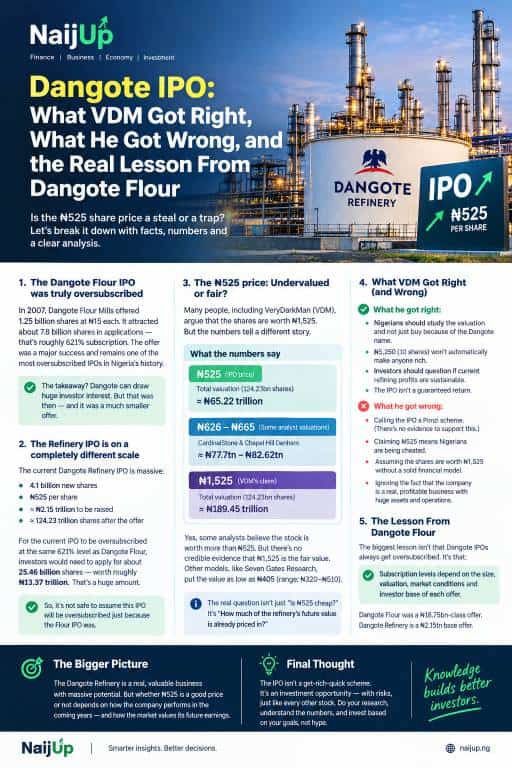
In 2007, Dangote Flour Mills offered approximately 1.25 billion shares at ₦15 each. The offer was seeking roughly ₦18.75 billion.
Demand was extraordinary.
The company received applications for about 7.8 billion shares, equivalent to roughly 621% subscription after applications that did not comply with the offer terms were excluded. In other words, investors applied for more than six times the number of shares available.
That was one of the most heavily oversubscribed IPOs in the history of Nigeria's capital market at the time.
The shares were subsequently listed in February 2008 at ₦15 and closed their first trading day at ₦15.75.
But there is an important lesson here.
A heavily oversubscribed IPO does not automatically guarantee extraordinary long-term returns.
Dangote Flour Mills eventually went through a complicated corporate history. Tiger Brands acquired control in 2012, Dangote later reacquired the business, and Olam eventually acquired Dangote Flour Mills in 2019. Olam's transaction valued the company at approximately ₦130 billion for its 5 billion issued shares, equivalent to about ₦26 per share on the headline consideration before transaction adjustments.
This means investors should not simply look at the 2007 oversubscription and conclude that every Dangote IPO must behave the same way.
Why Dangote Flour Mills cannot simply be used to predict Dangote Refinery
There is a temptation to say:
“Dangote Flour was oversubscribed, so Dangote Refinery will also be massively oversubscribed.”
That comparison is incomplete.
The Dangote Refinery offer is dramatically larger.
The refinery is offering 4.1 billion shares at ₦525 each, potentially raising approximately ₦2.15 trillion. The offer opened on September 14, 2026 and is scheduled to close on October 13.
Compare that with the roughly ₦18.75 billion Dangote Flour Mills offer.
The refinery IPO is therefore operating at a completely different scale.
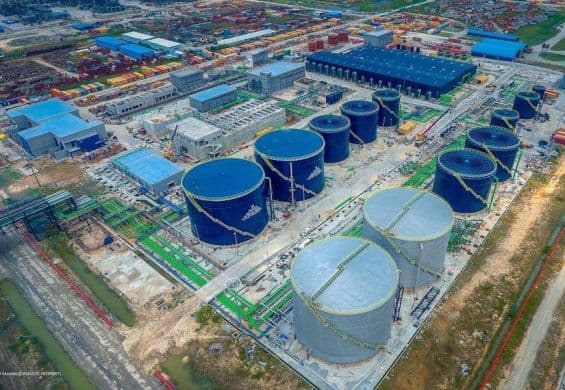
Even more importantly, the refinery is not an early-stage flour company entering the public market. It is a giant industrial asset that has reached commercial production at a scale of approximately 700,000 barrels per day.
Reuters reports that the refinery generated more than $13 billion in revenue and $1.82 billion in net profit during the first half of 2026, following a loss in the previous period as the business moved through its ramp-up phase.
That does not mean the current earnings will automatically continue forever. Refining is cyclical, and margins can change dramatically.
But it does mean investors are evaluating a fundamentally different asset.
The biggest difference: the size of the offer
This is where the Dangote Flour comparison becomes particularly important.
Dangote Flour Mills needed approximately ₦18.75 billion from investors.
Dangote Refinery is seeking approximately ₦2.15 trillion.
That is more than 100 times larger.
The question therefore becomes:
Can the Nigerian capital market absorb a ₦2.15 trillion public offer even if millions of people are interested?
That is a legitimate question.
And it is one reason why assuming that Dangote Refinery must experience a 621% oversubscription simply because Dangote Flour did would be poor analysis.
Interestingly, the early numbers have nevertheless demonstrated enormous demand.
Within the first hour of the offer opening, NGX reported approximately ₦1.476 trillion in applications across 402,634 transactions.
That figure represented a substantial portion of the ₦2.15 trillion base offer.
So far, the evidence demonstrates very strong demand.
But it does not prove that the final offer will be oversubscribed by the same percentage as Dangote Flour Mills.
The offer remains open until October 13.
Why ₦525 deserves closer examination
The most interesting part of this IPO is arguably not the size of the offer.
It is the valuation.
At ₦525, the refinery's indicative post-offer market capitalisation is approximately ₦65.22 trillion, or roughly $47–48 billion depending on the exchange-rate assumption used.
That is a huge valuation.
But this is where the debate becomes more complicated.
Some independent analysts have produced valuations above the IPO price.
CardinalStone reportedly valued the company at approximately ₦77.7 trillion, translating to around ₦688 per share based on its share-count assumptions.
Chapel Hill Denham estimated equity value at approximately ₦82.62 trillion.
Those valuations suggest that ₦525 is not obviously excessive under their assumptions.
However, other research reaches a different conclusion.
GTI Research reportedly estimated probability-weighted fair value at approximately ₦493 per share, slightly below the ₦525 offer price. BusinessDay's analysis also placed a probability-weighted central estimate around ₦493, while showing a much wider valuation range of approximately ₦328–₦640.
Seven Gates Research was more conservative, publishing a central fair value of approximately ₦405.
This is extremely important.
There is no single universally accepted “true value” of ₦1,525.
There are bullish valuations, conservative valuations and valuations close to the offer price.
That is how equity research normally works: different assumptions about future earnings, refining margins, capacity utilisation, expansion costs and risk produce different valuations.
So where does the ₦1,525 argument come from?
There have been discussions suggesting that the refinery could ultimately be worth considerably more than its ₦525 IPO price.
A ₦1,525 share price would imply a valuation roughly three times the IPO price.
That is possible mathematically.
But it should not be presented as though ₦1,525 is already an independently established fair value.
To justify such a valuation, the refinery would have to generate substantially higher sustainable earnings and/or successfully execute its expansion programme while maintaining strong margins.
That is a bull case, not a guaranteed outcome.
The distinction matters.
An investor can believe that ₦525 is attractive without claiming that the share is definitely worth ₦1,525.
Why the ₦525 price may have been strategically important
There is another point that deserves attention.
The IPO is a fixed-price public offer.
The company is not asking the market to discover the price through ordinary daily trading before the shares are issued. Investors subscribe at ₦525 during the offer period.
The price therefore establishes the initial valuation at which the public receives shares.
After listing, however, the market determines the trading price.
That means ₦525 does not guarantee that the stock will list above ₦525.
It could trade above it.
It could trade below it.
It could remain around it.
This is precisely why investors should separate IPO price from future market price.
The official IPO website itself warns investors that share values can rise or fall and that investors may not recover their investment.
Did Dangote learn from previous IPO experiences?
There are signs that the structure of this transaction reflects lessons from Nigeria's previous capital-market experiences.
The offer has deliberately been designed for mass participation.
The minimum application is only 10 shares, costing ₦5,250.
Applications are being distributed through a very large electronic network of banks, fintech platforms and other approved channels.
The stated ambition is to reach millions of investors.
The company has also provided an oversubscription mechanism that can increase the number of shares available if demand is sufficiently high and regulatory conditions are satisfied. Proshare reports that the offer can absorb up to 30% additional shares under the applicable oversubscription option.
Dangote has also indicated that more shares could potentially be made available if demand substantially exceeds the base offer.
That is different from simply putting a relatively small number of shares into the market and allowing demand to overwhelm supply.
This is where the VDM argument deserves to be challenged
VeryDarkMan has raised several questions about the IPO.
One of his arguments is essentially that ordinary Nigerians should not assume that purchasing a few shares in a huge company will suddenly make them wealthy.
On this point, he is correct in one important sense.
Buying 10 shares for ₦5,250 does not make somebody a millionaire.
If the share price doubled, those 10 shares would become worth ₦10,500 before transaction costs and taxes.
If the share price increased tenfold, they would become worth ₦52,500.
The amount invested matters.
Owning shares is not the same thing as receiving a salary from the company or controlling the company.
But that does not invalidate the concept of investing.
The purpose of equity investing is not necessarily to make a person rich overnight.
It is to allow an investor to own a fractional economic interest in a business and potentially benefit from:
- capital appreciation;
- dividends;
- business growth;
- expansion;
- retained earnings;
- and long-term value creation.
Therefore, saying “₦5,250 will not make you rich” is not an argument against an IPO.
It is simply a reminder that investment returns are proportional to capital and performance.
The “Ponzi scheme” comparison needs a different standard
VDM has publicly described the IPO in terms comparing it to a Ponzi-type arrangement.
That comparison should be treated carefully.
A conventional Ponzi scheme involves the use of money from later participants to pay earlier participants, rather than generating legitimate investment returns from an underlying productive asset.
The Dangote Refinery IPO, by contrast, is a regulated public share offering involving newly issued equity in an operating company.
The SEC approved the offer and has specifically instructed investors to use only approved receiving agents and subscription channels.
The proceeds from the offer are intended for the refinery's corporate purposes, particularly expansion.
That does not mean the investment is guaranteed to make money.
It means the structure is fundamentally different from a Ponzi scheme.
An investment can be:
risky, expensive, poorly timed or unsuccessful without being a Ponzi scheme.
That distinction is crucial.
What about the argument that Dangote should simply reduce product prices instead?
Another argument attributed to VDM is that Dangote could create more value for Nigerians by reducing prices of products such as fuel and cement rather than selling shares.
This is really a different economic question.
A company has two separate relationships with the public:
consumer relationship and ownership relationship.
Lower prices benefit consumers.
Shares give investors an ownership interest.
They are not substitutes.
If Dangote sells shares in the refinery, Nigerians who buy them become shareholders.
If the refinery lowers prices, Nigerians who buy its products benefit as consumers.
A company can theoretically do both, but one does not replace the other.
And shareholders do not automatically have the power to demand whatever price they want from management.
The strongest criticism of the IPO is actually valuation risk
Ironically, the strongest criticism of the IPO does not require calling it a scam.
It is valuation.
At ₦525, investors are already paying for a very large and successful refinery.
The refinery's future valuation depends partly on assumptions about:
- refining margins;
- crude availability;
- capacity utilisation;
- international petroleum prices;
- domestic fuel demand;
- foreign exchange;
- government policy;
- taxation;
- expansion costs;
- financing;
- and the successful completion of the planned capacity expansion.
The refinery intends to expand from approximately 700,000 barrels per day to 1.4 million barrels per day.
That expansion is estimated to require approximately $14.3 billion.
That is enormous.
If the expansion is executed efficiently and future earnings grow strongly, today's valuation could look considerably more reasonable.
If refining margins normalise sharply or the expansion becomes significantly more expensive, the valuation becomes harder to justify.
That is the real investment debate.
And this is why Dangote Flour Mills is both relevant and irrelevant
Dangote Flour teaches us something valuable:
Oversubscription is not the same thing as guaranteed investment success.
But Dangote Flour cannot be used as proof that the refinery IPO will perform poorly either.
The businesses are different.
The offer sizes are different.
The economic environment is different.
The Nigerian capital market is different.
The financial structure is different.
And the refinery has a completely different earnings profile.
The most useful lesson from Dangote Flour is therefore not:
“Dangote IPOs always become oversubscribed.”
Nor is it:
“Dangote IPOs eventually disappoint.”
The lesson is:
Study the specific company, the specific valuation and the specific offer.
The ₦2.15 trillion question
There is another reason why this IPO may not reproduce the 621% oversubscription of Dangote Flour.
To achieve the same percentage of oversubscription as the 2007 Dangote Flour offer, demand for the current base offer would need to be enormous.
The refinery's base offer is approximately ₦2.15 trillion.
A six-times-plus subscription would mean applications running into the ₦12 trillion–₦13 trillion range.
That is a completely different capital requirement.
So even though early demand has been extraordinary, it would be premature to assume that the refinery will necessarily reach the same oversubscription ratio as Dangote Flour.
And there is an important twist.
Because the refinery IPO is so large, a lower oversubscription ratio does not necessarily mean weak investor interest.
If ₦3 trillion or ₦4 trillion eventually comes into a ₦2.15 trillion offer, the percentage oversubscription would be much smaller than Dangote Flour's historic figure — but the absolute amount of capital attracted would still be enormous.
The bigger lesson for Nigerian investors
The Dangote Refinery IPO presents Nigeria with something that the country needs more of:
ordinary citizens participating in productive businesses as owners rather than only as consumers.
But ownership requires financial literacy.
Investors should not buy simply because Dangote is famous.
They should not avoid the IPO simply because a social commentator criticises it.
They should examine the prospectus, financial statements, valuation, risks and their own financial position.
The same principle applies to every Nigerian stock.
Final takeaway
The Dangote Flour Mills IPO was genuinely historic because it attracted applications for more than six times the shares offered.
But the Dangote Refinery IPO is operating on a completely different scale.
It is offering 4.1 billion shares at ₦525, targeting approximately ₦2.15 trillion, against the much smaller ₦18.75 billion Dangote Flour Mills offer of 2007.
The refinery has also already demonstrated substantial demand, with approximately ₦1.476 trillion recorded within the first hour of the offer opening.
The argument that ₦525 is automatically a bargain is also too strong.
Some analysts have valued the company above the IPO price, while others have arrived at valuations around or below ₦525.
Likewise, the argument that the IPO is inherently a Ponzi scheme does not fit the structure of a regulated equity offering backed by an operating industrial business.
The more useful conclusion is somewhere in between the hype and the criticism:
Dangote Refinery is a real business with real assets, real earnings and real expansion ambitions — but buying its shares still involves real investment risk.
The most important question is therefore not:
“Will Dangote make Nigerians rich?”
It is:
“At ₦525, what future earnings am I paying for, what could make those earnings grow, and what could make them fall?”
That is the question serious investors should be asking.
NaijUp does not provide personalised investment advice. Investors should read the approved prospectus and consult a registered investment professional before making investment decisions.
Keep reading
Related Topics





Conversation
Comments (0)
Sign in to join the conversation or like this post.

Mujeeb Olagunju
I am a finance professional with a strong background in economics and financial technology.,My work centers on building systems that support payments, digital banking, and investment solutions in emerging markets.,I have experience with risk management, transaction monitoring, fraud prevention, and the design of scalable financial products tailored to both retail and institutional clients.,With over 8 years of industry experience, I combine financial insight with technical expertise to deliver solutions that balance compliance, security, and business growth.,My goal is to bridge the gap between finance and technology, creating platforms that expand access to modern financial services and strengthen trust in digital finance.
58
Stories
16727
Reads
0
Likes
0
Comments