
Why Your Salary Increase Isn’t Making You Wealthier: The Bigger the Paycheck, the Bigger the Problems

You finally got the raise. The one you have been working toward for months, maybe years. Your account balance looks different. You feel different. And for a brief, beautiful moment, it feels like your financial stress is finally over.
Unfortunately, it's not because you are still broke and anxious about money. You only "levelled up" on paper.
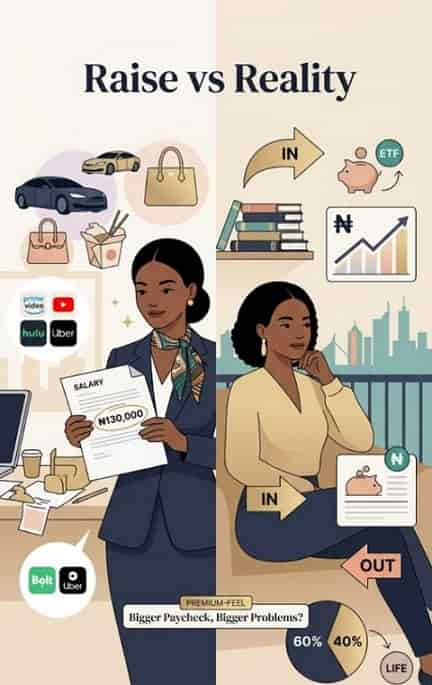
A bigger paycheck doesn't automatically mean a better financial life. In fact, for many people, it quietly makes things worse. That's the reality of bigger paycheck, bigger problems.
The Illusion of Earning More
We are conditioned to believe that income growth automatically equals wealth growth. It doesn't.
A salary increase is not a financial solution, it's just more raw material. What you do with it determines whether you actually become wealthier, or just more expensive. Because the uncomfortable truth is this: your income is not your wealth. Wealth is what you keep, grow, and protect. Income is just the raw material, and raw material without a plan gets wasted.
The moment most people receive a raise, they don't think "how do I build this?" They think "what can I finally afford now?" That single mindset shift, from building to spending is where the trouble begins. And for many people, a raise doesn't solve financial stress. It amplifies it.
Why? Because spending tends to rise just as fast as income does.
Parkinson's Law Is Eating Your Raise
There's a principle called Parkinson's Law. While it was originally about work expanding to fill available time, it applies brutally to money: your expenses will always rise to match your income.
This is why someone earning ₦500,000 a month today can feel just as financially stretched as they did earning ₦150,000 five years ago. The number changed. The habits didn't. The stress stayed, just in a more expensive wardrobe. Your lifestyle simply expanded to absorb the increase, and you didn't even notice it happening.
Meet Lifestyle Inflation: The Silent Ick of Wealth
Lifestyle inflation is the chain reaction of wants disguised as needs. It is the silent killer of financial growth, and the sneaky thing about it is that it never feels reckless in the moment. It feels like a reward; more takeouts instead of cooking, better gadgets, better clothes. It feels like "I worked hard for this, I deserve it."
And you do deserve good things. But lifestyle inflation doesn't give you good things. It gives you an increasingly expensive version of your current life while your actual wealth stands still.
Spending 100% of your new earnings on enjoyment doesn't make you richer. It just makes you a very expensive version of yourself.
The “Diderot Effect”: One Upgrade Leads to Ten More
Then there's the Diderot Effect, named after the French philosopher Denis Diderot, who received a beautiful new robe as a gift and ended up replacing nearly everything he owned just to match it.
This is what happens when one new purchase forces a series of additional spending:
- You buy a new car → your old lifestyle suddenly feels "outdated.”
- You renovate your house → your furniture looks wrong now.
- You upgrade your wardrobe → your accessories no longer match.
One decision creates a ripple effect of spending. Before you know it, your raise has been fully consumed and you're not even sure where it went.
Warning Signs You're Suffering From Lifestyle Inflation
You don't need a financial advisor to diagnose this. Just check your habits.
1. The Convenience Trap
You got a raise and suddenly you're ordering Bolt everywhere, eating out most days, and paying for same-day delivery on things you could have easily picked up yourself. Individually, these feel harmless. Collectively, they quietly drain hundreds of thousands from your account every month. Convenience is a lifestyle upgrade that rarely shows up on a budget, until you check your bank statement.
2. The Copy-Paste Lifestyle
You're spending money not because you need or even deeply want something, but because the people around you (colleagues, friends, a social media highlight reel) are living a certain way and you feel the pressure to match it. This is spending money you have earned (or haven't yet earned) to perform a version of success for people who aren't paying your bills.
3. The Leaky Budget
This is the most telling sign: you earn a good salary and still find yourself borrowing; from friends, family, or soft loans. Not because of an emergency, but because the month ran out before the salary did and you had no clear idea where the money went. That's lifestyle inflation actively at work.
And if that's you, here's the hard truth: it's not an income problem. It's a management problem.
The New Normal Trap
Beyond lifestyle inflation, something even more psychological is happening: your brain adjusts upward very quickly, but adjusts downward very slowly.
Once you start eating at nicer restaurants, the old spots feel like a downgrade. Once you start taking Uber everywhere, the bus feels unthinkable. Once the new normal sets in, going back, even temporarily feels like punishment, not discipline.
This is why a pay cut hits so much harder than a raise feels good. Your brain recalibrates its baseline to match your new income, and that baseline is very hard to undo. The raise stops feeling like a raise remarkably fast. And that's when people start chasing the next raise to feel the same relief, and the cycle quietly continues.
How to Actually Build Wealth When Your Income Grows
The goal of earning more should be to increase your quality of life, not just your standard of spending. Here's how to make sure your raise actually works for you.
1. The Time Management Strategy
When your income increases, mentally pretend it didn't, at least for the first few months. Budget with your old salary. Live on your old salary. Let your brain catch up before your spending does. This isn't about deprivation; it's about giving your wealth a head start. The discipline you apply in those first few months determines whether the raise becomes a foundation or just background noise.
2. Mental Division
Treat different portions of your income as separate money. Create buckets; one for baseline expenses, one for the new income, one for savings and investments. When the new money sits in its own mental category, it's much harder to casually absorb it into daily spending. Do this on a spreadsheet, across separate accounts, or with a budgeting app. The structure matters more than the tool.
3. The 60/40 Rule for New Income
When your income goes up, direct at least 60% of the increase into investments or an emergency fund. The remaining 40% can go toward personal expenses and genuine enjoyment. Your lifestyle can improve, just not at the expense of your financial future.
The First Rule of a Raise: Do Nothing
Managing a salary increase well is one of the most underrated financial skills in personal finance. The single best first step when your income increases is to not make any major financial decisions immediately. Don't upgrade. Don't commit. Don't announce. Sit with the new number for at least 30 days and let the initial high wear off. Financial decisions made in the excitement of new money are almost always regretted.
Protect Your Values from Other People's Expectations
When people know you earn more, they expect you to spend more on them, on outings, on appearances. You are not obligated to meet anyone's expectations of what your new income should look like from the outside. Your financial future is not a performance. Stay aligned with your values, not other people's expectations.
The Bottom Line
Every naira you spend that you didn't have to spend is a naira stolen from your future self. The goal isn't to suffer through a raise by refusing to enjoy it, it's to be strategically intentional, so that five years from now, you are genuinely wealthier, not just more expensive.
Your raise was supposed to be a door. Don't let lifestyle inflation turn it into a treadmill.
A salary increase is powerful, but only if you control it. If not, it controls you.
Because at the end of the day, you don't build wealth by earning more. You build wealth by keeping more.
So the next time your income goes up; pause, plan, then move like someone who actually intends to become wealthy. Not just look like it.
Keep reading
Related Topics





Conversation
Comments (0)
Sign in to join the conversation or like this post.