
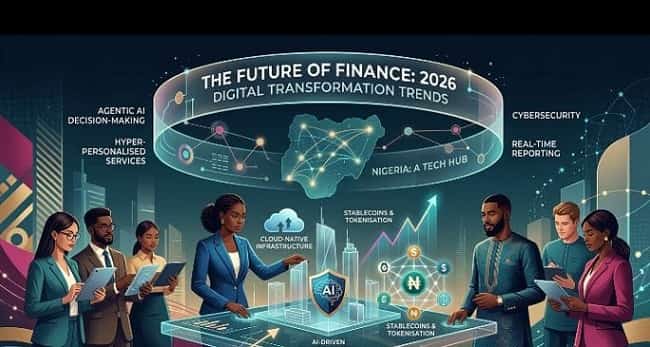
Finance is evolving faster than at almost any point in modern history.
What once looked like gradual technological progress has become a structural transformation. Artificial intelligence is beginning to support independent financial decision-making. Stablecoins are reshaping cross-border payments. Real-time financial systems are replacing traditional monthly reporting cycles.
In other words, finance is no longer simply using technology; it is becoming a technology-driven industry.
For banks, fintech companies, and finance professionals, the implications are significant. The institutions that succeed in 2026 will not be the ones merely experimenting with new tools. They will be the ones rebuilding their systems, processes, and strategies.
Here are some of the most important digital transformation trends reshaping finance today.
1. Agentic AI: From Assistant to Decision-Maker
Artificial intelligence in finance once meant chatbots answering customer questions or software flagging suspicious transactions.
That era is ending.
Financial institutions are moving toward agentic AI, systems capable of performing multi-step tasks and supporting operational decisions with minimal human intervention.
Instead of simply analyzing financial data, these systems can
- Monitor spending patterns
- Flag anomalies
- Trigger corrective actions, and even
- Predict working capital needs
Some financial institutions are already experimenting with AI agents that assist with trade accounting, client onboarding, fraud investigations, and regulatory compliance.
This shift moves AI beyond basic automation into something closer to operational decision support.
For finance teams, the impact is clear. Routine processes become automated, allowing professionals to focus on judgment-driven work such as strategy, risk evaluation, and financial planning.
AI is no longer just helping finance teams work faster. It is reshaping how financial decisions are made.
2. Hyper-Personalized Financial Services
For decades, banks offered financial products designed for broad customer segments.
Today, advances in artificial intelligence allow financial institutions to analyze behavioural, transactional, and lifestyle data in real time, enabling them to deliver hyper-personalized financial services at scale.
Imagine a bank detecting that a customer frequently books international travel and offering a personalized travel rewards card instantly. Or a digital financial assistant that monitors salary cycles, recurring bills, and spending habits to suggest optimal saving or investment strategies.
Personalization is becoming a major competitive advantage because customers who feel understood are more likely to remain loyal.
Research from PwC suggests that banks implementing personalization effectively could improve efficiency ratios by up to three percentage points while strengthening customer retention.
In short, banking is shifting from product-driven services to customer-driven experiences.
3. Cloud-Native Infrastructure: The New Foundation of Finance
Many financial institutions still operate on legacy systems built decades ago.
While reliable, these systems are often expensive to maintain, difficult to integrate with modern technologies, and slow to adapt to the demands of the digital economy.
As finance becomes increasingly digital, this infrastructure is being replaced with cloud-native platforms designed for speed, scalability, and flexibility.
Cloud infrastructure allows financial institutions to deploy services faster, process transactions in real time, and integrate technologies like artificial intelligence and advanced analytics more efficiently.
This transformation is happening at scale. Financial institutions around the world are investing heavily in digital transformation, with global spending reaching well over a trillion dollars in recent years.
Cloud-native architecture is quickly becoming the backbone of modern finance, enabling everything from real-time payments to advanced fraud detection systems.
For institutions that delay modernization, the risk is clear: competing in a digital-first financial environment becomes significantly harder.
4. Stablecoins and Tokenization: Rewiring the Plumbing of Money
For many people, the word “crypto” still brings to mind volatile markets and speculative trading.
But beneath the headlines, a quieter transformation is taking place.
Stablecoins, digital currencies pegged to traditional assets like the US dollar, are increasingly being used for faster cross-border payments and financial settlement.
In regions where currency volatility and expensive remittance corridors are common, stablecoins offer a way to move money quickly while reducing transaction costs.
At the same time, asset tokenization allows traditional financial assets such as bonds, real estate, and commodities to be represented as digital tokens on blockchain networks.
This makes it possible to enable:
- Fractional ownership
- Faster settlement
- Improved liquidity
- Programmable financial transactions
The global blockchain market in banking and financial services is projected to reach $17.58 billion by 2026, with major financial institutions already piloting tokenized assets and digital custody solutions.
What began as a niche crypto innovation is gradually becoming part of mainstream financial infrastructure.
5. Cybersecurity and AI-Driven Fraud
As financial systems become more digital, the threat landscape is evolving as well.
Artificial intelligence has significantly improved fraud detection. AI-driven monitoring tools can analyze vast transaction datasets and identify suspicious behaviour far more efficiently than traditional systems.
In fact, AI-powered fraud prevention tools helped financial institutions prevent over $217 billion in fraud losses globally in 2025.
However, the same technology is also empowering attackers.
Cybercriminals are increasingly using AI to create:
- Deepfake voice scams
- Synthetic identities
- Large-scale phishing campaigns
- AI-generated invoices and payment fraud
These attacks are becoming more sophisticated and more difficult to detect.
As a result, cybersecurity has become a core priority for financial institutions rather than just an IT responsibility.
Global cybersecurity spending by banks now exceeds $212 billion, with many institutions implementing zero-trust security models and AI-powered threat detection systems.
As financial services rely more heavily on automated systems; trust, transparency, and governance will become even more critical.
6. Real-Time Finance: The End of Monthly Reporting Cycles
Traditional finance operations were built around monthly reporting cycles and delayed insights.
That model is rapidly changing.
As financial systems become continuously updated, companies are moving toward real-time finance, where financial data is processed and analyzed instantly.
This allows organizations to detect irregularities earlier, manage risk more effectively, and make faster strategic decisions.
Real-time financial visibility also improves transparency across organizations, allowing leadership teams to monitor financial performance continuously rather than waiting for end-of-month reports.
In an increasingly complex economic environment, faster access to accurate financial data is becoming a major competitive advantage.
What This Means for Finance Professionals
These technological changes are not just transforming financial institutions; they are also reshaping the skills required to work in the industry.
As automation handles routine tasks, finance professionals are expected to focus more on analysis, strategic thinking, and decision-making.
Technical literacy is becoming essential. Understanding how AI systems operate, how financial data infrastructure works, and how digital assets influence financial markets is increasingly important.
The role of finance is shifting from record-keeping to insight generation and strategic guidance.
Professionals who combine financial expertise with technological awareness will be particularly valuable in the coming years.

Why These Trends Matter in Nigeria
Digital transformation in finance is especially significant in emerging markets like Nigeria.
The country has one of the largest and youngest digital populations in the world, with strong mobile adoption and growing demand for digital financial services.
Nigeria has also become one of the most active cryptocurrency markets globally. Research shows that the country processed over $90 billion in cryptocurrency transactions in a single year, making it the largest crypto market in Sub-Saharan Africa.
Stablecoins are also gaining traction as tools for cross-border payments and currency hedging. Reports suggest Nigeria recorded over $20 billion in stablecoin transactions within a year, highlighting the growing role of digital assets in the financial ecosystem.
At the same time, innovations such as open banking frameworks, fintech platforms, and digital payment systems are expanding access to financial services for individuals and businesses.
As infrastructure improves and regulation evolves, Nigeria may become an important testing ground for new financial technologies, particularly in areas such as financial inclusion, cross-border payments, and embedded finance.
The Bottom Line
Predicting the future of finance is never perfect.
Even the most respected forecasts have failed to anticipate major global events such as the financial crisis of 2008 or the COVID-19 pandemic.
However, one thing is becoming increasingly clear.
Finance is no longer simply a sector that uses technology. It is gradually becoming a technology-driven industry that happens to deal with money.
Artificial intelligence is automating decisions.
Infrastructure is moving to the cloud.
Payments are becoming instant.
Digital assets are reshaping how value moves globally.
For institutions and professionals alike, the most important skill in this environment is adaptability.
The organizations that embrace technological change and the professionals who learn to work alongside it will play a defining role in shaping the future of finance.
Keep reading
Related Topics






Conversation
Comments (0)
Sign in to join the conversation or like this post.