
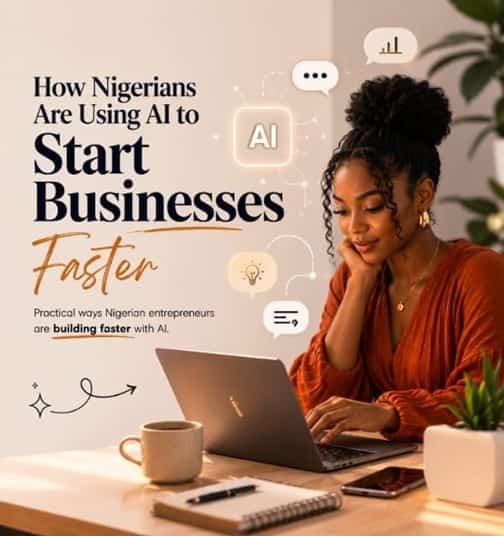
Starting a business in Nigeria has always been a test of endurance before it's ever a test of skill. You're navigating registration costs, chasing clients, creating content, managing customer messages, and somehow still trying to build something, all at the same time, usually alone.
But the rules are quietly changing. The same AI tools that big companies were paying consultants millions to implement are now free or near-free, sitting in your phone, available to anyone with data and the sense to use them. The market woman in Balogun, the freelancer in Yaba, and the final-year student in Nsukka are all operating with leverage that didn't exist five years ago.
The ones who figure this out early aren't just saving time. They're building faster, looking more professional, and closing more business than people who have been at it twice as long.
Here's exactly how they're doing it
1. Content Creation
If you’re selling anything in 2026, you need content. Instagram captions, product descriptions, WhatsApp broadcast messages, and email blasts. Hiring a content writer or agency costs money that most early-stage founders don’t have.
Tools like ChatGPT and Claude let you generate all of this in minutes. For example, a skincare vendor can use AI to brainstorm caption ideas, refine product descriptions, and speed up content planning, reducing hours of work to minutes while keeping their personal brand voice intact.
Type in what you sell, who you’re selling to, and what you want to say, and you get a solid first draft. You still have to edit it to sound like you, but the hard part (staring at a blank page at midnight) is gone.
Use it for:
- Product launch posts and promos
- Instagram and TikTok captions
- WhatsApp broadcast templates
- Emails to clients or vendors
2. Business Idea Validation Before You Spend a Kobo
Most people jump straight into execution, renting a space, ordering inventory, and building a website before they've asked the most important question: Will this actually make money?
AI lets you pressure-test an idea before you commit a single naira to it. You can ask it to break down your market, who your competitors are, what pricing looks like, and what similar businesses have struggled with. You can even ask it to argue against your idea so you catch the weak spots yourself before the market does.
This is basically free market research. What used to take weeks of googling, asking around, and paying consultants now takes 30 minutes and a good prompt.
Use it for:
- Checking if a niche is actually viable
- Understanding your competition
- Pricing research
- Building a customer persona
3. Customer Service. WhatsApp Bots That Work While You Sleep
Missing a customer message at 11 pm because you were asleep has cost many Nigerian business owners real money. The fix is closer than you think, and you probably already have it.
Start with WhatsApp Business (free). Most small business owners are sleeping on how much it actually does: auto-replies when you're unavailable, after-hours away messages, and quick replies to your most common questions. A thrift seller, for example, can set up automatic replies for pricing, delivery timelines, and payment details, so customers get responses instantly even when the seller is offline.
Set it up once, and it handles the basic stuff automatically.
If your business is growing and you need help routing orders, handling complaints, and confirming payments, there are now WhatsApp automation tools built specifically for Nigerian SMEs that go further. These connect to your WhatsApp number, let you build proper chatbot flows, and keep conversations organized even when multiple customers are messaging at the same time.
Either way, the goal is the same: a customer messages you at 11 pm and gets a response. They don't know you're asleep. They don't go to your competitor.
Use it for:
- After-hours auto-replies
- Answering FAQs automatically
- Order confirmations and tracking
- Organising customer conversations in one place

4. Business Registration & Legal Documents. No Lawyer on Retainer
Drafting a service agreement, a simple contract, or terms and conditions used to mean either paying a lawyer or copying something off the internet and hoping it held up. AI changes this. You can prompt ChatGPT or Claude to draft a freelance contract, vendor agreement, or privacy policy tailored to your business type.
It won’t replace a lawyer for complex deals or disputes. But for basic founder-to-client paperwork, it gets you 70% there, without the ₦50,000 consultation fee.
Use it for:
- Service and freelance contracts
- NDA templates
- Basic terms and conditions
- Simple offer letters for hires
5. Invoicing & Finance. Stop Doing It All by Hand
Most small business owners in Nigeria are managing money across three WhatsApp chats, a notebook, and one very stressed spreadsheet. It works until a client ghosts on payment, you forget to follow up, and ₦100k quietly disappears from your books.
The good news is that most Nigerian payment platforms you're already using (For example, Paystack and Flutterwave) now have built-in invoicing and payment link features. You send a link, the client pays, and the money goes to your account. There is no separate tool or extra signup. Start there.
From there, dedicated accounting and bookkeeping tools (several have free tiers that work in Nigeria and support Naira) take it further with auto-generating invoices, sending payment reminders so you don't have to, logging expenses, and producing basic profit & loss reports at the end of the month. If you have staff, Nigerian-built payroll platforms handle salary payments and PAYE calculations without you needing to understand the full tax code yourself.
You stop being the system. The tools hold the memory, chase the payments, and flag when something is off; you just make the decisions.
Use it for:
- Sending invoices and payment links
- Automatic reminders for overdue payments
- Tracking expenses without a spreadsheet
- Monthly P&L reports without an accountant
- Payroll and tax remittances if you have staff
6. Product & Service Innovation. Think Bigger, Faster
Stuck on what to offer, how to package it, or what to call it? AI is surprisingly useful here. Describe your skills and your target market, and ask it to suggest service packages, pricing tiers, or business names. You can even ask it to generate five different ways to position the same product for different audiences.
It’s not a replacement for knowing your market. But as a brainstorming partner at 1 am when your business idea is half-formed, and you have no one to think it through with? It’s genuinely useful.
Use it for:
- Service packaging and pricing ideas
- Business and brand naming
- Positioning for different customer types
- Expanding an existing offer
The Honest Part
AI won’t build your business for you. It still requires judgment, consistency, and actually understanding your customers.
But for someone with a viable idea and limited resources? These tools are the closest thing to having a full team on a solo founder’s budget. .
Keep reading
Related Topics





Conversation
Comments (0)
Sign in to join the conversation or like this post.

Elizabeth Ayoola
Elizabeth is a finance analyst and writer passionate about making financial markets accessible to everyday readers.
She has a deep interest in global markets, crypto, and everything shaping the financial world. She writes to simplify complex financial topics, turning them into practical, accessible insights for everyday readers.
102
Stories
31719
Reads
1
Likes
0
Comments