

If you scroll through Nigerian tech Twitter (X, whatever we're calling it these days) long enough, you'll notice a pattern. Someone posts a screenshot of a funding round, "$X million raised," "valued at $Y billion," and the replies fill up with the same energy: pride, disbelief, and that one person asking, "But how did it start?"
That question deserves a real answer. Not the polished, one-line version you see in press releases, but the actual grind; the arguments; the bank jobs people quietly kept while building something on the side; and the moment a founder realized his ATM card could be charged from his laptop and thought, Wait, this could be a whole company. This is that story, told through three of Nigeria's most recognizable startups: Paystack, Flutterwave, and Moniepoint.
It Usually Starts With One Annoying Problem
Every founder story in this piece starts the same unglamorous way: somebody got fed up with something that should have been simple but wasn't.
For Shola Akinlade, it was payments. He'd studied computer science at Babcock University, where he became close friends with classmate Ezra Olubi. After school, Shola went corporate, working in database management at Heineken, before founding his own software consulting company, Klein Devort, and later building an open-source collaboration platform called Precurio. Ezra Olubi, meanwhile, was a product lead at a Lagos startup before becoming CTO at Jobberman.
Through his early corporate experience interactions, he saw that many businesses struggled with fragmented payment channels, delayed settlements, complex integrations, and a heavy reliance on foreign payment solutions.
There was no grand five-year plan; they didn't start by chasing a valuation. They started by fixing one annoying, specific problem for one underserved group of Nigerians.
The Grind Nobody Posts About
The part that rarely makes it into the LinkedIn version of these stories: how long the "almost nothing" phase actually lasted, and how much doubt came with it.
- Paystack's founders faced real skepticism from investors before Y Combinator opened doors; Nigerian fintech wasn't the obvious bet it looks like today. Many international investors viewed Nigerian fintech as too risky. Questions about regulation, fraud, infrastructure, and whether businesses would even adopt digital payments were common.
- Moniepoint spent years as an unglamorous B2B infrastructure company most people had never heard of, quietly proving reliability to banks before it ever touched a consumer-facing product.
- Flutterwave had to convince businesses across dozens of African countries, each with different currencies, regulators, and banking quirks, to trust a single API, one market at a time.
None of these companies became overnight successes. What looks, in hindsight, like a straight line was actually years of patient execution, countless setbacks, and hundreds of small wins that rarely made the headlines. By the time the billion-dollar valuations arrived, most of the hardest work had already been done.
The Moment Things Actually Turned
Each of these startups has a moment you can point to and say, "This is where everything changed."
Paystack: The Exit That Changed What Was Possible
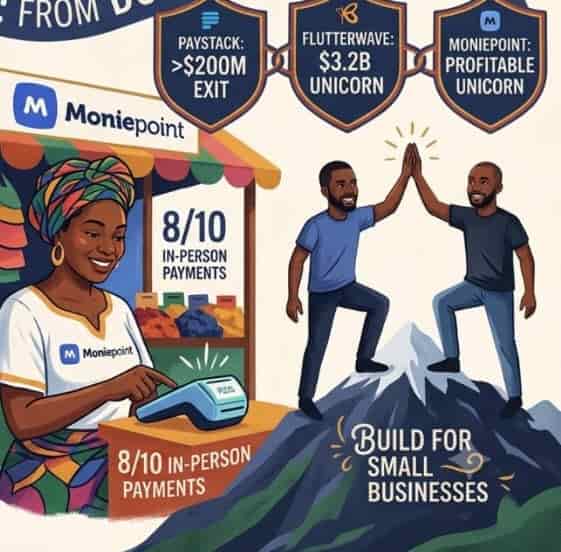
In October 2020, Stripe (the very company Paystack had long admired) acquired the Nigerian fintech for a reported over $200 million. At the time, it was the largest startup acquisition to come out of Nigeria and, reportedly, Stripe's biggest acquisition anywhere. What made it sting a little (in a good way) was the origin story underneath it: two Babcock University alumnis had created a company valuable enough for one of Silicon Valley's biggest fintech firms to buy.
The story didn't end there. In January 2026, as Paystack celebrated its tenth anniversary, CEO Shola Akinlade announced The Stack Group (TSG), a new holding company designed to expand beyond merchant payments into banking, consumer payments, and emerging technologies. He also revealed that he was personally investing in the new group, with Stripe, Akinlade himself, and Paystack employees becoming TSG's founding shareholders, a signal that, even after one of Africa's biggest startup exits, the company still saw its biggest opportunities as lying ahead.
Flutterwave: From Startup to Continental Infrastructure
Flutterwave became a unicorn in March 2021 after raising a $170 million Series C, one of the largest funding rounds ever secured by an African startup at the time. Less than a year later, a $250 million Series D tripled its valuation to over $3 billion, briefly making it Africa's most valuable startup.
The company didn't stop at raising capital. In January 2026, it acquired Nigerian open banking startup Mono, expanding beyond payments into financial data infrastructure and account-to-account payments. A few months later, Ripple joined Flutterwave's Series E as a strategic investor, valuing the company at $3.2 billion while deepening its push into blockchain-powered payments.
Today, Flutterwave says it has processed more than $40 billion in payments and over one billion transactions since its launch in 2016, serving businesses across different countries.
Moniepoint: The Unicorn Built on Small Shops
Moniepoint's turning point came in October 2024, when an $110 million Series C round pushed its valuation past $1 billion, making it one of Africa's newest unicorns and, notably, one of the very few fintechs globally to reach unicorn scale while already profitable.
Since then, its growth has accelerated dramatically. By 2025, the company reported processing more than 14 billion transactions annually, worth roughly $294 billion, up from 5.2 billion transactions just two years earlier.
According to Moniepoint, about eight out of every ten in-person payments in Nigeria now pass through its infrastructure. The company also earned widespread recognition during Nigeria's 2023 cash scarcity crisis, when its systems reportedly remained operational while several traditional banks experienced outages.
In October 2025, Moniepoint raised an additional $200 million to support international expansion, including launching a UK remittance product and acquiring a majority stake in Sumac Microfinance Bank in Kenya.
What Ties These Stories Together
Strip away the funding figures, and a few things show up again and again across all three companies:
- They solved a real, specific, often boring problem before they solved for scale: card payments, banking infrastructure, and POS reliability.
- They built for the businesses everyone else overlooked: small merchants, market traders, and local shops, not just the flashy enterprise clients.
- They stayed in it long enough for compounding to work, years of unglamorous grind before the growth curve bent upward.
- They kept building after the big win. Paystack's founder reinvested after the exit. Flutterwave keeps acquiring and expanding instead of resting on unicorn status. Moniepoint is pushing into new countries instead of coasting on its Nigerian dominance.
If there's a lesson worth stealing from Paystack, Flutterwave, and Moniepoint, it's this: build for the person nobody else is building for, and be patient enough to still be building when the world finally looks up.
Nigeria's startup ecosystem has no shortage of ambitious ideas. What these three companies prove is that the ones that go the distance usually start smaller and stay grounded longer than their eventual headlines suggest.
Keep reading
Related Topics





Conversation
Comments (0)
Sign in to join the conversation or like this post.

Elizabeth Ayoola
Elizabeth is a finance analyst and writer passionate about making financial markets accessible to everyday readers.
She has a deep interest in global markets, crypto, and everything shaping the financial world. She writes to simplify complex financial topics, turning them into practical, accessible insights for everyday readers.
102
Stories
31711
Reads
1
Likes
0
Comments