

If you ask that question in a room full of Lagos entrepreneurs, you could receive two entirely different answers, even from the same individual, just a few minutes apart. If you buy one of them a drink and have a chat about their product, their growth figures, and the size of the market, they'll plainly state that no city on this continent builds like Lagos. But as soon as you talk about NEPA, or the naira, or the number of months they took chasing a regulator for a license that ought to have taken only weeks, the answer changes to "Abeg, it is just hard to build here."
The contradiction isn't due to founders being dramatic or confused; it is in fact the most accurate summary imaginable of Nigeria's startup ecosystem, which is also the reason why the question in the headline doesn't really admit of a simple yes-or-no answer. Each founder operating in the country is simultaneously living both of those truths: the excitement of a massive, underserved market with real problems to solve and the daily tax of building in a country that makes almost nothing easy. If you ask ten founders whether Nigeria is still the best place to build a startup, you won't receive ten different views; instead, you'll get one common, complex relationship, which can be described in ten different ways.
Rather than choosing a side, it makes sense to examine the facts on both sides, including what is genuinely benefiting Nigeria at the moment and what is still working against it.
The case for Nigeria
Start with the numbers, because they're genuinely hard to argue with. Lagos is home to 987 startups, nearly 67% of everything in Nigeria, and it's the highest-ranked startup city on the continent, sitting at 70th globally with 23% growth, according to StartupBlink's Global Startup Ecosystem Index 2026. Nigeria as a country climbed four places to 62nd globally, posting 31.8% growth, trailing only Kenya in Africa.
The fintech numbers are where Nigeria really separates itself. The country ranks 13th globally in online banking and 17th in cryptocurrency, first in Africa in both categories. Moniepoint, Opay, Flutterwave, and Paystack are building on top of a regulatory environment that, since the Startup Act, has actually tried to give founders clarity instead of confusion. Nigeria also ranked first in Africa in “ecosystem value," meaning the startups here are generating real financial value, outperforming the country's third-place overall ranking on the continent.
And it's not only Lagos anymore. Abuja, Port Harcourt, Ibadan, and Enugu all made the Global 1000. Port Harcourt posted 82% growth, the fastest of any Nigerian city. Enugu climbed almost 40% in a single year on the back of a deliberate state strategy; the South-East state is running hackathons and building what its digital economy adviser, Ainze Chilo-Offiah, calls a “capital-ready innovation ecosystem” meant to feed founders into a hub that can scale them into globally competitive ventures.
A recent Bloomberg-backed ranking of notable African startups pointed to Nigerian founders increasingly building for structural problems rather than convenience. Less "Let's make ordering food easier,” more "Let's fix the financial rails, the logistics networks, and the power infrastructure that everything else depends on.” Companies in fintech infrastructure, healthcare, energy, and enterprise software are choosing harder, slower, more defensible problems, the kind that require real regulatory navigation and operational depth and that are much harder for a competitor to simply copy. Investors like that. Structural problems don't get disrupted overnight by the next well-funded entrant.
Underneath all of this sits Nigeria's actual advantage: people. A young population, a massive domestic talent pool, and a diaspora that keeps sending back capital, expertise, and connections. You cannot manufacture that. Either you have the talent density or you don't, and Nigeria does.
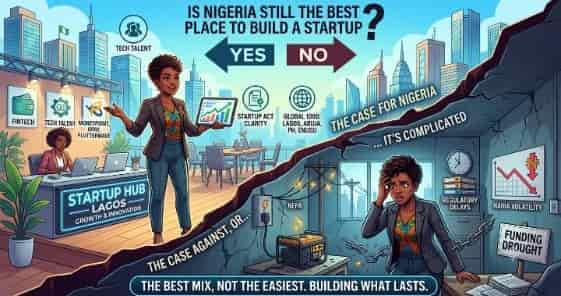
The case against, or at least, the case for “it's complicated”
This is where the truth comes out, since the same report that praises Nigeria's growth also places it 95th worldwide in the innovator's business environment index. Ninety-fifth. It's a nation whose real business conditions continue to be a serious hindrance to all else it is attempting to achieve.
The funding figures confirm this. In the first quarter of 2026, Nigerian startups raised $78.6 million through 15 deals that were made public, representing a 28% decrease compared to the previous year. There was a 43% drop in January when compared to January 2025. Since investors worldwide have become more selective, Nigeria, having been traditionally reliant on foreign venture capital, has felt the tightening of funding more so than other countries. Nowadays, more founders are combining venture capital with debt financing merely in order to reduce dilution, which indicates just how difficult the equity discussion has become.
There's also the issue of survival. About 54% of Nigerian tech startups go out of business in their first three years. Entrepreneurs are not only competing for funding; they have to contend with exchange rate volatility, insecurity, an unreliable power supply, and regulatory unpredictability, which can suddenly undermine a business model. While the idea of building something 'for African realities' may sound impressive in a press release, in reality it usually means having to provide your own power backup, sort out logistics on your own, and interpret the rules and regulations yourself since the infrastructure and institutions that you would normally rely on abroad are not trustworthy here.
The difficulty in terms of visibility makes the situation worse, since even products that are technically strong can fail to secure the attention and customer acquisition support that founders in more developed ecosystems take for granted.
So, best place to build?
Honestly? The best mix, not the easiest. Nigeria isn't the best place to build a startup because it's comfortable. It's arguably the best place because the problems are real, the market is enormous, and founders who survive here come out with something that's genuinely hard to replicate: proof they can build and scale under conditions most other markets don't force you to face. Lagos didn't become Africa's top-ranked startup city by accident; it became that despite everything working against it, which is a different, more durable kind of advantage than being ranked highest because things are easy.
The honest framing for founders deciding where to build isn't "Is Nigeria the best?" It's "Am I building something structural enough to survive Nigeria?" The startups winning right now, the fintech infrastructure plays, the logistics networks, and the healthcare and energy companies are succeeding despite the hard problems. They're succeeding because they picked hard problems that are difficult for anyone, anywhere, to copy.
Nigeria isn't the easiest place to build. It might still be the best place to build something that lasts.
Keep reading
Related Topics






Conversation
Comments (0)
Sign in to join the conversation or like this post.

Elizabeth Ayoola
Elizabeth is a finance analyst and writer passionate about making financial markets accessible to everyday readers.
She has a deep interest in global markets, crypto, and everything shaping the financial world. She writes to simplify complex financial topics, turning them into practical, accessible insights for everyday readers.
102
Stories
31719
Reads
1
Likes
0
Comments