
₦57 Trillion in Government Bonds on the NGX, Only 9 Trades: Inside Nigeria's Silent Bond Board
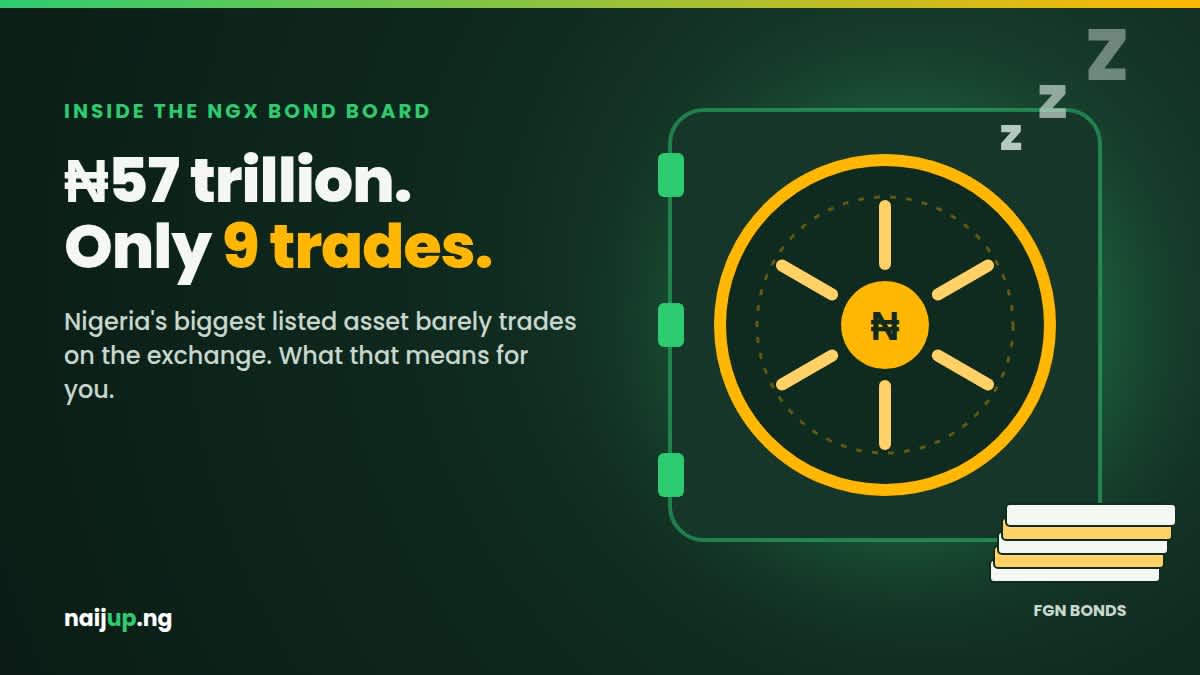
When people talk about the Nigerian Exchange, they usually mean stocks. The NGX's own data shows that more than a quarter of everything listed on the exchange is debt, mostly Federal Government of Nigeria (FGN) bonds.
That debt is almost never traded on the exchange. Here is what the data shows, why it happens, and what it means for anyone who wants to earn bond yields in Nigeria.
The numbers
From the NGX Market Capitalisation Report (27 October 2026):
| Debt category | Value | % of total NGX |
|---|---|---|
| Federal (FGN bonds, FGN Savings Bonds, Eurobonds, etc.) | ₦57.22 trillion | 25.39% |
| Corporate bonds/debentures | ₦1.31 trillion | 0.58% |
| State & local government bonds | ₦571 billion | 0.25% |
| Commercial papers | ₦65 billion | 0.03% |
| Non-Interest (Sukuk) – Federal | ₦1.14 trillion | 0.51% |
| Non-Interest (Sukuk) – Corporate & State | ₦108 billion | 0.05% |
| Total debt + ETPs | ₦60.47 trillion | 26.83% |
By listed value, FGN debt (₦57.2trn) is bigger than MTN Nigeria, BUA Foods, BUA Cement and Seplat combined (about ₦51trn).
Now the trading data
On Friday, 30 October 2026, the NGX Daily Summary listed 154 debt securities: 142 on the main debt list, 2 on the NGX Impact Board and 10 on the Non-Interest Finance Board.
• Conventional bonds (142 securities): 0 trades.
• NGX Impact Board green bonds (2): 0 trades.
• Non-Interest Finance Board (Sukuk & Islamic bonds): 9 trades, 4,063 units.
| Security | Trades | Volume | Price change |
|---|---|---|---|
| 11.200% FGN JUN 2027 (Sukuk) | 3 | 1,001 | +10.21% |
| 20.5% TAJ SUKUK S2 | 4 | 2,624 | −0.01% |
| 15.75% FGN OCT 2033 | 1 | 400 | +4.99% |
| 19.75% FGN MAY 2032 | 1 | 38 | +13.18% |
Every bond trade on the exchange that day was a Sukuk or non-interest instrument. Not one conventional FGN bond traded on the NGX order book.
Why are FGN bonds so quiet on the NGX?
1. The real trading happens elsewhere
Most secondary trading in FGN bonds happens over the counter (OTC) between banks, pension funds, asset managers and other dealers, mainly on the FMDQ platform. The NGX listing gives the bonds visibility and a price reference, but large investors don't usually trade them there.
2. Bond lot sizes are built for institutions
Conventional FGN bonds are typically sold in the primary market in large minimum amounts that suit institutions, not individuals.
3. Retail investors use other routes
Most individual Nigerians get government bond exposure through:
• FGN Savings Bonds (FGNSB), which are sold monthly in small denominations and are also listed on the NGX (you'll see them as "FGNSB" in the price list).
• Fixed-income and money-market mutual funds.
• Sovereign Sukuk, which have a growing retail following, and that is reflected in the trading data above.
Interesting details in the NGX bond list
Reading through the 30 October 2026 debt price list turns up some useful information:
• Coupons range from 6.125% to 23.5%. The low-coupon FGN issues (6.125% SEP 2028, 7.625% NOV 2047, 8.25% SEP 2051) are FGN Eurobonds denominated in US dollars. The 23.5% DANGCEM DEC 2034 is a Dangote Cement corporate bond.
• High-coupon FGN bonds trade above par. The 22.60% FGN JAN 2035 last priced at ₦124.86 per ₦100, and the 19.89% FGN MAY 2033 at ₦113.53. Investors are paying a premium for coupons that are above current yields.
• Some listed prices are clearly stale. The 13.50% DIF JUL 2032 shows ₦20.00. Several FGNSB issues show ₦70–80 per ₦100 even though they redeem at par. When nobody trades, the "price" may be months or years old.
• Corporate names you know have listed bonds: Dangote (DAN, DANGCEM), BUA, UACN, Lagos State (LAB), Lagos Free Zone (LFZC), NBET, Fidelity (FID), Union Bank (UBN) and more.
• The memorandum quotation list still shows a 5.50% FMN DEC 2025 bond, past its maturity date, with a quote last updated in January 2021.
Lesson: For bonds, the NGX price list is not a live price. Ask your broker or bank for a current bid/offer before investing.
How retail investors can access bond returns in Nigeria
| Route | Minimum (typical) | Liquidity | Where to buy |
|---|---|---|---|
| FGN Savings Bond | Low (₦5,000 range) | Moderate (listed on NGX) | DMO-appointed stockbrokers |
| Sovereign Sukuk | Low–moderate | Improving | Stockbrokers, banks |
| Fixed-income mutual fund | Very low | High (redeem at NAV) | Asset managers, apps |
| Bond ETF (e.g., Vetiva S&P Sovereign Bond ETF) | One unit | Low | Stockbroker |
| Direct FGN bonds | High | OTC | Banks, primary dealers |
Always confirm current minimums and offer terms with the DMO or your broker. They change.
Takeaways
1. About 26% of the NGX is debt. If you only follow stocks, you are missing a large part of the market.
2. Listed doesn't mean liquid. ₦57 trillion of FGN bonds produced zero conventional on-exchange trades on 30 October 2026.
3. Sukuk is where on-exchange bond activity is. All 9 bond trades that day were on the Non-Interest Finance Board.
4. Don't rely on listed bond prices. Many are stale. Get a live quote.
5. For small amounts, use FGN Savings Bonds, Sukuk or fixed-income funds instead of trying to trade large FGN bonds yourself.
FAQ
Are FGN bonds listed on the Nigerian Exchange?
Yes. On 27 October 2026, federal government debt listed on the NGX was worth ₦57.22 trillion, about 25.4% of total NGX market capitalisation.
Why are FGN bonds rarely traded on the NGX?
Most FGN bond trading happens over the counter between institutions, mainly on FMDQ. The NGX listing serves as a reference and an access point for some investors.
What is the easiest way to buy government bonds in Nigeria as an individual?
FGN Savings Bonds, sovereign Sukuk and fixed-income mutual funds are the most accessible options for retail investors.
What bonds traded on the NGX on 30 October 2026?
Only non-interest instruments: 11.200% FGN JUN 2027, 20.5% TAJ Sukuk S2, 15.75% FGN OCT 2033 and 19.75% FGN MAY 2032. That was 9 trades in total.
Data source: NGX Data Library: Market Capitalisation Report (27/10/2026), Daily Summary (30/10/2026), Memorandum Quotations (26/10/2026). Not investment advice. Confirm current offers with the Debt Management Office (DMO) or a licensed broker.
Found this useful? Share it
Help friends, family and colleagues stay informed on Nigerian finance.
Keep reading
Related Topics



Conversation
Comments (0)
Sign in to join the conversation or like this post.

Mujeeb Olagunju
I am a finance professional with a strong background in economics and financial technology.,My work centers on building systems that support payments, digital banking, and investment solutions in emerging markets.,I have experience with risk management, transaction monitoring, fraud prevention, and the design of scalable financial products tailored to both retail and institutional clients.,With over 8 years of industry experience, I combine financial insight with technical expertise to deliver solutions that balance compliance, security, and business growth.,My goal is to bridge the gap between finance and technology, creating platforms that expand access to modern financial services and strengthen trust in digital finance.
79
Stories
28355
Reads
0
Likes
0
Comments